Libertarians: Far right conservatives in disguise

The dictionary definition of “Libertarian” is: An advocate or supporter of a political philosophy that advocates only minimal state intervention in the free market and the private lives of citizens. The problem is that each self-proclaimed “Libertarian” invents his definition of “minimal.” So, the real, practical meaning is: “Libertarian is someone who decides how much state intervention he wants.” Period. Thus, everyone is a Libertarian. Or not. If you want to increase Medicare availability but cut Social Security, you can claim to be a Libertarian. If you want to cut them both, you also can claim to be a Libertarian. Do you want to eliminate all federal spending? You’re an extreme Libertarian. Want to stop all federal agencies? Extreme Libertarian. Want to cut federal spending by 99%, 75%, 25%, or 1%? You can do any of it under the guise of “Libertarianism.” Thus, for this reason alone, Libertarianism is the all-purpose bullsh*t excuse for doing whatever you want. But it worsens when we consider why Libertarians want to cut state intervention. There are two fundamental reasons:
  1. Freedom from government control
    Romina-Boccia-cropped2.jpg
    Romina Boccia
  2. Affordability of government spending
And self-proclaimed Libertarians vacillate between the two, depending on their mood.

1. Freedom: Every law reduces someone’s freedom. For absolute freedom, there would be no laws. Libertarians hate laws when their own freedom is reduced but accept laws that protect any of their freedoms.

A true Libertarian thinks people should be free to carry any weapon anywhere. Does that include machine guns, bazookas, flame throwers, drone bombs, poison gas?

Should people be free to keep slaves, spread smallpox, steal, kill, and kidnap? Well, no, that’s too much freedom. So, how much freedom should people have? Ask two Libertarians, and you’ll get five opinions.

Thus, Libertarians claim their right to tell you how much freedom you should have, and whatever they decide is based on their personal desires and their definition of Libertarianism.

2. Affordability: Because Libertarians feign ignorance about Monetary Sovereignty, they claim the thing called “federal debt” is like state/city debt, personal debt, monetarily non-sovereign debt, and business debt.

It isn’t. States, counties, cities, people, businesses, and euro nations can run short of whatever currency they use to pay their bills. The U.S. government cannot.

The finances of the Monetarily Sovereign U.S. government are unique. It alone can afford anything that can be purchased with U.S. dollars. Whether an obligation totals $1 or a hundred trillion dollars or any other number makes no difference to the federal government’s ability to pay for it.

The U.S. federal government pays for everything by creating U.S. dollars ad hoc. It never unintentionally can run short of dollars. Even if the government didn’t collect a penny in taxes, it could continue spending forever.

Alan Greenspan: “A government cannot become insolvent with respect to obligations in its own currency.”

I suggest that Libertarian leaders are well aware of #1 and #2 above, and that there is a different reason for their objections to government spending. I suggest that the Libertarian party is a proxy for the Republican party in being tied to America’s richest 1%. “Rich” is a comparative, relying on the width of the Gaps between the top vs. the middle and bottom. Widening the income/wealth/power Gap between the richest and the rest of us makes the rich richer. Narrowing that Gap makes the rest of us richer.

You are rich if you have $1,000, while everyone else has $10. But you are poor if you have $1,000 while everyone else has $10,000. It is the Gap that determines how rich or poor you are. The wider the Gap below you and the narrower the Gap above you, the richer you are.

The Libertarians, as proxies for the Republicans, work to widen the Gap between the rich and you, making the rich richer. It is reflected in Gap Psychology, the desire to widen the Gap below you and to narrow the Gap above you. Keep this in mind as we review excerpt from the following Libertarian article:

Don’t Let the Government-Shutdown Charade Distract You From the Debt Crisis America’s biggest fiscal challenge lies in the unchecked growth of federal health care and old-age entitlement programs.

These programs primarily benefit those who are not rich. Therefore, they are fair game for the Libertarian budget-cutters, who seldom express concern about tax loopholes for the rich but constantly complain about benefits to the rest of us.

With the Senate and now the House reopening for business, Congress is resuming its negotiations over annual spending on discretionary programs. As Washington tinkers around the edges of the behemoth federal budget, members are steering clear of the biggest budget items—the ones sending U.S. debt to unprecedented heights.

Here are the facts:
  1. The U.S. debt is not the dollars the U.S. government owes. It is the total of dollars deposited into T-security accounts. The so-called “debt” is not a debt of the government any more than your deposit into your safe deposit box is a debt of your bank.
  2. When you open your T-security (T-bill, T-note, T-bond) account and deposit it, the dollars belong to you. The government never touches them other than periodically to add interest dollars.
  3. When your T-security matures, those dollars are returned to you, just as the contents of your safe deposit box are returned to you.
  4. Finally, almost every year, the U.S. debt moves to “unprecedented heights.” With rare exceptions, it has been doing that since 1940, and every year, those ignorant (intentionally or otherwise) about Monetary Sovereignty complain. Yet here we are, with a healthy economy and the federal government having no difficulty paying its bills.

 Discretionary means that Congress hasn’t put these programs on autopilot, unlike so-called mandatory programs. Instead, Congress must vote to either continue or alter the spending. Otherwise, discretionary program funding expires.

While controlling discretionary spending is important for fiscal responsibility, for reducing government waste, and for negotiating the proper size and scope of federal activities, the current shutdown debate is largely symbolic.

To the Libertarians, “fiscal responsibility” and “government waste” refer to benefits received by the middle- and lower-income groups. Tax benefits that allow billionaires like Donald Trump to pay virtually $0 in taxes seldom concern Libertarians.

America’s biggest fiscal challenge lies in the unchecked growth of federal health care and old-age entitlement programs.

Oh, woe! Sick and elderly Americans, especially poor Americans, are receiving more money. To Libertarians, this is outrageous. Never mind that the federal government has the infinite ability to create the dollars that fund these programs. The Libertarians’ concern is not affordability. The federal government can afford anything. The real concern is that the poor and middle classes receive dollars, narrowing the Gaps between the rich and the rest. The rich hate that because it makes them less rich. And what the rich hate, the Libertarians and the Republicans also hate.

Alan Greenspan: “There is nothing to prevent the federal government from creating as much money as it wants and paying it to somebody.”

Repeated shutdown fights and a slew of temporary continuing resolutions have gotten us no closer to reforming Social Security and Medicare.

In the Libertarian world, “reforming” means “cutting.”

Those paying attention to the debt limit debate that ended in early June may be wondering what all the shutdown fuss is about, given that Congress and the White House agreed to new spending limits just a few months ago.

Those limits, specified in the Fiscal Responsibility Act, were a sham from the beginning. Secretive side deals undermined the stated goals of the bipartisan agreement before the ink was dry.

President Joe Biden has requested $40 billion in additional emergency supplemental spending, with the Senate adding several more billion to its appropriations bills, a glaring attempt to evade even modest fiscal restraints.

The federal government has infinite dollars. What, then, is the purpose of “modest fiscal restraints”? The sole purpose is to impoverish the great mass of people so that the rich can continue to rule.

Alan Greenspan: “The United States can pay any debt it has because we can always print the money to do that.”

The debt limit deal did succeed in allowing both Democrats and Republicans to claim political victory while suspending the debt limit for more than 18 months.

The losers are the American people, as excessive federal spending and unchecked entitlement growth drive up inflation and interest rates and undermine stronger economic growth.

Three lies in just eleven words, a remarkable record:
  1. Federal spending does not “drive up inflation.” All inflations are caused by shortages of critical goods and services, most often oil and food. Today’s COVID-induced inflation resulted from a scarcity of oil, food, transportation, metals, lumber, computer chips, labor, and other goods and services.Federal spending to cure these shortages, not interest rate increases, has been moderating inflation.
  2. Federal spending does not “drive up interest rates.” Interest rates are up because the Federal Reserve falsely believes low interest rates lead to inflation, and high rates cure it. This is utter nonsense. Adding high interest to the cost of goods makes those goods more costly. The sole effect of high rates is to stagnate the economy by transferring dollars from borrowers to lenders. A stagnant economy is known as a “recession” or a “depression,” and neither recession nor depression is the opposite of inflation. Apparently, the Fed never heard of “stagflation,” the combination of inflation and a stagnant economy.
  3. Stronger economic growth is defined as increased growth in Gross Domestic Product. (GDP). The formula for GDP is: GDP = Federal Spending + Nonfederal Spending+ Net Exports. Now I ask the Libertarian geniuses, given that formula, what can the federal government do to increase GDP growth? If you know basic algebra, your answer was “increase Federal Spending.” Seemingly, this is beyond the abilities of the Libertarians.

A more responsible way to raise the U.S. debt limit would have paired such an increase with a credible fiscal plan to stabilize the growth in the debt.

Hmm. “Raise the debt limit” by “stabilizing the debt growth.” If that makes sense to you, you are far wiser than me. By setting up a functional impossibility, the Libertarians make sure they always will have something to complain about.

Ben Bernanke: “The U.S. government has a technology, called a printing press (or, today, its electronic equivalent), that allows it to produce as many U.S. dollars as it wishes at essentially no cost.”

The longer Washington waits to fix autopilot spending, the more damage they’ll do. The Congressional Budget Office’s latest long-term budget outlook projects that U.S. government spending will consume nearly 30 percent of the economy by 2053—almost 40 percent higher than the historical average.

Look again at the formula for GDP. Federal spending does not “consume” part of the economy but adds to itBy simple, mathematical formula, increased Federal Spending increases GDP. It also increases Non-federal Spending by adding dollars to the private sector. Thus, IF one wishes to increase economic growth, the last thing would be to cut Federal Spending. The word “if” is accented because increasing economic growth is not a Libertarian goal. They want to widen the Gap between the rich and the rest, a goal that often can be met by recessions or even by depressions.

Quote from former Fed Chairman Ben Bernanke when he was on 60 Minutes: Scott Pelley: Is that tax money that the Fed is spending? Ben Bernanke: It’s not tax money… We simply use the computer to mark up the size of the account.

Recessions and depressions provide opportunities for the rich to become richer. At those times, the rich can snap up assets at bargain prices while forcing labor to slave at meager salaries.

Congress is expected to rack up more than $100 trillion in additional deficits over those 30 years—more than four times what the U.S. government has borrowed over its entire history. Who will lend the U.S. government such vast sums?

More lies from the Libertarians. The federal government, having the infinite ability to create U.S. dollars, never borrows. Never.

Statement from the St. Louis Fed: “As the sole manufacturer of dollars, whose debt is denominated in dollars, the U.S. government can never become insolvent, i.e., unable to pay its bills. In this sense, the government is not dependent on credit markets to remain operational.”

Thus, no one lends to the federal government. Those dollars spent on T-securities do not go to the federal government. They go into T-security accounts, which are owned by the depositors. Those accounts provide a safe place to store unused dollars. This stabilizes the dollar. It does not give the federal government spending dollars, of which it already has infinite.

The main drivers of this increase are heightened interest costs and the growth in health care and Social Security spending.

With Medicare and Social Security responsible for 95 percent of long-term unfunded obligations, according to the Treasury Financial Report, there’s simply no way any serious fiscal reform effort can leave these programs untouched.

Yet another lie. All financial obligations of the U.S. government are “unfunded” until the government funds them by creating new dollars ad hoc. Federal taxes do not fund federal spending. Unlike state/local tax dollars, which remain in the private sector by being deposited into private banks, federal tax dollars are destroyed. When they reach the U.S. Treasury, they cease to exist in any money supply measure. (No money supply measure includes federal dollars because the federal government has infinite dollars. Thus, your federal tax dollars cease to exist once received by the Treasury.) The Libertarians define a “serious reform effort” as anything that takes dollars from the poor and the middle classes.

The most likely outcome from the current standoff is a continuing resolution into December, followed by a spending-laden Christmas tree bill before year’s end. This shutdown debate matters only so much, considering the huge fiscal challenge confronting the United States.

A “Christmas tree bill” is the Libertarian’s intentionally misleading description of anything that provides more money to the poor and middle classes.

By ROMINA BOCCIA , the director of budget and entitlement policy at the Cato Institute.

The Cato Institute claims it promotes “individual liberty, limited government, free markets, and peace, an honest description of an organization that wants the rich to rule. Nothing in that description is about reducing poverty, feeding the malnourished, educating the masses, narrowing the Gap, or being charitable. Quite the opposite. “Individual liberty” means the rich do whatever they want, and the rest do whatever the rich want. “Limited government” and “free markets” mean there will be no laws to prevent the rich from cheating and enslaving the rest of us. And as for “peace,” those angry protests by the poor can be messy. The Libertarians want the downtrodden to accept their lot in life, peacefully. What a perfect society the Libertarians try to force on us. Rodger Malcolm Mitchell Monetary Sovereignty Twitter: @rodgermitchell Search #monetarysovereignty Facebook: Rodger Malcolm Mitchell

……………………………………………………………………..

The Sole Purpose of Government Is to Improve and Protect the Lives of the People.

MONETARY SOVEREIGNTY

Why Trump never will go to jail or be President, again.

Here is why Trump never will go to jail:

Dinesh D’Souza, @DineshDSouza, Trump Returns To His Athletic Roots, Turns Iowa Football Game Into Trump Love Fest – ‘WE LOVE TRUMP’

Juanita Broaddrick, @atensnut, Just listen to these young people yell for Trump.

Insider Politics, @insiderpolitics, Trump greeted with a mix of applause and audible boos at Iowa college-football game, says report

Benny Johnson, @bennyjohnson, Trump literally can’t move in Iowa. How do you beat this https://twitter.com/i/status/1700627429629268158

Newsweek, MAGA Calls for Boycott After Gun Safe Company Complies With FBI Warrant, Story by Natalie Venegas, After complying with an FBI warrant and providing access to a safe, popular gun safe manufacturer, Liberty Safe, faced backlash from conservatives.

Despite all the evidence against him, Trump never will go to jail, because IT ONLY TAKES ONE REPUBLICAN to ignore the evidence, ignore the law, and find Trump not guilty.

It just one of these makes it onto the jury, Trump will not be convicted.

There is no way to keep at least one right-wing, knucklehead off the jury.

Here is why Trump will not be President, again.

The Republican refusal to acknowledge the evidence and the law will inflame the moral, patriotic, rational voting public.

Thankfully, they are the majority of this divided nation.

Rodger Malcolm Mitchell Monetary Sovereignty

Twitter: @rodgermitchell Search #monetarysovereignty

Facebook: Rodger Malcolm Mitchell

……………………………………………………………………..

The Sole Purpose of Government Is to Improve and Protect the Lives of the People.

MONETARY SOVEREIGNTY

Voters, when will enough be enough?

Here are excerpts from a letter sent to me by the National Rifle Association of America (NRA). Why me? I can’t imagine.

Unless you fight back starting right now, you’ll soon face the real threat of having your guns confiscated along with your right to self-defense.

No, I’m not talking about run-of-the-mill gun control.

I’m talking about an actual ban on the firearms you currently own, government confiscation of those firearms, and you facing actual jail time if you fail to comply. 

Yes, that paragraph was in bold type.

That’s why I’m urging you to join the National Rifle Association right now to save your guns and your freedom before it’s too late.

In fact, your membership is so vital that, for a limited time, you can get your one-year membership for only $30 (normally $45).

Time is running out. To stop the gun banners from taking our guns and crushing our liberty, you and I must fight back right now with all the strength we can muster.

Of course, it’s all bullshit. There is no movement for “an actual ban on the firearms you currently own.”

It’s the typical right-wing “we must fight” grievance, the same one Trump screamed when he sent people to the capitol in his attempted coup.

What made the above letter special was my receipt of it on the same day I read an article in the Florida Sun Sentinal. Here are excerpts:

Devices turn regular guns into machine guns on South Florida streets By Shira Moolten South Florida Sun Sentinel

Last year in March, a car unleashed a spray of bullets as it passed outside of a Miramar restaurant, killing two best friends as they were waiting for their food. 

One of the guns may have had a “Glock switch,” a tiny metal cube that attaches to the back of a pistol and turns it into an automatic weapon.

An influx of Glock switches and (similar devices, called “auto sears”) is on the rise, nationally.

They represent only the cusp of a new era in which technology like 3D-printing makes guns deadlier and easier to access.

The trendy devices cost as little as $20, popular among young people and others who can’t get legal licenses to carry machine guns.

With 3D printers, switches that turn guns automatic can be manufactured in less than an hour. The tiny cube slides onto the back of the gun, typically a Glock.

One pull of the trigger releases a 100-round magazine in a matter of seconds. Greater access to these devices means more shootings with higher numbers of victims, especially innocent bystanders.

You pull the trigger one time, 30 rounds fire in 2 seconds. The likelihood of striking the intended target more than once or twice is nil. Rounds are flying everywhere … they’re just letting them fly and people are getting shot.

On a national level, police agencies are seeing these weapons wielded in increasing numbers of shootings.

In Sacramento, the gunmen involved in a mass shooting that left six people dead and 12 injured are thought to have been using switches; in Houston, a man with a switch opened fire at two police officers, killing one and injuring the other.

Though switches are currently only made to attach to Glocks, it’s only “a matter of time” before people start using the same technology to manufacture devices that attach to other types of firearms.

Switches are also trendy. People post pictures of them on social media to show off; South Florida rappers brag about using them in songs.

It’s just the attraction of being able to have something that’s capable of firing fully auto.

The uptick in switches caught the attention of Broward State Attorney Harold Pryor, who worked with Florida Senator Rosalind Osgood to get legislation passed last session including language about the devices in Florida’s existing firearms laws.

The bill never made it to committee.

Osgood, who represents District 32 in Broward, said that the wording of SB 368, titled “Machine Guns,” may have given it the appearance of a bill that would not be popular in the pro-gun leaning Legislature.

“I think that gave them wrong idea of what it was,” Osgood said. “Especially in a time when the majority of legislators are fixated on permitless carry.”

Osgood worries that people, especially minors, may have even more access to guns equipped with these devices in Florida compared to other places because the gun laws are more lax.

You may not remember all the years before our current Republican Supreme Court decided that these thirteen words in the Constitution had no meaning whatsoever and could be ignored: “A well-regulated Militia, being necessary to the security of a free State.”

Back then, people did not believe allowing every nut on the street to own guns increased public safety. And for many years, the Supreme Court agreed.

The Republicans changed all that.

Now, “well-regulated” means “not-regulated.” and “Militia” means nothing at all, at least in the minds of the self-described “originalists” on the SCOTUS.

Because of that decision, the killing has increased massively, supported by the new law of the land, as interpreted by the Republican Party.

Today, even the slightest effort to control “machine-guns-for-every-nut and criminal” immediately is vetoed by the “party of law-and-order” and the Supreme Court it appointed.

This is the political party that votes against abortion because life is precious.

In contrast, it votes against Obamacare because health is not precious and wants guns-for-everyone because hey, life isn’t so precious after all.

If you voted Republican and someone you care about is wounded or killed by a gun, please spare us the crocodile tears.

You get what you vote for.

Rodger Malcolm Mitchell

Monetary Sovereignty Twitter: @rodgermitchell

Search #monetarysovereignty Facebook: Rodger Malcolm Mitchell

……………………………………………………………………..

The Sole Purpose of Government Is to Improve and Protect the Lives of the People.

MONETARY SOVEREIGNTY

OMG! Even the Washington Post parrots the lie.

The Washington Post and Jeff Stein have joined the ranks of IAMS (Ignorant About Monetary Sovereignty). The following article was published yesterday.

ECONOMIC POLICY: U.S. deficit explodes even as economy grows

Jeff Stein

A strong economy usually reduces the deficit. Not this time.

By Jeff Stein, September 3, 2023 at 6:00 a.m. EDT

The federal deficit is projected to roughly double this year, as bigger interest payments and lower tax receipts widen the nation’s spending imbalance despite robust overall economic growth.

The so-called spending “imbalance” implies that federal spending should be “balanced” against federal taxes. Nothing could be further from the truth. 

The U.S. government is unlike state/local governments, businesses, and individuals. It uniquely is Monetarily Sovereign. It alone has the unlimited ability to create dollars. It never unintentionally can run short of dollars.

Even if the federal government collected $0 taxes, it could continue spending forever. The purpose of collecting federal taxes is to control the economy by taxing what the government wishes to discourage and giving tax breaks to what it wishes to encourage.

Unlike state/local taxes which provide state/local governments with spending money, federal taxes do not provide the federal government with spending money.

The typical measure of the economy is GDP. For the economy to grow, the federal government must run deficits, as demonstrated by the formula for GDP:

GDP = Federal Spending + Non-federal Spending + Net Exports

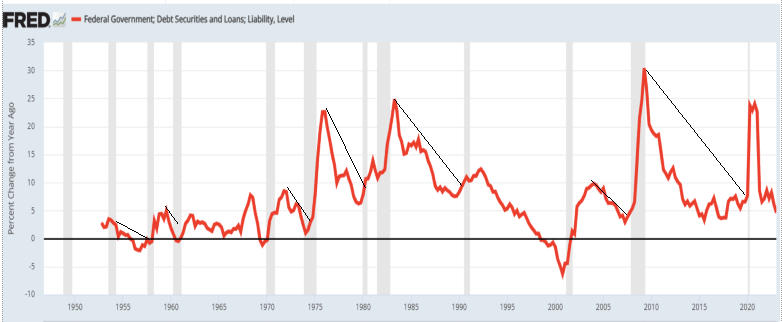
When federal spending declines or doesn’t grow enough, GDP declines. Not only does the formula demand it, but this graph illustrates it:

The red line demonstrates changes in federal deficits. The vertical gray bars are official recessions. The slanted lines show declining deficits leading to recessions, which then are cured by increased deficits.

The graph shows that when federal debt increases too little, we have recessions, which are cured by federal debt increases. 

After the government’s record spending in 2020 and 2021 to combat the impact of COVID-19, the deficit dropped by the greatest amount ever in 2022, falling from close to $3 trillion to roughly $1 trillion.

Did you get that line, “Record spending in 2020 and 2021 to combat the impact of COVID-19?” Here, Stein demonstrates his understanding that deficit spending grows the economy, yet still complains about it. And he fails to understand the reverse, that the lack of federal spending will recess the economy

Quite amazing.

But rather than continue to fall to its pre-pandemic levels, the deficit shot upward.

The deficit shot upward to cure the 2020 recession, a cure that the deficit accomplished.

Budget experts now project that it will probably rise to about $2 trillion for the fiscal year that ends Sept. 30, according to the Committee for a Responsible Federal Budget (CRFB), a nonpartisan group that advocates for lower deficits.

The so-called “non-partisan CRFB” leans heavily to the right, invariably recommending fewer benefits and higher taxes on the middle- and lower-income people, but seldom (if ever) mentions the tax loopholes of the wealthy.

If you go to the CRFB website, you will see many articles grousing about the federal debt and deficits, but none explaining exactly why these are bad for the economy. Perhaps this is the reason for their reticence:

U.S. Depressions tend to come on the heels of federal surpluses.

1804-1812: U. S. Federal Debt reduced 48%. Depression began 1807.
1817-1821: U. S. Federal Debt reduced 29%. Depression began 1819.
1823-1836: U. S. Federal Debt reduced 99%. Depression began 1837.
1852-1857: U. S. Federal Debt reduced 59%. Depression began 1857.
1867-1873: U. S. Federal Debt reduced 27%. Depression began 1873.
1880-1893: U. S. Federal Debt reduced 57%. Depression began 1893.
1920-1930: U. S. Federal Debt reduced 36%. Depression began 1929.
1997-2001: U. S. Federal Debt reduced 15%. Recession began 2001.

That is the information you never will see on the CRFB website nor presumably in any article written by Jeff Stein for the Washington Post.

The unexpected deficit surge, which comes amid signs of strong growth in the economy overall, is likely to shape a fierce debate on Capitol Hill about the nation’s fiscal policies as lawmakers face a potential government shutdown this fall and choices over trillions of dollars in expiring tax cuts.

The deficit surge didn’t come “amid” the signs of strong growth. The deficit surge caused the strong growth. It’s like saying the Cubs’ good pitching came amid signs of a winning streak. No, the good pitching caused the winning streak.

Stein and the Washington Post don’t see the relationship between adding dollars to the economy and economic growth, despite the abovementioned formula for GDP.

The Senate will return from the August recess this week, and the House will return the following week. Biden and House Speaker Kevin McCarthy (R-Calif.) approved a deal in June to raise the nation’s borrowing limit, but it did little to alter the long-term debt trajectory.

Except, the U.S. federal government, which has the unlimited ability to create U.S. dollars, never borrows U.S. dollars. Who says so? The Federal Reserve:

Statement from the St. Louis Fed:
“As the sole manufacturer of dollars, whose debt is denominated in dollars, the U.S. government can never become insolvent, i.e., unable to pay its bills. In this sense, the government is not dependent on credit markets to remain operational.”

That phrase, “not dependent on credit markets,” is Fed-speak for “doesn’t borrow.” Accepting T-security deposits is not “borrowing,” as the government never touches the money. The dollars are held in privately-owned accounts and upon maturity, they are returned to the depositors.

The higher deficit may undermine Biden’s attempts to take credit for reining in the budget ahead of the 2024 presidential election.

Because Americans have been programmed to believe, falsely, that federal spending is bad — and perhaps because of his own ignorance about federal financing — Biden takes credit for doing something stupid: Reducing the amount of growth dollars the federal government pumps into the economy.

And it could pose a challenge to Republican lawmakers, who — despite their calls for fiscal responsibility — are pushing to extend more than $3 trillion in tax cuts they approved in 2017.

The Republicans always call for “fiscal responsibility” (i.e. the fiscal irresponsibility of reduced spending) when the President is a Democrat. They don’t want the economy to grow during a Democratic administration.

The 2017 tax cuts were cuts for the rich. The GOP, the party of the rich and Trump, always wants those tax cuts. They don’t want cuts to taxes that ordinary people pay, i.e., FICA.

“The deficit will double from 2022 to 2023,” said Marc Goldwein, senior vice president of the Committee for a Responsible Federal Budget. “This should prompt a serious evaluation of federal policy going forward, though I worry it won’t.”

If the deficit actually does double, the economy will grow beautifully. Remember: GDP = ….etc., etc.

Stock market tip: The larger the deficit spending, the faster the stock market will grow. Cut deficit spending, and we’ll have a recession. We always do.

The surge in red ink has confounded many economists’ expectations. Typically, deficits contract when the economy grows because businesses and consumers owe more taxes, and the government does not need to spend as much to protect those who have lost their jobs.

It confounded only those economists who don’t understand Monetary Sovereignty. (Yes, they exist and some have “Peter Principled” their way up to important jobs. Hello, Larry Summers.)

Deficits begin to contract when the economy grows because the ignorante believe they no longer are needed. Eventually, however, this contraction leads to a recession that is cured by increased deficit spending. Recessions aren’t necessary. They are caused by reduced deficit spending.

Think Jeff, if deficit spending grows the economy and cures recessions, why wouldn’t deficit spending grow the economy during non-recession times?

Then deficits typically expand again in downturns, as those factors go into reverse. And yet, the current surge in the deficit is coinciding with a period of unusually strong economic growth amid historic lows in unemployment and robust corporate profits.

No, Jeff, deficits are intentionally expanded to cure downturns.

Jason Furman, who served as a top economist in the Obama administration and is now an economics professor at Harvard, said the current jump in the deficit is only surpassed by “major crises,” such as World War II, the 2008 financial meltdown, or the coronavirus pandemic.

During a major crisis, the government spends more to cure the problem. One wonders why this is so difficult for Furman to understand. Obama was notorious for not understanding the economy. Perhaps Furman was at fault.

It also is difficult to understand why economists, people who spend their lives looking at the economy and federal spending, can’t make that mental connection. It’s quite simple:

  1. The government has infinite dollars.
  2. Adding dollars to the economy grows the economy.
  3. Therefore the federal government always should run deficits.

Is that really beyond their ken? Or is the problem simply semantic? Words like “debt,” “borrow,” and “deficit” do not have the same implications for a Monetarily Sovereign entity as they do for monetarily non-sovereign entities.

Or do they falsely believe that federal spending causes inflation?

Economics 101:

  1. Inflations are a general increase in prices.
  2. Prices increase when items are in short supply.
  3. Inflations are caused by important items (usually oil and food) being in short supply. 

The wrongheaded printing of larger currency denominations when facing inflation gives the illusion that the currency printing causes inflation, when in fact, inflation causes the wrongheaded currency printing.

The slogan, “Inflation is too much money chasing too few goods and services,” should be, “Inflation is too few goods and services.” Period.

Today’s inflation was caused by shortages of oil, food, lumber, computer chips, shipping, labor, and other goods and services. If the Saudis keep cutting production, we will have another increase in inflation. And no, raising interest rates will do nothing to stop it.

In fact, raising interest rates makes things more expensive as interest is a business cost that must be overcome.

The U.S. economy is expected to grow at a steady 2.1 percent this year.

Thankfully, the government was smart enough to increase the spending that pumped growth dollars into the economy.

“To see this in an economy with low unemployment is truly stunning. There’s never been anything like it,” Furman said. “A good and strong economy, with no new emergency spending — and a deficit like this.

The fact that it is so big in one year makes you think it must be some weird freakish thing going on.”

The “weird, freakish thing” is the economy’s normal reaction to federal spending. Seemingly, Mr. Furman, the Harvard economist, doesn’t understand basic algebra: GDP=Federal and Nonfederal Spending + Net Exports.

From August 2022 to this July, the federal government spent roughly $6.7 trillion while bringing in roughly $4.5 trillion. According to the Committee for a Responsible Federal Budget, that represents a total increase in spending of 16 percent relative to last year and a 7 percent decrease in revenue.

Let me rephrase his statement: “From August 2022 to this July, the federal government pumped a net of 2.2 trillion growth dollars into the economy.” And he thinks the GDP growth is “weird and freakish”??

The Treasury Department is also on track to take in substantially less new revenue this year, partly because of the stock market’s slump last year.

Rephrase: “The Treasury Department is also on track to take in substantially fewer growth dollars out of GDP this year.”

In 2021, amid a cryptocurrency bubble and an explosion in housing prices driven by rock-bottom interest rates, investors recorded huge gains that led them to pay capital gains taxes at record levels. But then the bubble burst, leading to a sharp drop in capital gains tax revenue.

Automatic adjustments to the tax brackets to account for inflation also reduced tax obligations for many Americans, resulting in less incoming revenue relative to last year.

Then, a number of other spending increases contributed to the rising deficit — Social Security payments increased because they are indexed to inflation; the government spent more on education, veterans benefits, and health care; and the bipartisan infrastructure law, as well as the 2022 Inflation Reduction Act, started sending billions of dollars out from the government’s accounts.

Experts are fiercely divided on the extent to which the higher deficit amounts to a pressing problem for the economy.

The experts who understand basic algebra and Monetary Sovereignty are not divided. Deficits are not a problem; they are how the economy grows.

The federal government can issue more debt even as interest payments rise, with demand for the dollar remaining strong.

The federal government doesn’t need to “issue debt.” The sole purposes of so-called “debt” (i.e., T-securities) are:

  1. To provide a safe place for people and nations to store unused dollars. This stabilizes the value of the dollar.
  2. To provide a continuing demand for the dollar because taxes must be paid in dollars.

Issuing debt does not provide the federal government with spending money. It creates, ad hoc, all the dollars it spends.

That isn’t always the case: In Argentina, soaring debt levels have forced the government to impose limits to prevent citizens from taking money outside the country.

Argentina printed currency rather than curing the food shortages causing its inflation.

Other government debt crises have been marked by catastrophic drops in the exchange rate amid investor concerns that the currency will be devalued. These signs of distress have not materialized in the United States.

Fears of a debt crisis during the Obama administration also consistently failed to materialize, emboldening those who regarded the warnings of fiscal conservatives demanding budget cuts as overblown and ideologically motivated.

The demands being seen today are overblown, ideologically motivated, and based on national ignorance about Monetary Sovereignty. If the populace understood MS, the politicians would not be able to get away with nutty “debt ceilings” and ignorant arguments by the Committee for a Responsible Federal Budget.

“If you think of places that have actually had problems of real fiscal sustainability which have gotten to the point of crisis — we know what those places look like, and this doesn’t look anything look like that,” said Matthew C. Klein, publisher of the Overshoot, a subscription research service focused on the global economy.

“You can argue about whether you want it, but this is not a crisis.”

Amen, brother. Amen.

Rodger Malcolm Mitchell
Monetary Sovereignty

Twitter: @rodgermitchell Search #monetarysovereignty
Facebook: Rodger Malcolm Mitchell

……………………………………………………………………..

The Sole Purpose of Government Is to Improve and Protect the Lives of the People.

MONETARY SOVEREIGNTY