Ignorance has its costs. If you don’t understand Monetary Sovereignty and the federal government’s infinite ability to pay for anything, you pay the price. Here is one of many examples.
Nutrition programs for older adults facing service cutsJessie Hellmann, CQ-Roll Call
WASHINGTON — Programs that feed older, homebound adults are instituting waiting lists amid budget crunches, rising costs of food, growing demand for their services and funding cuts from the government.
There is no financial reason for “funding cuts from the federal government.” It has the infinite ability to create dollars. The following is a disgrace, akin to a billionaire walking blithely past a starving family, ignoring their plight.
Combined with the end of COVID-19 era aid, local groups are finding that they can no longer serve the same number of people, resulting in difficult decisions about next steps.
“This is a huge challenge for our network,” said Josh Protas, chief advocacy and policy officer at Meals on Wheels America, a national organization that supports local organizations delivering meals to homebound individuals, mainly older adults.
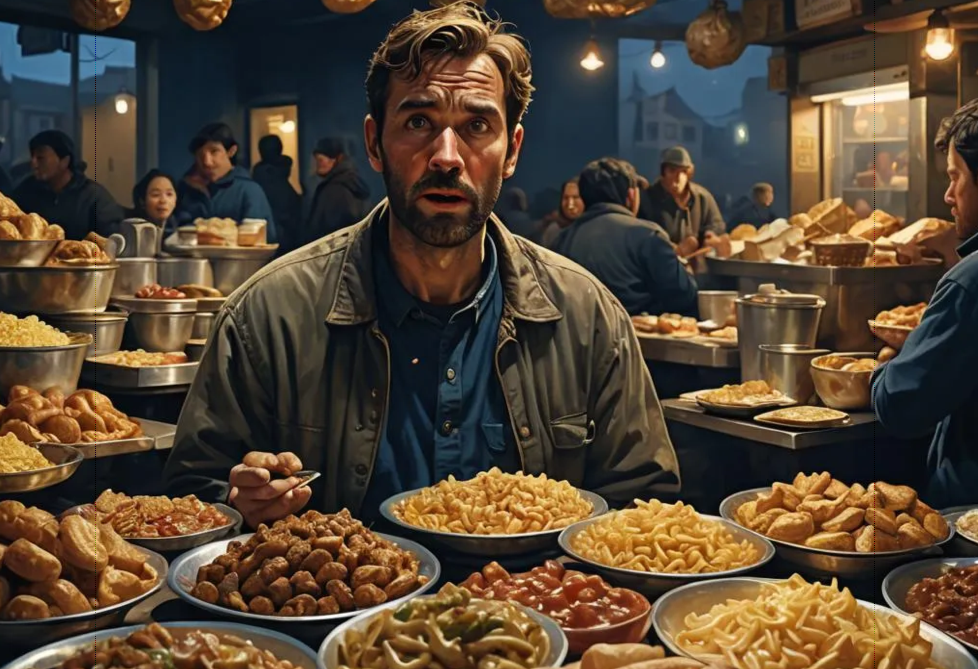
The Federal Government says, “YOU CAN’T HAVE ANY. WE’RE ALL OUT.”
Meals on Wheels is among the groups pushing for funding increases through the appropriations process for programs funded under the Older Americans Act, a decades-old law first signed by President Lyndon Johnson to support adults as they age in their communities.
One in three Meals on Wheels programs has a wait list, with an average wait time of three months.
“The vast majority of them recognize that there are more seniors in need in their communities that they’re not able to serve, in large part because of a lack of adequate federal funding,” Protas said.
Why is there a lack of federal funding?
Higher demandThe population is getting older. Over the next decade, people 65 and older will represent 22 percent of the population, compared to 17 percent in 2022.
They are at a unique risk for going hungry because of fixed incomes, social isolation, lack of access to transportation and health conditions that make it difficult to cook or shop for groceries.
Almost 7 million seniors were “food insecure” — or didn’t have enough to eat — in 2022, and more than 9 million could be by 2050, according to Feeding America.
Meals on Wheels or similar programs are almost ubiquitous. Many have been around for more than 50 years, providing a source of nutrition and social contact to people who can’t leave their homes and helping them age in place. Programs served 206 million home-delivered meals and 55 million congregate meals in fiscal 2021.
But the demand has outpaced the ability of programs to serve people in their communities.
“We have 12,000 people every day who are turning 60, and as a society, we haven’t really reckoned with the changes that are necessary to address those needs,” Protas said.
Former Federal Reserve Chairman Alan Greenspan: “A government cannot become insolvent with respect to obligations in its own currency.”
The Federal Government says, “YES, WE HAVE INFINITE MONEY, BUT WE DON’T FEED THE STARVING. INSTEAD, WE PAY CONGRESS, SCOTUS, AND THE WHITE HOUSE.
Current legislationCongress has recognized the need for more funding for the programs. But budget pressures have made that difficult.
The Senate Health, Education, Labor and Pensions Committee — on a bipartisan basis — approved in July a reauthorization of the Older Americans Act, recommending to appropriators an increase of 20 percent each for the home-delivered and congregate meal programs.
Still, the Senate Labor-HHS funding bill, advanced by the Senate Appropriations Committee in August, would level-fund those programs in fiscal 2025. Meanwhile, the House appropriations bill would cut the nutrition programs by 1.6 percent.
Former Federal Reserve Chairman Ben Bernanke: “The U.S. government has a technology, called a printing press (or, today, its electronic equivalent), that allows it to produce as many U.S. dollars as it wishes at essentially no cost.”
The Older Americans Act funds several different programs intended to help older adults age in place, but its most well-known ones are related to food services: one for home-delivered meals, another for meals served in congregate settings, like senior centers, and the Nutrition Services Incentive Program, which allows programs to purchase fresh, local produce, dairy or proteins for meals.
Alan Greenspan: “There is nothing to prevent the federal government from creating as much money as it wants and paying it to somebody.”
While home-delivered meals and congregate settings received increases in fiscal 2024, the nutrition services incentive program received a cut, surprising advocates.
The program is intended to incentivize states to serve more meals because the amount of money it gets is based on how many meals it served the previous year.
“If you’re discouraging incentives, you’re actually lowering meal counts at the end of the day,” said Robert Blancato, president of the National Association of Nutrition and Aging Services Programs.
Overall, funding to the nutrition programs was cut by 0.8 percent in fiscal 2024and states received about $10 million less in appropriations from the federal government in fiscal 2024 than in fiscal 2023.
Ben Bernanke: It’s not tax money… We simply use the computer to mark up the size of the account.
That cut, plus growing demand for services, cuts to state budgets, the end of COVID-19 aid and inflation has put pressure on local service providers and the people who count on them.
The 2021 COVID-19 rescue package alone nearly doubled the amount the government typically spends on home and congregate meals, allowing organizations to reach people they couldn’t before.
The 2021 COVID-19 rescue package demonstrates what the government can do merely by voting. There are no limits.
Local programsNow that the money is gone, groups have to make difficult decisions about who to remove from their programs or dropping the number of meals people receive per day, or creating wait lists.
The Federal Government says, “WE CAN FEED ONLY ONE OF YOU. WHO WILL IT BE?”
“During the pandemic, the demand definitely shot up, and so did government funding… but then that funding went away, and the demand didn’t,” said Adam Porter, director of Sound Generations Meals on Wheels based in Seattle.
The organization has had a wait list since February 2023. It currently has 1,423 people on it, more than the number receiving meals through the program.
Food costs have also increased by 25 percent from 2018 to 2023, according to the Bureau of Labor Statistics.
“It continues to go up and funding isn’t, so we’re reducing the number of meals we can serve,” Porter said.
Federal Reserve Chairman Jerome Powell stated: As a central bank, we have the ability to create money digitally.
In Pennsylvania, the Monroe County Area Agency on Aging, which is responsible for doling out Older Americans Act funding to local partners, has had a freeze on new clients entering the program since July 2023.
Its primary partner — Monroe County Meals on Wheels — had to seek out a grant to avoid instituting a waitlist after the state passed flat funding for senior services programs.
The organization enrolled people on the waiting list into its private pay program, which is based on a sliding fee scale, to ensure people weren’t going without needed meals. It received a grant to cover the costs of the meals for people who can’t afford it.
“We’ve been dependent on community support and grant funding to try to fill that gap because the alternative is a waiting list of our own,” Alyssa Koeck, executive director of Monroe County Meals on Wheels in Pennsylvania.
“We’re working very, very hard to make sure that we do our best to prevent that from happening because we know, especially with the cost of living, that having nutritious, affordable meals is so critical to our clients.”
So, it’s a rather easy question. Should the federal government, which has the infinite ability to create dollars, adequately fund efforts to feed the hungry? And if not, why not? Ask your Senator and Congressperson. (And no, it won’t cause inflation or raise your taxes).
I’ve researched the question, “What are the reasons against Universal Basic Income (UBI).” I call it “Social Security for All.”
Here is a summary of the anti-UBI claims:
1. Cost and Feasibility: One of the primary concerns is the high cost of UBI. For example, in the United States, a UBI of $12,000 per year for every adult would cost over $3 trillion annually/
2. Inflation: UBI could lead to inflation. If everyone has more money to spend, demand for goods and services might increase, driving up prices and potentially negating the benefits of the additional income.
3. Work Incentive: UBI might reduce the incentive to work. If people receive a guaranteed income regardless of employment, some may choose not to work, potentially leading to a decrease in the labor force and economic productivity.
4. Misuse of Funds: Recipients might misuse the funds, spending them on non-essential items rather than necessities. This could undermine the goal of reducing poverty and improving living standards.
5. Impact on Existing Welfare Programs: Implementing UBI might require cutting or restructuring existing welfare programs. This could harm those who rely on targeted support for specific needs, such as healthcare or housing.
6. Political and Social Challenges: Gaining political and public support for UBI can be difficult. Many people are skeptical of unconditional transfer programs and prefer welfare systems tied to employment or specific conditions.
Before I address #s 1 through 6, I’ll give you the real one:
7. It would narrow the income/wealth/power Gap between the rich and the rest. The Gap is what makes the rich rich. Without the Gap no one would be rich; we all would be the same.
The wider the Gap, the richer are the rich. The easiest way for the rich to remain rich is to make sure the Gap doesn’t narrow, so using their political and informational power, the rich invent and promulgate false reasons why UBI won’t work.
Now, let us address each of the reasons given for objecting to UBI.
1. Cost and Feasibility:
We already have a form of UBI, except it isn’t “U” (Universal). We call it “Social Security,” and it covers old and/or disabled people. All the ideas opposing UBI were put forth in the 1930s when Social Security first was proposed.
Contrary to popular myth, Social Security (as well as Medicare, the military, SCOTUS salaries, White House salaries, Congress’s salaries, and every other federal expenditure) are not funded by FICA or any other federal taxes.
A. When any federal government agency approves an invoice for payment, it sends instructions (not dollars) to the creditor’s bank, instructing the bank to increase the balance in the creditor’s checking account. The instructions are in the form of a check or a wire.
B. When the bank does as instructed ( by pressing a few computer keys), dollars are created by being added to the creditor’s checking account and to the money supply measure known as “M2.”
C. The bank then balances its books by clearing the payment through the Federal Reserve, which has the infinite power to approve all federal checks and wires.
So long as the federal government has the infinite power to pass laws and to issue instructions, it has the infinite power to pay any invoices it receives. The U.S. federal government, being the original creator of dollars from thin air, never unintentionally can run short of dollars.
You often have been told that Medicare, Social Security and/or their trust funds are running out of money. It is a false claim. Unlike state/local governments, the U.S. government is Monetarily Sovereign. With the infinite ability to create dollars, it could create the above-mentioned $3 trillion at the touch of a computer key.
The sole purpose of federal taxes (unlike state/local taxes) is notto provide the government with spending money. The dual purposes are to:
Control the economy by taxing what the government wishes to discourage and by giving tax breaks to what the government wishes to reward and
Assure demand for the dollar by requiring taxes to be paid in dollars.
Even if the federal government didn’t collect a single dollar in taxes, it could continue spending, forever.
Alan Greenspan: “A government cannot become insolvent with respect to obligations in its own currency. There is nothing to prevent the federal government from creating as much money as it wants and paying it to somebody. The United States can pay any debt it has because we can always print the money to do that.”
Ben Bernanke: “The U.S. government has a technology, called a printing press (or, today, its electronic equivalent), that allows it to produce as many U.S. dollars as it wishes at essentially no cost. It’s not tax money… We simply use the computer to mark up the size of the account.”
Statement from the St. Louis Fed: “As the sole manufacturer of dollars, whose debt is denominated in dollars, the U.S. government can never become insolvent, i.e., unable to pay its bills. In this sense, the government is not dependent on credit markets to remain operational.”
Mario Draghi, President of the Monetarily Sovereign European Central Bank: “We cannot run out of money.”
Further, UBI would grow the economy. It’s a mathematical certainty because the size of the economy is determined by this formula:
Gross Domestic Product (GDP) = Federal Spending + Nonfederal Spending + Net Exports.
By simple algebra, UBI would grow the economy because it would increase Federal Spending and, as a result, increase Nonfederal Spending, too.
When faced with the undeniable facts that UBI is affordable for the federal government and would grow the economy, those influenced by wealthy propaganda resort to excuse #2.;
2. Inflation: The common yet erroneous belief is that “excessive” fedeal spending causes inflation. This belief is wrong on several fronts.
First, no one knows what “excessive” means. The rich always claim federal spending is excessive (see: Historical claims the Federal Debt is a “ticking time bomb.” From Sept. 26, 1940, to July 22, 2024) because most federal spending goes to the poor. It narrows the Gap, a situation the rich despise.
By contrast, the rich favor tax deductions for the wealthy, which are not part of “spending” but widen the Gap just as federal spending does.
Economics is a pseudoscience loaded with hypotheses and flush with data— and ne’er the twain shall meet.
Some economists make this arguement based on intuition, but not on fact: They claim that people earn income by selling their labor on the labor market as a contribution to the production of goods and services for the economy. Income increases that aren’t directly related to correlating increases in production tend to result in higher prices.
It’s nonsense.
Which of these can claim their income is “directly related to correlatingincreases in production?” Taxi driver? School teacher? Musician? Flight attendant? Doctor? How about Elon Musk? If he made “just $100 million instead of a few billion, would that “directly relate to a correlating decrease in production”?
Pay has little to do with production and more with labor scarcity, politics, heredity, and other social factors. Queen Elizabeth’s pay had little to do with her output. I am retired, and my income has nothing to do with my production. Raising hotel workers’ skimpy pay or decreasing mortgage brokers’ high pay would not “directly relate to their production.”
The hypothesis is something that only an economics professor in a well-endowed think tank could dream up.
Inflation is not caused by federal spending. Inflation is caused by scarcities,most often scarcities of oil and food:
The peaks and valleys of inflation(red) do not match up with the peaks and valleys of federal spending (blue).
The peaks and valleys of inflation do match up with the peaks and valleys of oil prices, which are dictated by oil supply and demand.
Today, the federal government is spending more than ever, yet inflation is drifting down. The most recent inflation was COVID-related, not spending-related.It was caused by shortages of oil, food, computer chips, metal, lumber, shipping, and labor.
Raising everyone’s income by giving them money would not cause inflation. Scarcities of crucial items cause inflation.
Federal spending to cure scarcities cures inflation. The “federal spending causes inflation” meme is a fever dream promulgated by the rich to maintain the income/wealth/power Gap.
3. Work Incentive: Critics argue that UBI might reduce the incentive to work, decreasing the labor force and economic productivity. This is a favorite of the rich, who love to portray lower-income people as lazy slugs who, if given money, will simply loll about doing nothing.
The truth is that poor labor is harder than rich labor unless one considers costly vacations, country clubs, and having servants do one’s work to be “labor.” Virtually everyone wants a better life, and that includes the poor. Given a stipend by the government, they will work to increase their standard of living, just as the rich do.
Similarly, the vast majority of the rich want to be richer. Almost no one is satisfied, and it is certainly not a low-income family that receives Social Security.
I trust this isn’t just a projection on my part, but I began collecting Social Security at age 65. I continued to work for a living until I was 73, not because I loved work, but because I wanted more money to feel secure. I had what some may consider a lot, but I still wanted more.
That said, what is wrong with a decrease in the labor force? What is wrong with a four-day work week or a five-hour day? Work usually is not a purpose unto itself. The primary purpose of most work is to improve one’s life, however one defines “improve.”
For households in every quintile of the income distribution, the share of income required to pay for their 2019 consumption decreased, on average, because income grew faster than prices did over that four-year period.
Households in the top income quintile had the largest decline, on average, in the share of income required to pay for their 2019 consumption.
Translation: The rich kept earning more spending money than the rest of us did. Even though they had plenty of money, they wanted more, and worked for it. Why would the average and below-average income people be less motivated? They wouldn’t, but that is what the rich claim.
Artificial intelligence (AI) and automation are making it more possible to do less and accomplish more. A solution to the possible unemployment caused by AI may be UBI.
4. Misuse of Funds: Some argue that recipients might misuse the funds, spending them on non-essential items rather than necessities. This is another one the rich love — the notion that the poor are ignorant money managers and that if you give them money they’ll waste it on drugs and lottery tickets.
The reality is quite the opposite. By necessity, the poor have learned to be good money managers. In any event, it is none of the government’s business whether or not someone “misuses” their income. The idea the the government knows better is repulsive and bigoted.
5. Impact on Existing Welfare Programs: Implementing UBI might require cutting or restructuring existing welfare programs. Critics worry that this could harm those who rely on targeted support for specific needs, such as healthcare or housing.
This is easily prevented. Just don’t do it. Don’t include UBI income as part of any welfare criterion.
The current system — requiring someone to be poor to receive financial aid — is self-defeating. It encourages the very thing the rich claim to fear: people not working. It also leads to dishonesty and to gaming the system by mischaracterizing income.
6. Political and Social Challenges: Gaining political and public support for UBI can be difficult. Many people are skeptical of unconditional transfer programs and prefer welfare systems tied to employment or specific conditions.
This is the old “If I had to work for my money, why should he get money for doing nothing?” The solution would be to give every man, woman and child in America the same amounts regardless of their other income or wealth.
The money would mean little to the rich and much to the poor, but it would overcome the resistance of those who hate to see others receive something.
7. It would narrow the Gap between the rich and the rest. The Gap is what makes the rich rich. Without the Gap no one would be rich; we all would be the same.
The wider the Gap, the richer are the rich. The easiest way for the rich to remain rich is to make sure the Gap doesn’t narrow, so using their political and informational power, the rich invent and promulgate false reasons why UBI won’t work.
This is the single biggest hurdle to cross. The first six objections easily are overcome and/or are based on incomplete information. This one is based on the intense emotions of America’s most influential people.
A rich man might be generous about charity for the poor, but he doesn’t want poverty to be eliminated altogether. He needs the poor. Having a mansion is not as attractive if everyone else has a mansion. It’s the Gap that makes him rich, and narrowing the Gap makes him less rich, an unappealing prospect.
If a neighbor wins the lottery or even gets a more lucrative job, how does the rest of the neighborhood feel? What does Mark Zuckerberg think about Elon Musk having more money?
The majority of us suffers from Gap Psychology, the desire to distance ourselves from those below us on the income/wealth/power scale and to come closer to those above us. The conflict arises because those above us don’t want us closer and those below us want us closer.
SUMMARY
There are no good reasons not to begin a UBI program and plenty of reasons to start.
I suggest the following monthly payments:
$1,000 to every adult (18+)
$500 to every child
Include undocumented adults and children.
Assume:
258 million adult (citizens) + 31 million adult (non-citizens) = 289 million total adults; Annual Cost: $289 billion * 12 = $3.468 trillion
73 million children (citizens) + 14 million children(non-citizens) = 87 million children; Annual Cost: $43.5 billion * 12 = $522 billion
Combined Annual Cost: $3.468 trillion (adults) + $522 billion (children) = $3.99 trillion per year
This compares to the most recent (2023) federal expenditure of about $6.3 trillion.
Poverty generally is worse in the states that tend to vote Republican, the party that wrongly opposes social benefits, saying they are “unaffordable” and “socialism” — which they are not.
(Socialism is government control of industry, not just government funding. All governments fund things, but relatively few of those things can be called “socialism.”)
Government spending has a multiplier effect on GDP. The multiplier effect measures how much economic activity is generated by an initial amount of the expenditure. Estimates for the fiscal multiplier vary, but a typical range is between 0.5 and 2.0.
With a conservative multiplier of 1.5, GDP would grow about $6 trillion on top of the most recent 28.65 trillion for a new value of $34.65 trillion.
Improve the infrastructure and help cut global warming
And improve the entire American nation’s quality of life by using the brainpower now hampered by a lack of funding
Do all this at no cost to anyone.
Think of it. The United States of America has the power to be the first large nation on earth to eliminate poverty. Millions of men, women, and children could begin to contribute to America’s success.
Too good to be true? No, too good only for those who don’t understand the power of human thought and desire, when funded by Monetary Sovereignty.
Lest you believe the MAGA movement is unique, it’s happening in Venezuela, too.
Is there hope for Venezuela as Maduro clings to power?From the 08/15/24 Sun SentinelWill Freeman, Los Angeles Times
MADURO
The Latin American left has a decision to make about Venezuela: Oppose Nicolás Maduro’s totalitarian bid to remain in power indefinitely or enable it.
Efforts to constrain Maduro may not succeed.
According to an Associated Press review of about 80% of Venezuelan voting machines’ paper tallies provided by the opposition, Maduro lost the July 28 election to opposition coalition candidate Edmundo González Urrutia by a more than 2-to-1 margin.
Rather than acknowledge it, however, Maduro simply announced that he had won and blamed an unsubstantiated cyberattack by Elon Musk for his inability to prove it.
Maduro’s blatant steal marks a dark new chapter in Venezuela. Until July 28, the country was authoritarian with a patina of democracy, holding periodic unfree, unfair elections.
Now that Maduro knows he lacks the popular support to win even on a tilted playing field, he is scrapping the facade and going full totalitarian, exceeding even his previous crackdowns.
Trump lost the popular vote by a vast 7 million-vote margin.
He also lost the electoral vote despite it being slanted to favor the smaller red states.
The right-wing Supreme Court he installed didn’t save him, and his own Vice President didn’t save him.
His attack on Congress didn’t save him, even when he waited 3 hours before calling it off, hoping that somehow the mob would succeed.
His attempts to cheat by installing fake electors didn’t save him.
He lost all 60+ lawsuits in the states he had lost electorally when he falsely claimed he had been cheated.
And when none of that worked, he simply declared he had won. He tried every dirty trick he could think of.
His followers are still being prosecuted for their role in his illegal coup attempt. Now, he wants to be President again, and when he loses again, he will claim he won.
Maduro’s government has arrested more than 2,000 people without trial since election day; deployed Russian Wagner group mercenaries, Cuban secret police and other forces; and promised to send critics to “reeducation camps.” At least 24 people have been killed since election day.
TRUMP
Venezuela’s descent into authoritarianism and a coinciding economic collapse in the 2010s pushed about 8 million Venezuelans into exile abroad, more than half a million of whom came to the United States.
The lurch toward full-fledged totalitarianism could prove even more destabilizing. Preelection polls suggested about 3.7 million additional people planned to migrate if Maduro remained entrenched.
Can anything hold Maduro back? Barring an improbable uprising within his security forces, further mass protests seem unlikely to rein him in. The United States could tighten its sanctions, but Maduro and his inner circle already know how to live under them, having forged ties with other pariah states.
Fortunately, Trump does not control America’s security forces.
That all could change should he become President.
Trump promised that, as President, he would deport 15-20 million undocumented immigrants.
He falsely claims they are causing increased crime in America. As usual, the facts say otherwise.
The research does not support the view that immigrants commit crime or are incarcerated at higher rates than native-born Americans.
In fact, immigrants might have less law enforcement contact compared to nonimmigrants.
Focusing on the facts is imperative, especially given that immigration has become a top issue for voters ahead of the election.Substantial research hasassessedthe relationship between immigration and crime.
Numerous studies show that immigration is not linked to higher levels of crime, but rather the opposite.
Studies have alsoexaminedthe impact of the concentration of immigrants in a community on crime patterns, finding that immigration is associated with lower crime ratesand an increase in structural factors — such as social connectionandeconomic opportunity— that are linked to neighborhood safety.
When looking specifically at the relationship between undocumented immigrants and crime, researchers come to similar conclusions.
Numerous studies show that undocumented immigration does not increase violent crime; research examining crime rates in so-called sanctuary cities also found no discernable difference when compared to similarly situated cities without sanctuary policies.
One study found that undocumented immigrants are33 percent less likelyto be incarcerated than people born in the United States. Indications of a negative relationship between immigration and crime also emerge when looking at conviction rates.
In recent years immigrants were 60 percent less likely to be incarcerated than U.S.-born citizens.
Thus, disappear Trump’s excuses for destroying the lives of millions of hard-working, tax-paying people, as well as destroying the U.S. economy that relies on those people.
“It would,” Trump said, adding, he would “have no problem using the military, per se,” although he thinks the National Guard would suffice.
He does not think that laws meant to prevent the use of the military against civilians inside the US without congressional approval would apply to his effort.
“These aren’t civilians,” Trump said of migrants. “These are people that aren’t legally in our country. This is an invasion of our country.”
Fear-mongering Trump invents his new definition of a “civilian.” The normal definition is: “a person not in the armed services or the police force.”
Because Trump does not even consider undocumented foreigners to be people, no wonder he claims they are not civilians.
He also repeated the conspiracy theory, for which there is no evidence, that “fighting age” males from China are somehow embedding themselves in the US.
He continues to invent idiocy to justify his craziness.
What about massive migrant camps?Trump tried to downplay the idea that there would be massive camps of detained migrants like those described to The New York Times by his immigration policy mastermind Stephen Miller, since, according to Trump, he would be deporting people so fast.
“We’re not leaving them in the country. We’re bringing them out,” he said. When asked under what authority he would make all of this happen, Trump suggested he would use federal money to pressure local police.
To where would these 15-20 million men, women and children be deported and how would he get them there? That hasn’t exactly been figured out. Presumably he would use the Nazi final solution of boxcars. Even Trump’s cruel advisors bear an uncanny resemblance to Hitler’s.
Finally, when Trump’s favorite lickspittle, flatterer, sycophant suckup softballed him with the easiest possible question, “Will you be a dictator,” Trump could simply have answered, “No.”
Instead, he answered, “Only for a day.” Would he do it. Would he violate the U.S. Constitution?
Although I might not remember what I had for dinner a week ago, I can remember some things from 85-90 years ago.
I remember kindergarten. We each had a blanket we stored in a cupboard. Every morning, at about 10:30, we would take out our blankets, unroll them, lay them on the floor, and nap. I loved naps then and still do.
A possible ASMR experience.
I also remember my first experience with ASMR in third grade. It may have been earlier, but I distinctly remember the experience itself. It was that pleasant.
I was sitting at my desk writing something. It may have been arithmetic.
I remember my teacher, a lady, coming up the aisle and squatting just behind me and to my right.
She touched my shoulder and said softly, “That’s good, Rodger.”
I especially remember my ASMR (Autonomous Sensory Meridian Response), which I almost can feel now.
It’s a very enjoyable tingly feeling in the scalp that runs from my forehead, up the top of my head, and down my neck.
Over the years, I have periodically experienced ASMR, though less frequently recently.
It always arrives the same way.
I am sitting and doing some small-muscle activity that requires some focus, usually writing. A female comes up behind me, touches my right shoulder, and says something softly.
It has to be a female, and it has to be my right shoulder. Don’t ask.
And that’s it. That’s what the ASMR community calls a “trigger.”
Apparently, everyone has a different trigger. It can be a touch or a sound, and you have to be in a quiet, receptive moment.
For the past 80 years, I thought it was exclusive to me, so I never discussed it with anyone. Now, 80+ years later, I just discovered it’s a real thing, far more common than I could have guessed. You can look it up here.
There even are websites devoted to ASMR. Hereare several.
They primarily consist of people, usually women, doing mundane things like slowly painting or giving a soft massage, all while whispering. This is an example.
Sadly, I found them useless, almost embarrassing. I would call it “ASMR porn.” I assume others have different responses.
I don’t know why it exists. As infants, most of us were softly stroked and whispered to by our mothers, and this pleasant experience may be the origin of ASMR, though I cannot say why it manifests in that tingly feeling on the scalp.
Whenever I visited my wife in the hospital, she liked me to touch her hair very softly, just the whisps, not even touching her scalp. I don’t know whether she was experiencing ASMR, but her outward reaction was indicative.
Not only is ASMR more widely felt than I imagined, but it may also not be exclusive to humans. Grooming is common among mammals, though I don’t know whether they experience ASMR the way we do.
My friend has a dog that can sit patiently while being softly petted, and when I stop, she uses her front paws to move my hands back in place.
In short, if you have not experienced ASMR, you may not be able to imagine what I’m talking about, but if you have, you may have been like me, thinking you were the only one.
And now you know there is a name for this quite pleasant, fleeting experience.






 #Monetary Sovereignty - Mitchell