–Federal Debt: A “ticking time bomb”

An alternative to popular faith

Popular faith holds that the federal debt is a ticking “time bomb,” ready to explode into inflation and high interest rates, and destroy our economy. Here are a few references, beginning 70 years ago. Note that the language remains the same, down through the years — repeated predictions of a disaster that never seems to come.

Even with the end of the gold standard in 1971, arguably the most significant economic event since the Great Depression, the debt-hawk language never changes — as though 1971 were a non-event.

Sept 26, 1940, New York Times: Deficit Financing is Hit by Hanes: ” . . . unless an end is put to deficit financing, to profligate spending and to indifference as to the nature and extent of governmental borrowing, the nation will surely take the road to dictatorship, Robert M. Hanes, president of the American Bankers Association asserted today. He said, “insolvency is the time-bomb which can eventually destroy the American system . . . the Federal debt . . . threatens the solvency of the entire economy.”

Feb 11, 1960, New York Times: Mueller Assails Rise in Spending: The enormous cost of various Federal programs is a time bomb, threatening the country’s fiscal future, Secretary of Commerce, Frederick H. Mueller warned here today “. . . the accrued liability is a ticking time bomb. Some day someone will have to pay.”

Oct 4, 1983 Evening Independent – The United States and the developed world face a “ticking time bomb” because of the huge foreign debt involving loans to Third World nations

Oct 26, 1983, David Ibata: “ . . . home-building officials called for a commission to propose ways to trim the $200 billion federal deficit. The deficit is a ‘ticking time bomb‘ that probably will explode in the third quarter of 1984,’ said Fred Napolitano, former president of the National Association of Home Builders.

Feb 21, 1984, James Warren: “‘We now hear from them (the Reagan administration) that deficits don’t cause high interest rates and inflation,’ AFL-CIO President Lane Kirkland said. ‘If that’s the case, we’ve suddenly discovered the horn of plenty and should stop worrying and keep borrowing and spending. But I don’t believe it. It’s a time bomb ticking away.”

January 12, 1985, Lexington Herald-Leader (KY):The federal deficit is “a ticking time bomb, and it’s about to blow up,” U.S. Sen. Mitch McConnell, a Louisville Republican, said yesterday.

Feb 17, 1985, Los Angeles Times: We labeled the deficit a `ticking time bomb‘ that threatens to permanently undermine the strength and vitality of the American economy.”

Jan 5, 1987, Richmond Times – Dispatch – Richmond, VA: 100TH CONGRESS FACING U.S. DEFICIT ‘TIME BOMB

November 28, 1987, The Dallas Morning News: THE TICKING TIME BOMB OF LONG-TERM HEALTH CARE COSTS A fiscal time bomb is slowly ticking that, if not defused, could explode into a financial crisis within the next few years for the federal government and our nation’s elderly. The ticking bomb is the growing cost of long-term care.

October 23, 1989, FORTUNE Magazine: A TIME BOMB FOR U.S. TAXPAYERS The government guarantees millions of mortgages, bonds, deposits, and student loans. These liabilities, now twice the national debt, are growing fast.

May 1, 1992, The Pantagraph – Bloomington, Illinois: I have seen where politicians in Washington have expressed little or no concern about this ticking time bomb they have helped to create, that being the enormous federal budget deficit, approaching $4 trillion and growing now at an annual rate of $400 billion per year.

October 28, 1992: Ross Perot: “Our great nation is sitting right on top of a ticking time bomb. We have a national debt of $4 trillion. Seventy-five percent of this debt is due and payable in the next five years. This is a bomb that’s set to go off and devastate our economy and destroy thousands of jobs.

Dec 3, 1995, Kansas City Star: Deficit is sapping America’s strength. Concerned citizens. . . regard the national debt as a ticking time bomb poised to explode with devastating consequences at some future date.

April 14, 2003: Porter Stansberry, for the Daily Reckoning: The baby boomers are heading into retirement with no savings and no productive companies to support them in old age. Generation debt is a ticking time bomb…with about ten years left on the clock.

October 1, 2004, Bradenton Herald: A NATION AT RISK: TWIN DEFICIT A TICKING TIME BOMB: Lawmakers approved Bush’s request without cutting federal spending by a penny, thereby fattening the country’s projected record deficit of $422 billion by another $145 billion next year.

May 31, 2005, Providence Journal, Defusing the Medicare time bomb, Some lawmakers see the Medicare drug benefit for what it is: a ticking time bomb, set to wreak havoc on the budget and shoot future tax rates sky-high.

April 5, 2006, NewsMax.com, “We have to worry about the deficit . . . when we combine it with the trade deficit we have a real ticking time bomb in our economy,” said Mrs. Clinton.

Dec 3, 2007, USA Today: US debt: $30,000 per American. WASHINGTON (AP): Like a ticking time bomb, the national debt is an explosion waiting to happen.

*September 24, 2010, Email from the Reason Alert: ” . . . the time bomb that’s ticking under the federal budget like a Guy Fawkes’ powder keg.”

*July 7, 2011, Washington Post, Lori Montgomery: ” . . . defuse the biggest budgetary time bombs that are set to explode as the cost of health care rises and the nation’s population ages.

[*Added subsequently]

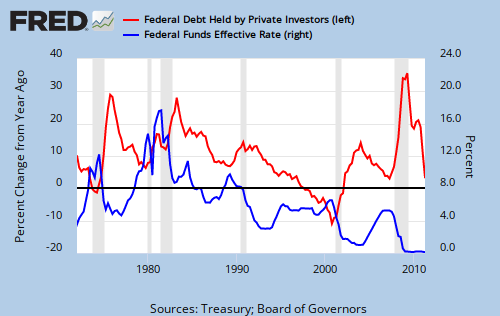
And on and on and on. You get the idea. That time bomb has been on the verge of explosion at least since 1940. Even today, the media, the politicians and sensationalist economists refer to the debt as a ticking time bomb. Please look at the following graph and see if you can find any relationship between deficit spending vs inflation and/or interest rates.

This graph shows there is no predictable relationship between federal deficits vs. inflation and or interest rates.

If the debt is a time bomb, it surely has the slowest fuse in history. The pundits have been wrong, wrong, wrong, all these years. We should understand federal deficits, even large federal deficits, have not caused inflation or any other negative economic effect, and the debt is not a ticking time bomb? It’s an economic necessity. Let us turn away from faith and start to rely on facts.

The faith healers* are killing our economy by restricting money growth. See: The damage done by deficit cuts.

Rodger Malcolm Mitchell
http://www.rodgermitchell.com

*Faith is belief without evidence. Science is belief from evidence.
–Deficits and interest rates: Another myth

An alternative to popular faith

11/15/09 (AFP): “The US government announced last month that it had closed its 2009 fiscal year with a record budget deficit of 1.417 trillion dollars, up 962 billion dollars from the prior year. The huge gap stemmed from declining revenues and a massive boost to spending in a 787-billion-dollar stimulus plan designed to jolt the world’s largest economy from its prolonged recession. Concerns over the deficit underscore a fundamental tension undercutting Obama’s presidency in its first year — the extent to which he is attempting sweeping political change at a moment of historic financial peril.

“Many economists say high deficits during economic crises are acceptable to fuel government spending to stimulate growth. But long-term deficits can result in high interest rates, making it much harder for consumers to finance outlays such as new homes and cars.”

Yet another myth in the pantheon of economic myths circulating the globe. Look at the following chart and tell me whether you can see a relationship between deficits — even large deficits — and interest rates.

Debt vs Interest Rates

Contrary to popular faith, deficits are not the cause of inflation or high interest rates. Browse through the posts on this site, and you will see why.

–Deficits: The Possible vs. the Certain

An alternative to popular faith

Human beings have difficulty distinguishing threat levels. Despite the absolute fact that airline travel is safer per mile than auto travel, some people drive, even long distances, because they fear the safer air travel more than the dangerous auto travel.

Then think of the people who won’t vaccinate their children against the H1N1 flue, because they fear any unknown, possible adverse effects of vaccination more than they fear the known, deadly effects of the flue.

I was reminded of this human failing when I read an article in which the author claimed the economic recovery was not “real,” because it relied on government funding rather than on private funding. The author seemed to feel government funding was, in some way, artificial – as though we were using saccharine, rather than sugar, to sweeten our coffee.

Of course, money is money, and federal money is indistinguishable in effect from private money. But I suspect the author had something more than artificiality in the back of his mind. He probably understands that the federal government has the unique and unlimited ability to create money from thin air, and repeatedly has proved it never can run out of money. So, what is his concern? He must fear two things: Federal deficit spending might cause inflation and our grandchildren might have to pay for deficits.

As for inflation: Despite current, massive deficit spending we do not now experience an unacceptable level of inflation, and are unlikely to soon. Moreover, in the thirty-five years since we went off the gold standard, large deficits never have caused inflation. Clearly, something is askew with the deficits-cause-inflation hypothesis.

Even if deficits did cause inflation, private spending is identical with public spending; both add money to the economy. So the author should fear the supposed inflationary effects of private and public spending, equally.

As for grandchildren, I am a grandchild of the adults who saw the gigantic deficits of WWII and of President Reagan. Yet, because tax rates have gone down, I never have paid one penny toward those monster deficits. Similarly, if tax rates continue to stay level or decline, as they should, my grandchildren will not pay a penny toward today’s deficits.

What has this to do with the human difficulty distinguishing threat levels? The debt hawks know with certainty, that many millions of people now suffer the devastating effects of unemployment and loss of homes and lifestyle. People are dying, financially, emotionally and yes, even physically.

These same debt hawks believe that at some unknown time in the future, their children, grandchildren or great grandchildren may have to pay some unknown amount toward today’s debt. Yet they fear unknown future damage more than the certainty of today’s. That is why you see people rail against deficits. In essence, they are so afraid they one day may run short of water, they will let a home burn to the ground rather than allowing the fire fighters to save it.

The shame is that many professional economists, who should know better, foster these misguided fears, leading to misguided actions.

Rodger Malcolm Mitchell
http://www.rodgermitchell.com/

-Debt hawks — Economics’ Chicken Littles

An alternative to popular faith

Are you too young (or too old) to remember the fable about Chicken Little, who believed the sky was falling down when an acorn fell on her head? She ran around in a panic, screaming “The sky is falling,” a now common idiom denoting an hysterical or mistaken belief that disaster is imminent.

Thus, have the debt hawks, aka Chicken Littles, been telling us for 30 years that the sky is falling, and that federal deficits will create disaster. Neither has occurred, or is likely soon, but failure of prediction neither embarrasses nor educates debt hawks.

We have arrived at a deficit of $1.4 trillion. In the past 30 years, the gross federal debt has grown an astounding 1,400%. The economy has grown, inflation has not been a problem, federal borrowing has not replaced private borrowing, countries have not refused to lend to us and because federal tax rates actually have gone down, no one’s grandchildren have paid for the $12 trillion gross debt.

The problem with debt hawks is they don’t understand money. They think of money as a scarce physical substance. It may be scarce to you and to me, but it no longer is scarce to the federal government, which since 1971, has created money at will, simply by creating T-securities from thin air, then exchanging them for the dollars it created earlier — also from thin air.

Visualize this. You go to a football game and the scoreboard reads 14 – 7. You might say one team “has” 14 points and the other team “has” 7 points. But in reality, the scoreboard merely has credited one team with 14 points and the other team with 7 points. The points are not physical things. No one “has” them.

Why is this important? Because in the economy, you and I are the teams and the government is the scoreboard. Points are not a real substance. Teams are merely credited with points. Money no longer (after we went off the gold standard) is a real substance. You and I, or more specifically, our bank accounts, merely are credited with money.

The scoreboard (government) never runs out of points. The government never runs out of the ability to credit you with dollars. The scoreboard does not need to ask either team to return some points so it can credit more points. Crediting a team with points does not reduce the scoreboard’s ability to credit more points. Crediting people or companies with money does not reduce the government’s ability to credit more money.

The scoreboard does not need to borrow points. The government does not need to borrow dollars. It as easily, safely and prudently can create dollars directly, rather than by creating and selling T-securities.

Imagine you decide to start a country from scratch. What is the first thing you will do? The people in your country need money, so you, as the government, will credit them with money. How? Perhaps by buying things from them. The people will give you material things and services; you will credit their bank accounts.

Debt hawks will call this exchange “deficit spending,” and they will demand that the people credit you, the government, back with some of the money. That’s called “taxation.” It is identical with giving the scoreboard back some points.

The scoreboard neither has nor needs points. The federal government neither has nor needs money. It never needs to be credited with money. It never needs to borrow money. It is the scoreboard. It can credit, endlessly.

The debt hawks continue to use obsolete, gold-standard thinking, from when money was a substance and was scarce to the government. Today, if the government wanted to give you $1 trillion, it simply would credit your bank account for $1 trillion, and debit its own balance sheets. Nothing physical would happen except the movement of a few electrons. The government can do this endlessly. In fact, last fiscal year, it did.

The government does not have a stash of money from which it spends. The government has no money at all. It merely credits bank accounts — yours, mine, foreign governments’.

Some may fear this can cause inflation, but the government now has absolute control over the value of its money through its control over both the supply and the demand (interest rates) for money.

The world changed in 1971, and the debt hawks have not yet understood that. Perhaps “hawk” is the wrong bird. More appropriate might be “Chicken Little.”

Rodger Malcolm Mitchell
http://www.rodgermitchell/