-The government is our landlord

An alternative to popular faith


       Representative Earl Pomeroy, a North Dakota Democrat, famously told AIG employees: “Give us our money back.” He had no idea what he was talking about.
       Imagine that you rent an apartment in a large building. Every month, each tenant sends the landlord rent. One month, the landlord decides to give one of the tenants a gift of $50. Did the landlord give that tenant your money or did he give his own money?
       Imagine that the tenant spends the $50 on something you consider to be wasteful. Should you, a fellow tenant, tell that tenant, “Give us our money back”?
       Imagine that instead of giving the tenant $50, the landlord lends the tenant $50. Some time later, the tenant repays the landlord the $50 plus another $10 in interest. Have you made a profit?
       Now imagine that the rent the landlord collects does not cover his expenditures, so each year he runs a deficit. But he is fabulously wealthy, so he never has problems paying his debts. Do you owe the landlord’s creditors or does the landlord owe his creditors? Are your grandchildren liable for the debts or is he?
       Seems pretty silly, doesn’t it? Yet exactly that kind of thinking permeates the discussions of our economy.
       In essence, the federal government is our landlord, to whom we pay “rent” (taxes). The rent does not cover the government’s expenditures, but the government is so wealthy, it never has problems paying its debts.
       When the government gives out stimulus money, it does not give our money (aka “taxpayers’ money). It gives government money, which it creates out of thin air. When the government lends money to a taxpayer, and the taxpayer subsequently repays, plus interest, we taxpayers do not make a profit. Only the government makes a profit. We don’t owe the landlord’s creditors, nor do our grandchildren.
       Our “landlord,” with help from the media and politicians, has created the myth that when he takes a loss, we taxpayers and our grandchildren are liable, when he raises our rent or cuts services to reduce his losses, we benefit, and when he makes a profit, we should believe it actually is our profit. Nonsense.
       This is a message to anyone who agrees with Rep. Pomeroy and the media, and who believes our landlord spends our money, not his, and we and our grandchildren owe his debts, and when he makes a profit, that’s money in our pocket: I have some costume jewelry I’d like to sell you.

Rodger Malcolm Mitchell
For more information, see http://www.rodgermitchell.com
–When China will pass the U.S. as the world’s dominant economy


An alternative to popular faith

      When China passes the U.S. as the world’s dominant economy, you can blame the economists, who parrot the popular faith that federal debts are unsustainable and cause recessions, inflations, high taxes and harmful high interest rates. No evidence supports these intuitive beliefs.
Contrary to popular faith:

–Fact: We do not need other nations to buy our debt. We do not even need to create debt. Just as the U.S. government has the unlimited ability to create T-securities and sell them (aka “borrow”), the government has the unlimited ability to create money, thus the unlimited ability to “sustain” any size debt.
–Fact: There is no historical relationship between deficits and inflation (See the blog: “Do deficits really cause inflation,” below). Data indicates inflation is more closely related to energy costs, specifically to oil, than to any other factor.
–Fact: In only 15 years, from 1979 through 1994, taxes were cut and the federal debt grew an astounding 500%. This massive, unprecedented money printing did not cause inflation or high taxes. Instead, we entered a long period of economic growth, low taxes and moderate interest rates. Repeating that 500% debt growth would yield a $72 trillion debt in 2024 and an average deficit of $4 trillion — and if history is a judge, the same economic growth, the same low taxes and the same moderate interest rates.
–Fact: All six depressions in U.S. history immediately followed years of federal surpluses. Every recovery coincided with increases in debt growth.
–Fact: All nine recessions in the past 50 years immediately followed reductions in federal debt growth. Every recovery coincided with increases in debt growth, such as we are seeing, today.
–Fact: There is no historical relationship between high interest rates and slow economic growth. Similarly, low interest rates have not stimulated growth.
–Fact: There is no historical relationship between deficits and tax rates. There is no mechanism for our grandchildren to pay for deficits.

The factually unsupported fear of federal deficits in the U.S., when compared with the lack of such fear in China, is why we will fail and they will succeed.

Rodger Malcolm Mitchell
For more information, see http://www.rodgermitchell.com

–Deficits, inflation and hyperinflation

The debt hawks are to economics as the creationists are to biology. Those, who do not understand monetary sovereignty, do not understand economics. Cutting the federal deficit is the most ignorant and damaging step the federal government could take. It ranks ahead of the Hawley-Smoot Tariff.
==========================================================================================================================================

      It commonly is believed large federal deficits cause inflation. Examples often are given of Germany, China, Brazil, Italy and other nations that experienced hyperinflation.

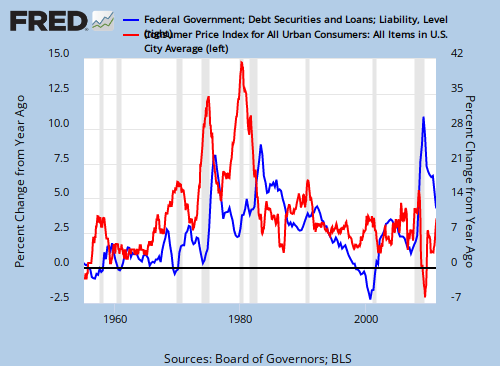
So it might be useful to see what the experience in America has been. Here’s a graph created by the St. Louis Federal Reserve. The blue line is deficit growth. The red line is inflation.

In the past 50 years at least, deficit growth has not been associated with inflation.

Inflation is more closely related to special factors than to deficits; such things as oil shortages, wars and weather are the main culprits.

Deficits vs inflation

I do not suggest the government should create an unlimited amount of money, though it has the power to do so. In 1979, gross federal debt was $800 billion. In 2009 it reached $12 trillion, a 1400% increase in 30 years.

During that period, GPD rose 440% (annual rate of 5.5%) with acceptable inflation throughout. The same 1400% increase would put the debt at $180 trillion in 2039, a mean deficit of $5+ trillion.

This calculates to a 9.5% annual debt increase for the past 30 years. Repeating that growth rate would put the 2010 deficit at about $1.14 trillion, and the 2011 deficit at about $1.25 trillion.

The deficit for year 2039 would be about $15.8 trillion. I know of no reason why the results would not be the same as they have been in the past 30 years.

However, increasing the debt growth rate above 9.5% might show even better results. In the 10 year period, 1980 – 1989, federal debt grew 210%, from $900 billion to $2.8 trillion (a 12% annual debt increase), while GDP grew .96% from $2.8 trillion to $5.5 trillion (a 7% annual increase).

During that same period, inflation fell from 14.5% in 1980 to 5.2% in 1989.
In summary, large deficits have led to GDP growth, while not causing unacceptable levels of inflation. Those are the bare bones.

For more information, see http://www.rodgermitchell.com


-How to Eliminate All Federal Debt and Interest Payments — if we want to

The debt hawks are to economics as the creationists are to biology. Those, who do not understand monetary sovereignty, do not understand economics. Cutting the federal deficit is the most ignorant and damaging step the federal government could take. It ranks ahead of the Hawley-Smoot Tariff.
==========================================================================================================================================

AP: August 12, 2009:
“The Obama administration is projecting that when the current budget year ends on Sept. 30, the (deficit) will total $1.84 trillion. The soaring deficits have raised worries among foreign owners of U.S. Treasury securities including the Chinese, the largest holder of such debt.”

Perhaps no subject has caused more controversy than the federal debt and deficit. The deficit includes interest payments, which this year are projected to be $260 billion, a substantial amount, even with today’s low interest rates. Interest payments will continue to grow as the debt and interest rates rise.

So we deal with three related worries: We worry about paying for the large and growing federal debt. We worry about our creditors buying our debt. And we worry about the growing amount of interest the government must pay.

Every one of these issues could be solved with one stroke of the pen.

The federal government borrows by creating Treasury securities (T-bills, T-notes and T-bonds) from thin air, backed only by “full faith and credit.”  It then trades these securities for dollars it previously created.  When the securities mature, the government trades them back, plus interest.

“Full faith and credit” is an intangible collateral. The government has an unlimited supply. This gives the government the power to create unlimited amounts of T-securities.  Finding buyers for these T-securities is addressed by offering interest rates high enough to attract investors.

While the government currently creates T-securities from thin air, it just as easily creates dollars from thin air – similarly backed only by full faith and credit – and can eliminate the borrowing step.  No longer would we be troubled by federal debt, federal deficits, concerns about China et al or interest payments. The same controls over T-security creation would apply to money creation. We merely would eliminate the one step that causes so much controversy.

Why does the U.S. government create T-securities ostensibly to obtain U.S. dollars?  Borrowing is a relic from the gold-standard days, which ended in 1971. Prior to that, U.S. dollars were backed in part by gold, a tangible product in limited supply.  This limit prevented the government from creating as many U.S. dollars as it needed, so it had to borrow these dollars.

When you think about it, the notion of the U.S. government “borrowing” U.S. dollars – dollars it alone has the power to create – is ironic. The government can eliminate debt, along with all the controversy these subjects cause.

Rodger Malcolm Mitchell
For more information, see http://www.rodgermitchell.com