U.S. Wealth Account

Sometimes, you don’t know whether to laugh or cry. That’s when you encounter an idea that is so bad the people who favor it are wrong, and those who oppose it are also wrong. Now, that is a bad idea. Here (in red) is a short article from the February 14th THE WEEK Magazine:
President Trump wants the United States to be in the investment business, said Jenny Leonard and Katherine Burton in Bloomberg. This week, Trump signed an executive order directing officials to create a national wealth fund. Trump floated the idea of a sovereign wealth fund –in essence, an investment fund owned by the government– during the campaign, proposing the “money from tariffs” could be used to “invest in manufacturing hubs, defense, and medical research.”
The Monetarily Sovereign U.S. government does not use any income for spending. It does not use taxes or “money from tariffs” (which effectively are taxes on American consumers). Having the infinite ability to create dollars, the federal government destroys all the dollars it receives and newly creates every dollar it spends. Even if the U.S. government did not receive a single tax or tariff dollar, it could continue spending dollars forever. Thus, the “wealth fund” could pay any amount it chose, at any time, to whomever it chose. Unlike a privately owned fund, a government fund can do whatever it wants with investors’ money, including keeping it. Witness America’s Social Security, which changes the rules every year. You have been told that your FICA dollars fund Social Security. They don’t. If they did, the government couldn’t change the qualifying dates at will and couldn’t tax the benefits you supposedly paid for. Trump and the Republicans have promised to eliminate income taxes on Social Security benefits, which they have the power to do. Or they could double the taxes, at will. The “wealth fund” could pay you any amount it chose, whenever it chose, and change the rules every day, at whim. So, what would be the purpose of a government investment fund, and how would that be different from accepting deposits in T-bills, T-notes, and T-bonds? Further, funds must have an investment philosophy. That is, will the fund mimic the S&P? The largest growth stocks? The total stock market? Include foreign stocks? Or will it be traded according to some other formula, and if so, which? Never one to be bothered with details, Trump doesn’t say. But those are vital questions.
Other wealth funds generally exist in nations with excess money, either from “large foreign exchange reserves, like China, or revenue from the sale of oil.”

Uncle Sam sitting on a giant pile of money
The U.S. government has infinite dollars.
The U.S. always has “excess money” because it has infinite money. When a government can create money at will and at no cost, at what point could it be said to have “excess money”? China has funds in dollars and other currencies. It can exchange those dollars for yuan if it wishes to use them for spending (on oil, which is traded in dollars) or do anything else.

Trump floated the suggestion that “the fund could facilitate the sale of TikTok.”

Utter nonsense. The U.S. government has the financial ability to buy TikTok along with FaceBook, X, and every other app, and still has plenty left for politicians to pave their local streets in gold.
Let’s hope this doesn’t go anywhere, said Dominic Pino in National Review.  A sovereign wealth fund makes sense for oil-rich states like Saudi Arabia and the United Arab Emirates, which pull in massive revenues and “don’t have a ton to spend it on.”

According to the U.S. Energy Information Administration, the United States has produced more crude oil than any nation at any time, according to our International Energy Statistics, for the past six years.

Crude oil production in the United States, including condensate, averaged 12.9 million barrels per day (b/d) in 2023, breaking the previous U.S. and global record of 12.3 million b/d, set in 2019.

Average monthly U.S. crude oil production established a monthly record high in December 2023 at more than 13.3 million b/d.

A sovereign wealth fund in oil-rich nations facilitates the foreign exchange of local currencies and eliminates the need to rely on foreign exchange markets. The money is invested and banked, transforming into whatever currency the nation desires. In dollars, the U.S. is the world’s second-largest oil exporter. That fact has nothing to do with the U.S. creating a government-owned fund. The U.S. government has infinite money and infinite things to spend it on.
Among Western countries, “Norway is the canonical example of a successful sovereign wealth fund,” But it has money to spend, averaging a budget surplus of 10 percent of GDP since the 1970s.
A “budget surplus” means the government takes more money out of the economy than it puts in. The formula for GDP is GDP=Total Spending + Net Exports. Norway is a major exporter, and though it technically is Monetarily Sovereign, when was the last time you accepted payment in Norwegian Krones? Still, it has the unlimited ability to pay its own people in Krones, so its fund cannot run short of money unless the government wants it to. And finally, we come to the most naive statement in the entire article.
The U.S. is running enormous deficits, “would have to borrow even more money to start a wealth fund,” and is a “poor steward of the money it already controls.
The authors display that they have no idea about the differences between Monetary Sovereignty and monetary non-sovereignty. 1: The U.S. government never borrows dollars. Think about it. Given the unlimited ability to create dollars, why would it ever borrow? It makes no sense. The economically naive think that allowing deposits in Treasury Security Accounts (T-bills et al.) represents borrowing. It doesn’t. A borrower takes ownership of money to spend or invest that money. However, the U.S. government never takes ownership of T-security dollars, and it never spends those dollars. Think of T-security dollars as being similar to dollars placed in a bank safe deposit box. The bank takes possession of the dollars but does not have ownership of the dollars. The T-security dollars remain the property of the depositors; the federal government never touches those dollars. It doesn’t use them for spending purposes. It only possesses the dollars. This is not borrowing. It is safekeeping. T-securities’ sole purposes are to help the Fed control interest rates and provide a safe storage place for unused dollars. They do not provide spending money to the government. 2:  Federal deficits are not a burden on the federal government. Unlike you, me, business, and the state and local governments, the federal government could deficit spend, forever. It neither needs nor uses tax dollars or any other form of income. 3:  Federal deficits are essential for GDP growth. Every depression in history has come when the federal government ran a surplus; government surpluses take dollars out of the economy, which reduces GDP. A reduction in GDP is known as a recession (short term) or a depression (long term). The federal government would not have to borrow even one dime in order to start a wealth fund. It could begin to one tomorrow — a fund containing a trillion dollars or a trillion, trillion dollars — at the touch of a computer key. (The government also has the Constitutional power to create a multi-trillion dollar platinum coin, and deposit in the General Account from which to write checks. It’s unnecessary, but legal.) And as far as the government is a “poor steward of the money it already controls,” who does the author think would control the investments in the wealth fund if not the “poor steward” federal government? In summary, both the proponents and opponents of the “wealth fund” demonstrate ignorance about federal financing. Their pro and con comments apply to a private-sector fund, not to a Monetarily Sovereign government fund. Trump, as usual, wants something he can twist into his own self-enrichment. Imagine him controlling a few trillion in assets, that the Supreme Court has ruled he can steal at will because he is immune to prosecution for actions taken as part of his official duties.  You can be sure that pumping a few billion or trillion into Trump properties will be considered “official duties” by the compliant Republican-controlled Senate and House. These bodies currently have no duties but to attend, vote “Yes,” and leave. And yes, to cash their paychecks and take advantage of their ill-gotten perks. Rodger Malcolm Mitchell Monetary Sovereignty Twitter: @rodgermitchell Search #monetarysovereignty Facebook: Rodger Malcolm Mitchell; MUCK RACK: https://muckrack.com/rodger-malcolm-mitchell; https://www.academia.edu/

……………………………………………………………………..

A Government’s Sole Purpose is to Improve and Protect The People’s Lives.

MONETARY SOVEREIGNTY
A straightforward question for students of Constitutional law

Here is a straightforward question for students of Constitutional law: What is the purpose of the Republicans in today’s Congress? (i.e., what exactly do they do, and why are they given a salary, office, healthcare insurance, and other perks?)

Rodger Malcolm Mitchell

Monetary Sovereignty

Twitter: @rodgermitchell

Search #monetarysovereignty

Facebook: Rodger Malcolm Mitchell;

MUCK RACK: https://muckrack.com/rodger-malcolm-mitchell;

https://www.academia.edu/

……………………………………………………………………..

A Government’s Sole Purpose is to Improve and Protect People’s Lives.

MONETARY SOVEREIGNTY

IF THIS SURPRISES YOU, YOU HAVEN’T BEEN PAYING ATTENTION

EVERY

EVERY DEPRESSION IN U.S. HISTORY BEGAN WITH A REDUCTION IN FEDERAL DEFICIT SPENDING.

1804-1812: U. S. Federal Debt reduced 48%. Depression began 1807.
1817-1821: U. S. Federal Debt reduced 29%. Depression began 1819.
1823-1836: U. S. Federal Debt reduced 99%. Depression began 1837.
1852-1857: U. S. Federal Debt reduced 59%. Depression began 1857.
1867-1873: U. S. Federal Debt reduced 27%. Depression began 1873.
1880-1893: U. S. Federal Debt reduced 57%. Depression began 1893.
1920-1930: U. S. Federal Debt reduced 36%. Depression began 1929.
1997-2001: U. S. Federal Debt reduced 15%. Recession began 2001.

The graph below shows the essentially parallel paths of GDP vs. perhaps the most comprehensive measure of the money supply, Domestic Non-Financial Debt:

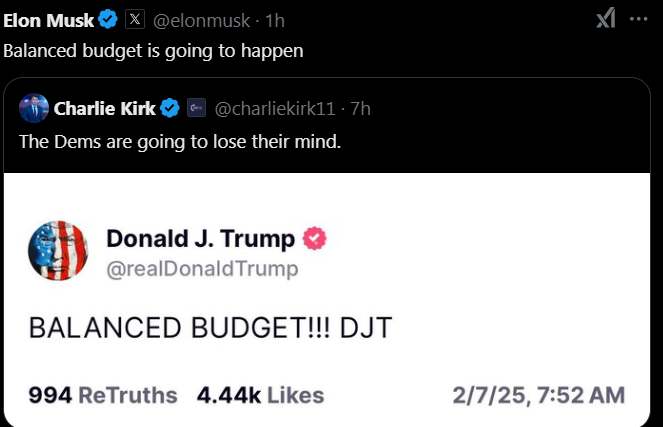
COMNG TO YOUR NEIGHBORHOOD SOON: THE TRUMP DEPRESSION (which Trump will blame on Obama, Biden, Pelosi, Democrats, and eventually on Musk (who like all Trump associates, will be thrown under the bus to save Trump).

Balancing the federal budget always has caused a calamity because of this simple formula:

GDP = Federal Spending + Nonfederal Spending + Net Exports

Read it carefully, and you will understand why a federal balanced budget absolutely, positively will cause a recession if we are lucky or a depression if Trump continues to be President.

We will be saved only in the unlikely event that the public begins to understand Monetary Sovereignty.

Rodger Malcolm Mitchell

Monetary Sovereignty

Twitter: @rodgermitchell

Search #monetarysovereignty

Facebook: Rodger Malcolm Mitchell;

MUCK RACK: https://muckrack.com/rodger-malcolm-mitchell;

https://www.academia.edu/

……………………………………………………………………..

The Sole Purpose of Government Is to Improve and Protect the Lives of the People.

MONETARY SOVEREIGNTY

The federal cost-saving myth

When Elon Musk bought Twitter, now “X,” his primary objective was to own a giant megaphone for his political ambitions. He immediately began to cut costs.
Twitter Layoffs: The Before and After of Elon Musk’s Staff Cuts
  1. Massive Restructuring: Elon Musk’s $44 billion acquisition of Twitter led to layoffs of nearly 80% of its workforce, altogether redefining the company’s structure, operations, and mission.
  2. Redistribution of Talent: Former Twitter employees have transitioned to leading tech companies like TikTok, Reddit, and Google, with many moving into senior and executive roles.
  3. Industry Ripple Effects: Musk’s drastic cost-cutting set a precedent for widespread layoffs across the tech industry, reshaping talent dynamics and organizational strategies.
  4. Mixed Platform Performance: X (formerly Twitter) reports growth metrics, but independent studies show contrasting metrics in user engagement and traffic since the rebranding.
  5. Applying Organizational Philosophy: Musk is now set to apply his organizational reforms to government through his involvement in DOGE and the Trump administration. 
He cut costs because X is a private enterprise, a for-profit, monetarily non-sovereign enterprise. As such, it is the opposite of the Monetarily Sovereign federal government: Different problems; different solutions. (Think of the difference between solutions for overweight and underweight, and you’ll get the idea.)

Musk claimed that the layoffs were necessary to save the company from financial ruin. Fast forward to 2024, and Musk promises to bring these draconian cuts to government bureaucracy. 

Elon Musk’s takeover of San Francisco-based Twitter significantly transformed the social media platform. Musk’s acquisition, valued at $44 billion, led to drastic measures to restructure the company, starting in November 2022. This included laying off more than 6,000 Twitter employees—a reduction of nearly 80% of Twitter’s workforce.

The problem is that the federal government cannot experience “financial ruin,” Its primary task of growing the economy requires the federal government to spend more than it receives — in short, to run deficits. Every time the federal government has spent less than it received — i.e., run a surplus, it has caused a depression, except once when it “only” caused a recession.

U.S. depressions come on the heels of federal surpluses.

1804-1812: U. S. Federal Debt reduced 48%. Depression began 1807. 1817-1821: U. S. Federal Debt reduced 29%. Depression began 1819. 1823-1836: U. S. Federal Debt reduced 99%. Depression began 1837. 1852-1857: U. S. Federal Debt reduced 59%. Depression began 1857. 1867-1873: U. S. Federal Debt reduced 27%. Depression began 1873. 1880-1893: U. S. Federal Debt reduced 57%. Depression began 1893. 1920-1930: U. S. Federal Debt reduced 36%. Depression began 1929. 1997-2001: U. S. Federal Debt reduced 15%. Recession began 2001.

The relationship between federal deficit spending and economic growth is demonstrated by the following graph:
“Debt Securities” (red) tracks federal deficit spending. Gross Domestic Product (blue) tracks economic growth
The lines are essentially parallel. A growing economy requires a growing supply of money, and federal deficits increase the money supply. Unlike the federal government, X:
  1. Does not have the infinite ability to create dollars.
  2. Requires income to survive, long term.
  3. Its primary financial goal is profits.
  4. It reports to shareholders, in this case, Musk, and is designed to help achieve one shareholder’s personal goals.
By contrast, the U.S. federal government:
  1. Has the infinite ability to create dollars simply by touching computer keys
  2. Needs no income and, in fact, destroys any income it receives.
  3. Needs no profits, and in fact, profits would be counterproductive to its mission of protecting and improving people’s lives. Federal losses are the economy’s gains.
  4. It reports to the people of the United States and to a lesser extent, the people of the world.
Thus, when the ad hoc creation of the so-called “Department of Government Efficiency (DOGE) fires employees, it does nothing to help the government or American taxpayers. Federal savings do not fund federal spending. On the contrary, firing federal workers to save money hurts the American economy. It hurts the workers individually and every American because the government will pump fewer growth dollars into the economy. Gross Domestic Product (GDP) = Federal Spending + Non-federal Spending + Net Exports. This demonstrates why great businessmen seldom make good Presidents. The entire motivation and process are different from what they know. What a businessman does instinctively (minimize spending and maximize profits) is exactly the opposite of what a Monetarily Sovereign government leader should do (although it is perfect for leaders of monetarily non-sovereign state and local governments). Musk may know this, but even so, he knows the public doesn’t understand it. The public is conditioned to believe nine of the myths mentioned in Inflation: The Bugaboo That Confuses Our Leaders:
  1. Federal finances are similar to state and local government, business, and/or personal finances
  2. The federal government should live within its means, just as people and businesses should.
  3. The federal government should be frugal.
  4. Wasteful federal spending is a significant economic problem.
  5. Excessive federal spending causes inflation.
  6. Inflation is too much money chasing too few goods.
  7. Federal deficits and debt are financial burdens on federal taxpayers and the government
  8. The federal government levies taxes to pay for its spending.
  9. The federal government borrows to pay for its spending.
    musk EATING a bowl of money
    Give me more, more, more money while I fire more, more, more people.
Wrong on all nine counts. Having the infinite and unique ability to create dollars, the federal government has no “means,” and even “wasteful” spending is beneficial. Taxpayers don’t pay for spending; the government spends with newly created dollars, so it never borrows. And shortages like oil and food, not federal spending, cause inflation. Actions that are good for a non-sovereign business often will be disastrous when applied to a Monetarily Sovereign government. Musk’s and Trump’s combination of economic ignorance, hubris, laziness, and massive power, together with an insatiable craving for self-enrichment, will create a disaster for America and all Americans. Finally, it’s one thing to fire employees of a disseminator of rumor and silliness like “X,” but do you really want fewer people inspecting your food for disease and poisons. Do you want fewer people to provide family assistance, child support, childcare, Head Start, child welfare, and other programs that help children and families? How about fewer people to help improve the quality, safety, efficiency, and effectiveness of health care for Americans? Do you really want less effort to protect people from harmful chemical exposures? Or less effort to enforce federal criminal laws regulating the firearms and explosives industries? Or a smaller staff to preserve U.S. government records, manage the Presidential Libraries system, and publish rules, regulations, Presidential, and other public documents? Is it your opinion that the Army Corps of Engineers and the rest of our military have too many people? Should we devote fewer resources to measuring labor market activity, working conditions, and economic price changes? Maybe we should have fewer U.S. Capitol Police Officers to protect life and property, investigate criminal acts, and enforce traffic regulations on U.S. Capitol Grounds, while protecting members, officers of Congress, and their families. No one ever would attack the Capitol (right?), and if they did, the President would pardon them, so why have police? And, of course, we should cut the Centers for Medicare and Medicaid Services (CMS), which provides health coverage to more than 100 million people through Medicare, Medicaid, the Children’s Health Insurance Program, and the Health Insurance Marketplace (right?) And, what’s the good of the U.S. Courts of Appeals that hear appeals from lower courts of both civil and criminal trials to investigate whether or not the law has been fairly and correctly applied by the lower courts? Don’t we already have too many people protecting the public from investment fraud, manipulation, and abusive practices? Then there are the useless patent and copyright offices. Shouldn’t they be cut? And certainly, we could do without all those people whose jobs involve customs, border, immigration enforcement, emergency response to natural and manmade disasters, antiterrorism work, and cybersecurity. There are thousands of examples of federal agency people who devote their lives to protecting you and national leaders (including the President) and visiting heads of state. I would vote right now to get rid of the group risking their lives to protect the President. When you go through the list of federal agencies, you learn how vital these people are in improving and protecting all our lives. Sadly, Musk’s casual, broadscale firing makes no allowance for individuals. That simply is too much work for him. His deferred resignation program already has received thousands of acceptances of his “deferred resignation” offer. Are these good employees, bad employees, vital employees, young, old, experienced, recently hired? No one knows, and no one seemingly cares. To Musk and Trump, employees aren’t people who provide valuable services. They are job titles we can do without and without suffering losses. Ignorance, hubris, laziness, and massive power together with an insatiable craving for self-enrichment — was there ever a better description of today’s White House? SUMMARY Federal deficit spending is necessary for economic growth and to fulfill the federal government’s mission to improve and protect the people’s lives. GDP = Federal Spending + Nonfederal Spending + Net Exports. Even “wasteful” federal spending grows the economy. Federal taxes do not fund federal spending. Spending cuts do not lead to tax cuts, but they do lead to service cuts. Running a for-profit business is entirely unlike running a for-service Monetarily Sovereign federal government. A Monetarily Sovereign government is not better when it is smaller and spending less. It is better when it is providing more services and collecting less tax, regardless of cost. Rodger Malcolm Mitchell Monetary Sovereignty Twitter: @rodgermitchell Search #monetarysovereignty Facebook: Rodger Malcolm Mitchell; MUCK RACK: https://muckrack.com/rodger-malcolm-mitchell; https://www.academia.edu/

……………………………………………………………………..

The Sole Purpose of Government Is to Improve and Protect the Lives of the People.

MONETARY SOVEREIGNTY