Ignorance is suicide

In economics, as in most other fields, ignorance leads to failure and to further ignorance. Nowhere is this more evident than in discussions about the so-called “national debt,” which is neither national nor debt.

The following article appeared in the June 2, 2025 Florida Sun  Sentinel:

Can Trump manage national debt? Several investors, GOP senators and Musk have doubts By Josh Boak Associated Press
WASHINGTON — President Donald Trump faces the challenge of convincing Republican senators, global investors, voters and even Elon Musk that he won’t bury the federal government in debt with his multitrillion-dollar tax breaks package. 
The response so far from financial markets has been skeptical as Trump seems unable to trim deficits as promised. The overall national debt stands at more than $36.1 trillion.

Mr. Josh Boak seems to misunderstand the difference between federal financing and personal financing. He insists our Monetarily Sovereign federal government is at risk of being buried in debt.

The federal government is Monetarily Sovereign. That means it never can run short of dollars. It could continue spending at its current rate, or even at three times its current rate, forever. 

Your city, county, and state can be buried in debt. Your business can be buried in debt. You can be burning in debt, as can I. We are monetarily non-sovereign. We cannot create unlimited dollars. 

But the U.S. federal government cannot be “buried in debt.” Not now. Not ever.

Why would anyone want to reduce annual deficits? The government never can run short of dollars, and federal deficits are essential for economic growth.

The most common measure of economic growth is Gross Domestic Product (GDP). The formula for GPD is:

GDP = Federal Spending + Nonfederal Spending + Net Exports

“Nonfederal” is the private sector.

Simple algebra shows that cuts to Federal Spending reduce economic growth. Federal Spending increases GDP directly, but also tends to increase Nonfederal Spending by sending dollars into the private sector, which spends them.

“All of this rhetoric about cutting trillions of dollars of spending has come to nothing — and the tax bill codifies that,” said Michael Strain, director of economic policy studies at the American Enterprise Institute, a right-leaning think tank.

It is surprising that someone titled “Director of Economic Policy Studies” does not understand the fundamentals of federal finance. Mr. Strain appears to misunderstand the differences between monetary sovereignty and monetary non-sovereignty.

“There is a level of concern about the competence of Congress and this administration, and that makes adding a whole bunch of money to the deficit riskier.”

Yes, there is a level of concern about the competence of people who believe the government can run short of its own sovereign currency.

The White House has viciously lashed out at anyone who has voiced concern about the debt snowballing under Trump, even though it did exactly that in his first term after his 2017 tax cuts.

Trump often attacks anyone who disagrees with him, despite his limited understanding of economics.

White House press secretary Karoline Leavitt opened her briefing Thursday by saying she wanted “to debunk some false claims” about his tax cuts.

Leavitt said the “blatantly wrong claim that the ‘One, Big, Beautiful Bill’ increases the deficit is based on the Congressional Budget Office and other scorekeepers who use shoddy assumptions and have historically been terrible at forecasting across Democrat and Republican administrations alike.”

Here is the irony. Rather than imitating Trump by lying, insulting, and criticizing, Leavitt should have stated, “Yes, we increase the deficit because it stimulates economic growth. We draw from the federal government, which has an infinite supply of dollars, and give support to the economy, specifically, the private sector.”

In summary, she apologizes for unintentionally doing the right thing while believing it to be wrong, and then she denies that she is doing it. 

House Speaker Mike Johnson piled onto Congress’ number-crunchers Sunday, telling NBC’s “Meet the Press”: “The CBO sometimes gets projections correct, but they’re always off, every single time, when they project economic growth. They always underestimate the growth that will be brought about by tax cuts and reduction in regulations.”

Tax cuts bring about growth because they leave more dollars in the private sector, which is exactly what federal deficit spending does. So why does Johnson promote tax cuts but oppose federal deficits, both of which accomplish the same thing? 

Is he really that ignorant about economics, or is he just trying to defend Trump no matter what?

But Trump has suggested that the lack of sufficient spending cuts to offset his tax reductions came out of the need to hold the Republican congressional coalition together.

“We have to get a lot of votes,” Trump said last week. “We can’t be cutting.”

Get it? Trump is saying, in effect, that “we should cut spending, but the Republican coalition seems to know that spending cuts are harmful, so we’ll keep spending, which will grow the economy.”

That gibberish is what passes for wisdom in Washington.

That has left the administration betting on the hope that economic growth can do the trick, a belief that few outside of Trump’s orbit think is viable.

“Economic hope can do the trick?” What trick? Is Boak saying that the Republicans hope economic growth can cure the federal deficit? 

How does that work? The deficit is the private sector sending fewer dollars to the government than the government sends to the private sector. How does economic growth cure that? It’s mathematical nonsense.

In the equation, GDP = Federal Spending + Nonfederal Spending + Net Exports, the Republicans hope that GDP goes up, while Federal Spending and Nonfederal Spending go down!

Would someone please find a 5th grader who will explain algebra to the politicians and Mr. Boak?

Most economists consider the nonpartisan CBO to be the foundational standard for assessing policies, although it does not produce cost estimates for actions taken by the executive branch, such as Trump’s unilateral tariffs.

Tech billionaire Musk, who was until recently part of Trump’s inner sanctum as the leader of the Department of Government Efficiency, told CBS News: “I was disappointed to see the massive spending bill, frankly, which increases the budget deficit, not just decreases it, and undermines the work that the DOGE team is doing.”

Musk may understand business finance, but he has no clue about federal finance. The goals are different. The goal of business is to increase income compared to outlay, thus increasing profits. So cost cutting is a viable, even necessary, option.

The goal of the federal government is to increase benefits to the people (by pumping more dollars into the economy). So taxing less and spending more are the best options — exactly the opposite of what a business should do.

In short, the sole purpose of any government is to improve the lives of the people. The purpose of a business is to improve its own life. Totally different goals and totally different abilities. Musk repeatedly proved he didn’t understand that.

To him, “government efficiency” means taking more dollars from the people and giving fewer dollars to the people.

Why do we need a government for that?

The tax and spending cuts that passed the House last month would add more than $5 trillion to the national debt in the coming decade if all of them are allowed to continue, according to the Committee for a Responsible Financial Budget, a fiscal watchdog group.

Translation: The tax cuts primarily benefiting the wealthy, along with spending cuts that hurt middle- and lower-income groups, are projected to inject 5 trillion growth dollars into the pockets of the rich over the next decade.

This estimate comes from the Committee for a Responsible Federal Budget, which is a Libertarian organization that opposes providing benefits to people who are not affluent.

To make the bill’s price tag appear lower, various parts of the legislation are set to expire. This same tactic was used with Trump’s 2017 tax cuts and it set up this year’s dilemma, in which many of the tax cuts in that earlier package will sunset next year unless Congress renews them.

But the debt is a much bigger problem now than it was eight years ago. Investors are demanding that the government pay a higher premium to keep borrowing as the total debt has crossed $36.1 trillion.

The interest rate on a 10-year Treasury Note is around 4.5%, up dramatically from the 2.5% rate being charged when the 2017 tax cuts became law.

Tell me this. Why would an entity, with the endless ability to create dollars by simply pressing a few computer keys, ever need to borrow dollars? Think about it.

The federal government, unlike state and local governments, does not borrow dollars. Federal bonds are completely different from state and local bonds, though they use the same word, “bonds.”

State and local governments do borrow dollars, when tax income is not sufficient to pay bills.

The federal government always can pay its bill simply by creating more dollars.

Fed Chairman Alan Greenspan: “A government cannot become insolvent with respect to obligations in its own currency. There is nothing to prevent the federal government from creating as much money as it wants and paying it to somebody. The United States can pay any debt it has because we can always print the money to do that.”

Fed Chairman Ben Bernanke: “The U.S. government has a technology, called a printing press (or, today, its electronic equivalent), that allows it to produce as many U.S. dollars as it wishes at essentially no cost.” It’s not tax money… We simply use the computer to mark up the size of the account.

Fed Chairman Jerome Powell stated, “As a central bank, we have the ability to create money digitally.

Statement from the St. Louis Fed: “As the sole manufacturer of dollars, whose debt is denominated in dollars, the U.S. government can never become insolvent,i.e., unable to pay its bills. In this sense, the government is not dependent on credit markets to remain operational.” You can find it in their publication titled “Why Health Care Matters and the Current Debt Does Not” from October 2011.

Paul Krugman (Nobel Prize–winning economist): “The U.S. government is not like a household. It literally prints money, and it can’t run out.” 

Hyman Minsky (Economist, key influence on MMT) “The government can always finance its spending by creating money.”

Eric Tymoigne (Economist) “A sovereign government does not need to collect taxes or issue bonds to finance spending. It finances directly through money creation.”

Every knowledgeable economist knows the federal government cannot run short of dollars and does not borrow (i.e., “dependent on credit markets” as the St. Louis Fed confirmed).

So what about T-bonds, T-notes, and T-bills? Aren’t they borrowing?

No. They are interest-earning deposits, the purpose of which is not to provide spending money to the government. Instead, they provide a safer place (compared to banks and insurance companies) for people and countries to store unused dollars.

The federal government never touches those dollars. So they are not borrowed. They are just held for safe-keeping, and at agreed-upon dates, the dollars, plus interest, are returned to their owners.

Think of them as similar to bank safe-deposit boxes, where the bank never touches the contents.

The confusion arises because the word “bonds” describes state and local government borrowing, while the same word, “bonds,” means federal safety-deposit accounts.

The idea that the U.S. federal government, which created the U.S. dollar, would need to borrow its own dollars from China or anyone is absurd.

(It’s equally absurd to believe that the federal government would need to levy taxes so it could have dollars for spending.)

The White House Council of Economic Advisers argues that its policies will unleash so much rapid growth that the annual budget deficits will shrink in size relative to the overall economy, putting the U.S. government on a fiscally sustainable path.

As the quotes from knowledgeable individuals indicate, the U.S. government always is on a fiscally sustainable path.

White House budget director Russell Vought said the idea that the bill is “in any way harmful to debt and deficits is fundamentally untrue.”

Harmful to debt and deficits”? Does he mean that increasing the so-called “debt” and deficits is true, but it could be beneficial to the economy (if it were not so skewed in favor of the rich)? Hard to know exactly what he means.

Most outside economists expect additional debt would keep interest rates higher and slow economic growth as the cost of borrowing for homes, cars, businesses and even college educations would increase.

Additional debt (which, as you have seen, is not “debt’) does not keep interest rates higher or lower. The Fed sets the rates arbitrarily in its misguided effort to fight inflation. Accepting deposits into Treasury Security accounts does not affect interest rates.

( Raising interest rates to fight inflation is misguided because it raises business costs, thus raising prices.)

“This just adds to the problem future policymakers are going to face,” said Brendan Duke, a former Biden administration aide now at the Center on Budget and Policy Priorities, a liberal think tank.

Duke said that with the tax cuts in the bill set to expire in 2028, lawmakers would be “dealing with Social Security, Medicare and expiring tax cuts at the same time.”

It’s quite easy for an informed economist to solve the “problems” of Social Security, Medicare, and tax cuts. Just create the needed dollars by pressing computer keys.

The government would need $10 trillion of deficit reduction over the next 10 years just to stabilize the debt, Tedeschi said. Even though the White House says the tax cuts would add to growth, most of the cost goes to preserve existing tax breaks, so that’s unlikely to boost the economy meaningfully.

“It’s treading water,” he said.

If the government wanted to stabilize the misnamed “debt,” it has plenty of simple options.

  1. Simply refuse to accept any more deposits into T-security accounts. The government neither needs nor uses the dollars. They just sit there, safely earning interest.
  2. Enact legislation to add $10 trillion to the General Account, which is the account used for federal payments.
  3. Have the Treasury mint a $10 trillion coin, as it has the legal authority to do so, and deposit the coin with either the Federal Reserve or the General Account.

If It’s So Simple, Why Don’t They Do It?

Here’s why so many smart people can’t seem to solve a simple problem: They don’t want to.

America is run by the very wealthy. What does “wealthy” mean? 

“Wealthy” does not mean having a thousand, a million, a billion, or a trillion dollars. “Wealthy” means having substantially more wealth than 95% or 99% (pick your percentage) of the country.

Look at this table of the amount of wealth required to be in the top 1% of Americans:
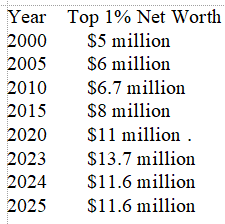
 

In the year 2000, having $5 million would have put you in the upper 1%, but only 2o years later, you would have needed to more than double your wealth to be as wealthy. 

So, to remain wealthy, you had two options.

  1. Dramatically increase the amount of money you have, and/or
  2. Make sure those below you don’t increase their wealth

If it is difficult to double your money in twenty-five years, consider ensuring that those beneath you do not increase their wealth. This way, your top 1% ranking would remain secure.

How do you prevent them from rising? By convincing them with the false notion that the government cannot afford to provide benefits.

Make them pay for their own healthcare. Keep Social Security benefits low. Don’t help them financially with college, so they either pay the tuition or are forced to work lower-paying jobs.

Consider the FICA tax. You might think you pay half, but in reality, you pay the full amount. Your employer takes FICA into account when determining salaries. FICA represents a significant percentage of your income.

For the wealthy, FICA taxes are insignificant or nonexistent. Why is this the case? To ensure that the Gap between you and the top 1 percent does not narrow.

You hear the government claim that it “can’t afford” Medicare for everyone, Social Security for everyone, or college for anyone who wants to attend. They say this is because the federal debt (which isn’t truly federal and isn’t really debt) is too large, and that deficits need to be reduced. Meanwhile, tax loopholes for the wealthy are being widened.

And government spending causes inflation, so any increase in spending must be paid for by your taxes.

And it’s all a lie, a Big Lie, for federal tax dollars are not used to fund federal spending.

That’s what the rich want you to believe. It’s how they stay rich. Or get even richer.

IN SUMMARY

  1. Unlike state and local governments, the federal government is Monetarily Sovereign. It has infinite money.
  2. It does not borrow the currency it originally created and continues to create by passing laws.
  3. “Federal debt” is neither federal nor debt. It is deposits in T-security accounts, wholly owned by depositors and never used by the government. The purpose is to provide a safe place to store unused dollars. This stabilizes the dollar.
  4. Federal deficits are necessary for economic growth.
  5. Federal spending does not cause inflation; it results from shortages of essential goods and services. Federal spending can alleviate inflation by acquiring these scarce assets.
  6. The Big Lie in economics is that the federal financing is like personal financing. The federal government needs no income. It creates all its income.
  7. The Big Lie aims to benefit the wealthy by increasing the income, wealth, and power Gap between the rich and the rest.
     

Rodger Malcolm Mitchell

Monetary Sovereignty

Twitter: @rodgermitchell

Search #monetarysovereignty

Facebook: Rodger Malcolm Mitchell;

MUCK RACK: https://muckrack.com/rodger-malcolm-mitchell;

https://www.academia.edu/

……………………………………………………………………..

A Government’s Sole Purpose is to Improve and Protect The People’s Lives.

MONETARY SOVEREIGNTY

Who cares about our environment? Not the MAGAs.

No further comment needed.
Analysis: $14B in US clean energy plans nixed in ’25 Firms concerned Trump tax bill will jeopardize investments By Alexa St. John and Isabella O’Malley Associated Press
dirty filthy smoky air with chimneys belching pollutants over neighborhoods
MAGA America

More than $14 billion in clean energy investments in the U.S. have been canceled or delayed this year, according to an analysis released Thursday, as the pending megabill supported by President Donald Trump has raised fears over the future of domestic battery, electric vehicle, and solar and wind energy development.

Many companies are concerned that investments will be in jeopardy amid House Republicans’ passage of a tax bill that would gut clean energy credits, nonpartisan group E2 said in its analysis of projects that it and consultancy Atlas Public Policy tracked.

The groups estimate that the losses since January have also cost 10,000 new clean energy jobs.

The tax credits, bolstered in the landmark climate bill passed under then-President Joe Biden in 2022, are crucial for boosting renewable technologies key to the clean energy transition. E2 estimates that $132 billion in plans have been announced since the so-called Inflation Reduction Act passed, not counting the cancellations.

Last week’s bill effectively renders moot many of the law’s incentives. Advocacy groups decried the potential impact that could have on the industry after the multitrillion-dollar tax breaks package passed.

“The House’s plan coupled with the administration’s focus on stomping out clean energy and returning us to a country powered by coal and gas guzzlers is causing businesses to cancel plans, delay their plans and take their money and jobs to other countries instead,” E2 executive director Bob Keefe said.

The Senate is reviewing the bill, with an informal July 4 deadline to get it to the president’s desk.

Of the projects canceled this year, most — more than $12 billion worth — came in Republican-led states and congressional districts, the analysis said. Red districts have benefited more than blue ones from an influx of clean energy development and jobs, experts say.

“If all of a sudden these tax credits are removed, I’m not sure how these ongoing projects are going to continue,” said Fengqi You, an engineering professor at Cornell University who was not involved in the analysis.

A handful of Republican lawmakers have urged the continuation of energy tax credits, with some saying in an April letter to Senate Majority Leader John Thune, R-S.D., that a repeal could disrupt the American people and weaken the country’s position as a global energy leader.

The Trump administration has sought to dismantle much of Biden’s environmental and climate-related policy in an effort to bolster a fossil fuel-led “American energy dominance” agenda.

Meanwhile, other countries are proceeding with green investments.

The European Parliament is committing to the European Union Carbon Border Adjustment Mechanism, a policy meant to prevent “carbon leakage,” or companies moving production to countries where climate policies are less strict.

And the International Maritime Organization is moving toward a global carbon tax on shipping.

Rodger Malcolm Mitchell

Monetary Sovereignty

Twitter: @rodgermitchell

Search #monetarysovereignty

Facebook: Rodger Malcolm Mitchell;

MUCK RACK: https://muckrack.com/rodger-malcolm-mitchell;

https://www.academia.edu/

……………………………………………………………………..

A Government’s Sole Purpose is to Improve and Protect The People’s Lives.

MONETARY SOVEREIGNTY

What if time were a property like mass, charge, or spin?

Humans are unique in that we can believe facts that don’t comport with our intuition.

We intuit that causes precede their effects. For example, if you tip an egg off a table, it falls to the floor and breaks—this outcome is not surprising. However, if the broken egg were to jump off the floor and reassemble itself on the table, that would be amazing.

Magicians mystify us by seemingly defying “natural” laws, making things disappear and then reappear without any obvious explanation.

We expect time to flow evenly so that I can set my watch by asking you what time it is. I expect you and me to run on the same time.

Yet, Einstein’s Relativity demonstrates that movement and gravity each affect time. The famous “twin paradox” shows that identical twins will age differently if one is moving at relativistic speeds or exists in a strong gravitational field.

They will not only seem to age differently, but their time will literally pass at different rates. The traveling twin will return home to find his brother has aged more. Time affects reality.

Quantum mechanics, the science of the very small, presents many counterintuitive facts. Small particles can exist in two different places, simultaneously. They can seem to communicate faster than light speed, instantaneously no matter how far apart they are ( “entanglement”).

Particles can be well-defined or vaguely defined wave-like; they can shift properties merely by being observed without being touched, as exemplified by the double-slit experiment.

Einstein’s masterwork, Relativity, seems at odds with Quantum Mechanics (QE),  though both descriptions of reality have been amply verified, countless times, and both make claims that mere observation can affect test results.

When a mathematically proven effect cannot be explained, intuitively or experientially, we may defend it, but always will feel uncomfortable with our explanations. So we continually ask the most difficult question in science: “Why?”

Why do the above effects occur? Why do Relativity and QE not meet in the middle? Why is reality so counterintuitive?

“Why” is often answered by a speculation (What if?), and I’ll give you one, here, one I’ve not heard of, though it well may already have been suggested and even discarded. If you know, please tell me.

What if . . .

Relativity and QE share at least one factor: Time. The speed of light and gravity waves, the simultaneity of entanglement and of particles existing in two locations, the measures of gravity relate to time. (At Earth’s surface, the acceleration of gravity is about 9.8 metres (32 feet) per second per second.)

We think of time as being a river in which everything swims, a constantly flowing river engulfing everything.

But, what if time isn’t a background dimension flowing uniformly, but a local propertylike mass, charge, or spin—carried individually by every particle?

In this view, each atom, each electron, has its own “tempo”—its own block of time. These timeblocks don’t always align, especially at the quantum level. When particles interact or entangle, they synchronize their local time states, at least temporarily.

The “spooky action at a distance” we call entanglement may simply be the expression of a shared time, both forward and backward.

The macro world we experience is the large-scale statistical average of countless synchronized timeblocks. It feels smooth, continuous, and directional, not because time is that way, but because differences fade in the averaging process.

Wavefunction collapse, the observer effect, and even quantum uncertainty may all reflect time as a localized variable. The quantum world looks “weird” because we are using a global clock to measure systems that don’t share it.

This view bridges relativity and quantum mechanics not by changing the math, but by changing the metaphor. If time is a property, not a stage, then what we observe is not paradox—it’s parallax.

Moiré Time: A Visual Unification of Relativity and Quantum Mechanics

Summary Physics has long sought a bridge between the smooth spacetime of relativity and the probabilistic strangeness of quantum mechanics.

I suggest that the unifying variable may not be mass, charge, or spin, but time itself. Not as a universal dimension, but as a localized quantum property, unique to every particle, layered across reality.

Visualized as overlapping temporal patterns, like moire patterns. this “moiré time” forms the composite image we experience as the macroscopic world. The slightest move of one pattern has far-reaching and profound effects on the overall moire phenomenon.

That model may clarify why quantum phenomena appear paradoxical to observers embedded in emergent macroscopic time.

Core Idea In relativity, time is malleable: it stretches under speed and bends under gravity. In QE, time seems to be everywhere and nowhere.

Entanglement occurs instantaneously yet obeys causality. The two-slit experiment suggests particles take all paths, simultaneously.

Uncertainty binds energy and time. And every measurement has a temporal component: when it is made defines what it measures.

The energy–time relationship is widely used to relate quantum state lifetime to measured energy widths but its formal derivation is fraught with confusing issues about the nature of time.

What if every particle carried an individualized, internal time structure—a “time block”—analogous to spin or phase? These timeblocks may oscillate, rotate, or interact with others. The macroscopic flow of time, with its singular direction and steady rhythm, could then be seen as a statistical average of many overlapping timeblocks.

This would create moiré-like interference patterns, where the observer’s own time structure interacts with those of the measured particles.

Entanglement would represent a shared or synchronized time pattern, explaining the apparent “instantaneous” connection.

Wavefunction collapse could occur not because of a mystical observer effect, but due to temporal alignment between observer and particle.

Unifying Power Time, in this view, is the only variable that fully inhabits both the relativistic and quantum worlds.

It is common to the changing of clocks in gravitational fields and to the uncertainty of energy in quantum transitions.

Rather than treating time as a background coordinate, we elevate it to a quantum participant. Reality becomes a familiar phenomenon—a moiré of overlapping timeblocks, each pattern contributing to the image seen by each observer.

Conclusion

By imagining time not as a single flow but as a field of local temporal patterns, we gain a new view of a merger between quantum weirdness and relativity. Time re-envisioned may be the only variable rich and strange enough to belong to both worlds, and simple enough to unify them.

What appears to be a paradox may, in fact, be parallax—the artifact of perspective across entangled timeblocks. It may be why observation changes reality.

===============================

Delving a  bit deeper

1. Can time be an entangled property?

When two particles become entangled, the state of one particle is instantly related to the state of the other, regardless of the distance between them.
If the properties, spin or polarization,  can be entangled, why not time? In fact, in delayed choice quantum eraser experiments, it seems like actions in the present affect outcomes in the past.
The delayed choice quantum eraser is an experiment in quantum mechanics that explores the peculiar consequences of the double-slit experiment and quantum entanglement.

It demonstrates that the behavior of quantum particles (whether they act like particles or waves) can be influenced by measurements made after the particles have been detected.

Maybe what’s entangled isn’t just spin—it’s the timelines of two particles. When you measure one, you’re not just collapsing a property, you’re collapsing the time experience of both particles.

That’s not faster-than-light signaling—it’s shared chronology collapsing into coherence.

It seems time can be entangled—if it’s a property, not a background.

2. Can time be in a superposition?

In quantum mechanicsquantum superposition is a fundamental principle stating that a quantum state can exist in multiple states simultaneously until it is measured.
Quantum states exist in superpositions. Could a particle be in multiple time states at once?

That’s been proposed, actually—there’s a field called quantum time crystals which suggests that, under the right conditions, events may not happen in a definite sequence.

Quantum time crystals are systems of particles whose lowest-energy state involves repetitive motion, and they cannot lose energy to the environment.

So again: If time is a property, it can exist in superposition, just like position or energy, and in fact, that may be another term for entanglement.

3. Can time be quantized? Many physicists suspect that at the Planck scale, time is not continuous.

If it’s discrete, then each “tick” of time may be like a photon of time—maybe even exchangeable, the way photons mediate forces.

Planck Length: Approximately 1.616 × 10⁻³⁵ meters, the smallest measurable length.   Planck Time: About 5.391 × 10⁻⁴⁴ seconds, the time it takes light to travel one Planck length. 

If time isn’t a smooth flow, but a quantum resource, like angular momentum, that would fit in with the idea that each atom carries its own quantized time structure, like a wristwatch with digital ticks.

4. Can time be non-local?

That’s the heart of the entanglement puzzle. In current theory, properties seem to collapse non-locally, but time is still assumed to flow locally.

But if time is itself a correlatable quantum variable, then non-locality might simply mean: two particles share a single time state across space. There’s no signal—just synchronization

Most quantum interpretations are mathematical patches on a broken visualization: we don’t know what is happening, we just know the math works. But what if time isn’t the canvas but part of the paint?

That might not provide equations, but rather a map for what to visualize.

What would the universe look like if time were a locally defined variable, like mass or spin? Exactly what the universe looks like now. And that is the point. The universe already provides us with evidence of quantum time:

  • Entanglement is just a shared time state. No faster-than-light communication or hidden variables.
  • Quantum weirdness is normalized.
  • Superposition is the time ambiguity demonstrated by Relativity.
  • Wavefunction collapse is the resolution into one temporal framework.
  • The observer effect is not “consciousness affects physics.” It’s a clash of local time states.
  • Twin paradox is not paradoxical—it’s two local time properties interacting through spacetime, not flowing within it.

We posit that the macro world isn’t fundamentally different. It’s just a more synchronized, harmonized average of billions of local time systems. Coherence wins out. Local uniqunesses wash away.

A quantized time could be the long-sought bridge connecting Relativity and QE.

—————————————————————

One last speculation for illustrative purposes.

Consider that time might resemble mass in that it is not fundamental in itself, but rather emerges from interaction with a pervasive field.

While some have speculated that time is composed of discrete units known as chronons, we might go further and ask: What if time, like mass, is not fundamental but arises from a field?

Just as the Higgs field’s excitations produce mass, a “time field” might give rise to both the flow and structure of time. In such a view, the chronon would be not just a discrete tick, but the quantum ripple of that field, a “tempon,” so to speak.

In this view, time would not merely be a coordinate or background dimension, but a derived property—an emergent feature of interactions with an as-yet-undiscovered field, whose quantum excitation (if such exists) might one day be detectable, as the Higgs boson was.

Whether this “time field” is real or metaphorical, the comparison invites a deeper exploration of whether time, like mass, is not something possessed but something conferred.

Rodger Malcolm Mitchell

Monetary Sovereignty

Twitter: @rodgermitchell

Search #monetarysovereignty

Facebook: Rodger Malcolm Mitchell;

MUCK RACK: https://muckrack.com/rodger-malcolm-mitchell;

https://www.academia.edu/

……………………………………………………………………..

A Government’s Sole Purpose is to Improve and Protect The People’s Lives.

MONETARY SOVEREIGNTY

What is reality? Does it even exist?

THE SEARCH FOR REALITY

What we perceive is not reality. It is an illusion. This post describes a search for reality.

Imagine someone who is just learning English, and a speaker says to them, “Hold your horses. Don’t look a gift horse in the mouth; don’t flog a dead horse, and don’t put the cart before the horse.”

Wouldn’t that person believe you are talking about horses, when not one line has anything to do with horses?

I give that as an example of how our senses interpret input. Interpretation is not reality.

When we see, what we see are photons, but our visual system does not interpret them as photons. Instead, the photons are translated into things of all sizes, shapes, and colors.

We “see,” for instance a table — or rather the photons coming off that table into our eyes — and this “seeing” is verified by other senses. We can “feel” the table, though what we feel is not a table but mostly hydrogen, carbon, and oxygen atoms (for a wood table).

Those atoms don’t “know” they are wood. They simply are very common atoms that happen to be arranged into something we perceive as wood. Also, they don’t know what color they are. We perceive them as brown, flat and shiny, though the atoms are none of those.

We don’t “see” all photons, just those in our visual range, which differs from other animals’ (and plants) reaction range. Most photons hitting our bodies are not sensed by our eyes.

Some photons are sensed by our skin as heat. They are mostly in the infrared range. Ultraviolet photons are sensed by the melanocytes, which darken in response, giving us sun tans. The vast majority of photons are not sensed at all.

Try to imagine a world where we could “see” radio range photons. Much would be transparent. Much would be invisible. In some cases, we could see around corners. What we currently believe to be reality would be different, depending on the specific radio wavelengths we could interpret.

Similarly, we do not hear music. We interpret sound waves — those in our hearing range — to be music, or words, or thunder. But the waves are none of those. They are merely movements of air molecules.

Our entire bodies continually receive stimuli, thousands every second, from outside and from inside, each of which we interpret uniquely.

All of these interpretations constitute what we consider reality, though none of them is real. Red is not red. It is our own invention. A note on a piano, an itch, a pain, an odor, a taste — they are not reality. They all are interpretations of stimuli.

What we perceive is an interpretation of the stimuli we receive. And what we believe is our interpretation of those interpretations.

“Big, small, loud, soft, heavy, light, fast, slow — all are interpretations of our interpretations of the stimuli we receive. At best. What we believe is two levels from reality.

But it gets worse in our search for reality.

Our beliefs are an amalgum of what we remember, what we sense, and how we combine them into a whole. Consider someone wearing a red dress to a funeral. You make several interpretations.

  1. What is it? A dress? A robe? A costume?
  2. What is its purpose?
  3. Is it red, and if so, what shade of red?
  4. Is it beautiful, ugly, or plain?
  5. Is it appropriate?

These are all based on many factors, including our immediate responses to stimuli, our memory of past responses, and our combined interpretations.

And together, this is “consciousness,” which we define, not in vague metaphysical terms but very simply: Consciousness is the response to stimuli. The more stimuli and the greater the response, the greater the consciousness.

Ironically, much of our “consciousness” happens without our awareness. We are not aware that individual photons are hitting the rods and cones in our eyes. We are aware only of the translations our visual system makes of those photons.

We can remember only a small percentage of what we have interpreted. We can bring forth into awareness a small percentage of what we remember. Everything we know evolves from that same source: Our memory of interpretations.

And that also is where dreams come from.

Thus, dreamed “reality” and awake “reality” have the same sources, and so at first, the same degree of confidence. While dreaming, we believe our dreams. While awake, we believe our awake interpretations. It is our information processing system that sorts them out to create a coherent pattern of what we believe

(There is “lucid” dreaming, in which we know we are dreaming and can even control a dream to some extent. This has the same basis as every other thing we believe.)

Everything remembers. From the smartest human to a brick in a wall, everything retains the scars of previous encounters with stimuli, and these scars are called “memory.”

Though everything meets the definition of consciousness — the response to stimuli — we do not know whether everything dreams. However, there is evidence that many animals dream.

Dreaming is merely the brain’s assembly of memories, beliefs, and desires, which is exactly what awake thinking is. The only difference between a dream and an awake thought is the brain’s interpretation. Otherwise, they are the same in that they are illusions of reality.

Sometimes, there can be confusion, in that a person may have a memory of a dream about something that did not occur, and believe it did occur. (“Did that really happen, or did I dream it?”)

All of what we believe has been filtered through our brain, and may have only a distant relationship to any reality.

But it gets worse in our search for reality.

Quantum mechanics tells us that quantum particles do not have definite attributes like position in space, momentum, and spin.

Perhaps the most bizarre property we’ve discovered about the Universe is that our physical reality doesn’t seem to be governed by purely deterministic laws.

The Heisenberg Uncertainty Principle states that you cannot know everything about a quantum particle.

It says it is impossible to know both the position and momentum of a quantum particle with perfect accuracy at the same time. The more precisely you can measure one of these properties, the less precise you can be about the other.

In short, you can never discover everything it’s possible to know about every atom in the universe.

And even if you could, and you owned this impossibly huge computer, you still would not be able to calculate exactly what has happened, what is happening, and what will happen.

Is reality simply unknowable?  Yet, knowing reality is exactly what each human brain attempts to do with the limited stimuli it receives.

But it gets worse in our search for reality.

According to Einstein’s Relativity, reality depends on an observer. This has been proved many times. For instance, in the famous “twin paradox,” one twin takes a rocket to another planet and then returns, while the other twin remains on Earth.

The stay-at-home twin sees that the round trip has taken a year, but the returning twin believes it has taken less than a year. Upon his return, the twins discover that the traveling twin is younger than the stay-at-home twin.

So what is the fundamental reality?” Was the twin gone for a year or for less than a year? The answer is, both are correct. Each twin lives a different fundamental reality because time is affected by motion and gravity, especially very fast (near light speed motion) and strong (near black holes) gravity.

If you were to come near a black hole, your reality would be that you are being sucked faster and faster into the black hole and entering it with no change.

For someone standing on Earth with a radio telescope, their reality would be that you are moving ever more slowly toward the black hole, eventually to be almost stationary on the outside for millions of years.

Two different realities, both real and both accurate, and most importantly, both dependent on the observer.

This observer-dependent reality is what makes a search for reality fruitless and alien. In our experience, stimuli as translated by our brain, exist at a defined time and place and move at a defined speed, no matter who is watching. That is what we call an “underlying reality.”

Except there seems to be no underlying reality. Every object in the universe, including you and me, is moving at its own speed, affected by a different amount of gravity, and interpreting stimuli differently. There is an infinite number of realities, all equally reliable and truly real — none more “real” than the others.

Given the probability of infinite realities, and that each is legitimate, what can we deduce about the fundamental mystery of quantum mechanics: Entanglement?

When two particles, such as a pair of photons or electrons, become entangled, their properties always are correlated even if they are light years apart.

“It may be tempting to think that the particles are somehow communicating with each other across these great distances, but that is not the case,” says Thomas Vidick, a professor of computing and mathematical sciences at Caltech. “There can be correlation without communication,” and the particles “can be thought of as one object.”

Entanglement can also occur among hundreds, millions, and even more particles. The phenomenon is thought to take place throughout nature, among the atoms and molecules in living species and within metals and other materials.

Science believes that what we know is reality. But, as we have already seen, what we know is our brain’s interpretation of stimulus responses, which are themselves interpretations of the effect of stimuli — two steps away from the stimuli themselves.

That is, the brain synapses receive signals in electronic code. The code might be interpreted as: “Here is a strong signal along with a weak signal in these two particular synapses.”

Then the brain interprets that as: “When you receive a strong signal and a weak signal in these two synapses, and you are looking at a circle, that circle is bigger than the one next to it. Otherwise, it is smaller.”

Confusion in those kinds of interpretations is what leads to illusions, for instance, where parallel lines seem skewed, as below.

 
Optical illusion where lines are parallel but seem to be slanted
The horizontal lines all are parallel and all perfectly straight, not bumpy. Your brain interprets a different reality.

In attempting to find reality, intuition fails us. Special relativity shows that two observers moving relative to each other won’t agree on what events are simultaneous.

What one observer considers “now” could be in the past or future for someone else. That is, I literally could see your future — not just predict it, but literally see it happening. That’s reality.

Then there is the “block universe” hypothesis, where past, present, and future all “exist” equally. The entire history of the universe is laid out like a loaf of bread.

We are not moving through time; we are located at a particular slice of the time dimension. There’s no universal “now”—just different cross-sections of this block from different observers’ perspectives.

Even Einstein believed in the block universe. He wrote, “For us believing physicists, the distinction between past, present, and future is only a stubbornly persistent illusion.

In classical physics, energy must be preserved; you neither can create nor destroy energy (though you can convert it to and from mass (E = mc^2)

In quantum mechanics, information is preserved. In Wheeler’s delayed-choice experiment, A photon seems to “decide” whether it behaves like a wave or a particle after you choose whether to observe its path.

This raises the idea that just the availability of information determines physical outcomes. So the mere potential for obtaining information changes what happens. Information is not just about what is known—but about what can be known

Mathematics is our one comprehension bridge between classical reality and quantum reality. Only through mathematics can we begin to discover any of the many possible realities.

SUMMARY
  1. There is no fundamental reality. Each observer experiences a slightly different reality.
  2. Waking reality and sleep reality (dreams) have the same basis, and can be distinguished only subjectively.
  3. What we perceive is a translation of our reactions to stimuli. Each observer translates differently.
  4. Not only is information a functional part of reality, but even the potential for acquiring information affects reality.
  5. The past, present, and future may be connected in ways that are not classically intuitive.
 

Rodger Malcolm Mitchell

Monetary Sovereignty Twitter: @rodgermitchell Search #monetarysovereignty Facebook: Rodger Malcolm Mitchell; MUCK RACK: https://muckrack.com/rodger-malcolm-mitchell; https://www.academia.edu/

……………………………………………………………………..

A Government’s Sole Purpose is to Improve and Protect The People’s Lives.

MONETARY SOVEREIGNTY