The Republican’s “Big, Beautiful Bill” (BBB) is big, and it sure is beautiful, ifyou’re in the upper 1% income group and you don’t give a hoot about what happens to those less fortunate.
Because Wednesday marked the start of the 2026 fiscal year, the WIC program — which provides free, healthy food to low-income pregnant women, new moms and children under 5— was due for an influx of funding.
YUM! This Big Beautiful Brunch is delicious. Too bad there isn’t enough to feed the kids.
Instead came the government shutdown.
If it persists, access to the federal program, known in full as the Special Supplemental Nutrition Program for Women, Infants and Children, could be jeopardized. A USDA letter to WIC state agency directors on Wednesday confirmed that states would not receive their next quarterly allocation of funds during the shutdown.
According to the National WIC Association, a nonprofit advocacy organization that represents state and local WIC agencies, “devastating disruptions” may deny millions of moms and children access to nutritious foods if the government remains closed for longer than a week or two.
WIC — a program within the U.S. Department of Agriculture — serves roughly 6.8 million people. It receives funding from Congress, which the USDA then allocates to stateson a quarterly basis.
From there, states distribute it to WIC clinics, of which there are roughly 10,000 nationwide. The clinics distribute preloaded cards that members use to purchase program-approved healthy foods at participating grocery stores. New moms can also purchase infant formula and receive lactation counseling.
Barbie Anderson, a mother of three who is pregnant, said she has relied on WIC to purchase healthy food since her oldest child was born nine years ago. Her family lives paycheck to paycheck in Milaca, Minnesota, she added, and the program helps them afford fruits, vegetables, eggs, milk, peanut butter and yogurt. She has also used it for breastfeeding support, she said.
Under normal circumstances, Anderson said, her WIC card would be reloaded on Oct. 15. She’s unsure if that will happen now.
“All the food that we get from WIC goes to our kids. So you’re really harming the kids” if services pause, she said.
During the shutdown, states will have to rely on up to $150 million in contingency funds from the USDA to continue offering services, along with a small amount of rollover funding from the previous fiscal year in some cases, according to the National WIC Association.
The group warned that the funding could dry up in a week or two if the shutdown persists, depending on how states allocate it.
A USDA spokesperson told NBC News that WIC’s continued operation will depend on “state choice and the length of a shutdown.”
It will be interesting to see which states choose to keep funding and which states choose to end funding.
And while you ponder that one, here’s the phony political statement from the federal agency, USDA:
“If Democrats do not fund the government, the Special Supplemental Nutrition Program for Women, Infants, and Children (WIC) will run out of funding and States will have to make a choice,” the spokesperson wrote in a statement.
Get it? The Republicans and their “Big Beautiful Bill” rushed to feed the rich, but decided not to feed the poor, so now it has fallen on the Democrats to “fund the government.”
However, some House Democrats say the federal government has the power to keep WIC afloat — if the USDA commits to replenishing state funds used during the shutdown after it ends. In a letter to Agriculture Secretary Brooke Rollins, Reps. Bobby Scott, D-Va., and Suzanne Bonamici, D-Ore., called on the USDA to do that.
The Democrats offer a solution that apparently the Republicans didn’t consider or didn’t want. We’ll see if the Republican-dominated Congress goes for it, or prefers to keep blaming the Dems for the BBB’s shortcomings.
The ability of WIC clinics to keep functioning will likely vary by state. Brandon Meline, director of maternal and child health at the Champaign-Urbana Public Health District, said he was told that Illinois(a blue state) clinics have sufficient money to last through the month.
The federal government has sufficient funds to support those in need and can never run short of dollars.
Additional federal taxes are not necessary to fund programs like WIC (Women, Infants, and Children).
If Congress and the President chose to do so, they could finance all their initiatives without imposing any taxes or accumulating what is often referred to as “debt.”
Simply by voting, the funds would become instantly available.
Your Representatives and Senators will now enter their extreme bullshit stage, where each party blames the other for a useless, harmful program they both have created and supported in the past.
Today, the only honest person in Washington regarding the debt limit, ironically, is America’s biggest liar, Donald Trump. He wants to get rid of it.
But he isn’t pushing that idea too hard, lest his MAGA zombies actually do it.
I’ve been traveling lately. Just returned from Put-in-Bay Island and Cleveland (Cleveland???) and found that in the interim, nothing changed.
MAGAs still ignorantly agree with a dangerous, stupid, amoral, Hitlerian leader, along with his dangerous. stupid, amoral Nazi appointees.
To demonstrate their fealty, MAGAs still spend their precious dollars on worthless air sold by dear leader, while decrying federal dollars for the poor. The GOP still favors free speech, so long as the dear leader approves.
SCOTUS and Congress still are hopelessly corrupt. The economy remains the “greatest of all time” as it begins its swirl down the stagflation toilet.
The hero of the day is a dead bigot. America still is hated, only more so, and fewer people wish to live here. Goodbye to the “shining city upon a hill” myth.
The only “real” Americans still are straight, white, male CINOs (Christians in Name Only), who demonstrate their faith in Jesus by doing exactly the opposite of everything Jesus preached, not the least of which is continuing to express hatred of Jesus’s own religion.
Thousands of our most honest, hardest-working, tax-paying, valuable consumers are being deported by Nazi masked brownshirts in favor of useless, rich slugs who can afford to buy their way into the country for the purpose of plunder.
People still “wonder” whether dear leader, who has been convicted of, and admitted to, attacking dozens of women, miraculously found the moral and legal restraint not to abuse his friend Epstein’s young girls — as though that were the greatest of his sins.
And I still am old – er.
Thus, since I have been doing this for well over twenty years and have effected precisely zero change, my motivations, as well as my strength, have declined.
Hey, even my MMT pals still believe that a Jobs Guarantee would be a viable solution to unemployment, and federal deficit spending causes inflation.
So, what the hell?
Lately, I’ve speculated that what we term quantum “weirdness” is absolutely necessary for the existence of the universe (and thus, not weird at all), and that locality is a figment of our limited imagination. I’ll ask my AI friends about that.
Until America comes to its senses — or doesn’t — to tide you over, I’ll offer a few predictions you can mull about:
Our dear leader will continue his march toward Hitlerism, aided and abetted by a corrupt and weak Congress and an even more corrupt Supreme Court.
We will enter a deep recession, which will be blamed on Democrats, immigrants, the poor, Jews, and liberals, in no particular order.
In response to the recession, the government will institute austerity measures, which will cause a depression.
The following programs will be cut because they are “unaffordable,” (meaning they benefit those who are not rich): Social Security, Medicare, Medicaid, Supplemental Security Income, Supplemental Nutrition Assistance Program (SNAP, “food stamps”), Temporary Assistance for Needy Families (TANF), Children’s Health Insurance Program (CHIP), Unemployment Insurance (UI), Earned Income Tax Credit (EITC), Child Tax Credit (CTC), Section 8 Housing Assistance (Housing Choice Voucher Program), Special Supplemental Nutrition Program for Women, Infants, and Children (WIC), School Lunch and Breakfast Programs, Head Start / Early Head Start, Pell Grants, Veterans Benefits, Federal Employee Retirement / Disability Programs.
Food-borne diseases will become more common as more inspectors will be fired.
All federal government services will be reduced.
The military will take over more cities.
Airplane accidents will increase.
Our dear leader will introduce more programs to enrich himself and his family. MAGAs will continue to invest in those programs and lose their money, learning nothing from the experience.
Tax dodges for the rich will be expanded.
Books that mention sex, bigotry, slavery, gays, mistaken executions, glass ceilings, religious quotas, or anything that reveals any flaws in America will be burned to “protect our children.”
Criticism of the government or politicians will be subject to punishment. (Harvard, take note.)
It will be determined that the Constitution really doesn’t provide for a two-term Presidential limit, and even if it does, dear leader will avoid it by running as a VP, then “allowing” the President to resign.
The Second Amendment again will be reinterpreted, this time to mean that anyone, regardless of age, mental capacity, or criminal history, can carry and use any kind of weapon at any time and in any place for any purpose.
SCOTUS will decide that past, current or future Presidents will be immune to all legal claims, civil or criminal.
SCOTUS will decide that any form of gerrymandering or voting restriction is legal.
Millions of Americans will be unvaccinated, and so will sicken or die of polio, measles, mumps, rubella, chickenpox, diphtheria, tetanus, whooping cough, hepatitis A, hepatitis B, pneumococcal disease. meningococcal disease, rotavirus, influenza, COVID-19, human papillomavirus, shingles, pertussis, and RSV.
Anyone, whether criminal or not, will be able to purchase and sell an immediate American citizenship for $1 million or two for $1.5 million.
Once again, the so-called “debt ceiling” is in the news. The Republicans, who traditionally favor limiting federal spending, now support increasing it. The Democrats, who traditionally favor increased federal spending, now advocate for limiting it.
So, as of this writing, we are headed toward a stalemate, which threatens America’s economy.
The Basic Problem: Inflation
Money was created as a store of value and a medium of exchange. It is the basis of economics.
The earliest form of “standard money” appeared between 3000 and 2000 BCE in Mesopotamia, among the Sumerians and Babylonians. They utilized silver, measured by weight in shekels, as a standard of value for trade and record-keeping, even before the invention of coins. In Egypt, grain, metals, and other commodities served as units of account.
By around 2500 BCE, a form of money as a unit of account and medium of exchange was already in use.
Since then, nations have faced recessions, depressions, and stagflation; however, the primary concern in economics is inflation—the decrease in the value of a nation’s currency.
Money is an artificial construct of value. A dollar bill is simply printed paper, just like a check. Neither possesses intrinsic value, and both can be easily created. The concern is that creating too much money will lead to a reduction in its value.
To prevent inflation, governments try to limit their ability to create money.
Gold and silver are permanently available in physical form and somewhat scarce, so linking money to these elements (gold and silver standards) was a means of restricting the creation of money.
Gold Standard and the Debt Limit
The debt limit serves as a modern equivalent to the historical gold standard. While the two concepts have different impacts, both aim to limit the government’s ability to create money.
If not for the fear of inflation, neither a gold standard, a silver standard, nor a debt limit would have been invented.
Under a gold standard, each unit of currency (dollar, pound, franc, etc.) was pegged to a fixed weight of gold. The U.S. Gold Standard Act of 1900 set 1 troy ounce of gold to be equal to, $20.67. People could, in theory, redeem paper money for gold at that fixed rate.
The government couldn’t create new money freely; it had to maintain sufficient gold reserves to back it.
If a government runs large deficits and needs to spend heavily, it risks losing gold reserves because creditors or foreign nations might demand repayment in gold. Additionally, “breaking the peg” could trigger panic, bank runs, and a loss of confidence.
In practice, deficit spending was tightly constrained by gold holdings. Countries often had to raise interest rates, cut spending, or deflate their economies to protect reserves.
Gold standards and other physical currency pegs limit economic growth. This limitation is both their purpose and their shortcoming.
When the economy grows faster than the supply of gold, it leads to deflation, meaning there isn’t enough money relative to the amount of goods available. Moreover, if gold is depleted—such as when it’s sent overseas to cover trade deficits—countries are forced to reduce credit and spending, even during recessions.
This is why the gold standard worsened the Great Depression: the U.S. and Europe focused on defending gold reserves instead of stimulating their economies.
The U.S. suspended gold convertibility for domestic purposes in 1933.
Following World War II the Bretton Woods system was established, which pegged various currencies to the U.S. dollar. The dollar, in turn, was pegged to gold at a rate of $35 per ounce.
In 1971, President Nixon ended gold convertibility by “closing the gold window.” Since that time, the U.S. dollar has become fiat money, meaning it is not backed by any physical commodity but rather by U.S. law and the “full faith and credit” of the U.S. government.
The years spent dealing with the challenges of the gold and silver standards have ultimately been in vain. Today, inflation is no greater a problem since those standards have been abolished. Additionally, we have not experienced a depression since the end of the gold standard.
The debt ceiling is a legal limit set by Congress on the total amount of money that the U.S. Treasury can borrow to fulfill existing obligations.
The stated purpose is to control borrowing. It was originally intended (in 1917, with expansion in 1939) to give Congress oversight of federal borrowing while allowing the Treasury to issue debt without constant, individual approval.
Supporters claim it forces Congress to confront federal deficits and spending levels. Also, it allows legislators to make a public statement about debt, deficits, or fiscal responsibility.
In reality, the debt ceiling does not control new spending. Rather, it restricts the payment of existing obligations. Spending levels and taxes are set by Congress through separate budget and appropriations laws. Once those laws are passed, the Treasury is obligated to pay the bills.
The debt ceiling creates a risk of default. Once the ceiling is reached, the Treasury cannot issue new debt, even though it must meet legally required obligations such as Social Security, interest on the debt, Medicare, military pay, and contracts. This situation forces the use of “extraordinary measures,” and if it continues for too long, it could lead to a U.S. default.
Additionally, the debt ceiling has become a political tool. In recent decades, political parties have used debt ceiling votes to advance unrelated policy goals.
Most economists view the debt ceiling as economically unnecessary and politically hazardous. It does not actually limit future debt, as spending and tax laws determine that. Instead, it introduces an unnecessary risk of default that can destabilize markets and increase U.S. borrowing costs.
The United States is unique in having a separate debt limit; few other advanced economies impose such a restriction, as they allow borrowing to flow automatically based on budget decisions.
In summary, while the stated purpose of the debt ceiling is to promote fiscal restraint, its actual effect is often a result of political posturing that can have serious economic consequences.
Major Debt Ceiling Crises
Congress raised the debt ceiling several times during President Eisenhower’s presidency.
Even then, this effort has been more about political strategy than actual debt control. While Republicans have aimed to project a fiscally more conservative image, the ceiling continued to rise under both parties.
1979 – “Technical Default”: A clerical error, plus temporary cash-flow issues, caused a brief delay in paying Treasury bills. Investors demanded higher yields afterward—showing even the hint of default costs taxpayers.
1995–96 – Clinton vs. Gingrich: The Republican House, led by Speaker Newt Gingrich, refused to raise the ceiling without big spending cuts. Result: Two government shutdowns. The ceiling was eventually raised with no major long-term cuts.
2011 – Obama vs. House Republicans: The Republicans refused to raise the ceiling unless Obama agreed to major deficit reduction. Outcome: The U.S. came within days of default. The “Budget Control Act” imposed automatic spending caps (sequestration).
S&P downgraded the U.S. credit rating for the first time in history due to political dysfunction. As a result, stock markets fell and borrowing costs rose.
2013 – Obama Again: Another showdown over Obamacare and spending. The Treasury used “extraordinary measures” for months. The ceiling finally was suspended—but markets were rattled, with short-term Treasury yields spiking.
2013 – Obama Again: Another confrontation over Obamacare and spending. The Treasury employed “extraordinary measures” for several months. The ceiling was ultimately suspended, but markets were unsettled, causing short-term Treasury yields to spike.2013 –
2019 – Trump: A bipartisan deal suspended the debt ceiling for two years. Republicans largely dropped opposition to debt increases when they controlled the White House.
2021–2023 – Biden Era: Republicans initially refused to raise the ceiling; Mitch McConnell allowed a temporary extension at the last minute.
2023: With Republicans controlling the House, Speaker Kevin McCarthy negotiated a deal with Biden. The deal capped some discretionary spending growth for 2 years. Treasury had been within days of running out of money.
Notice the pattern? The stated purpose always is to “control debt and deficits,” but the actual outcome is that the debt ceiling always is raised or suspended (78 times since 1960), the so-called “debt” continues to rise, and the economy continues to grow.
Meanwhile, the side effects are market turmoil, higher borrowing costs, political theater, and in 2011, a credit downgrade.
Other advanced countries do not have this issue. In those countries, borrowing authority is automatically granted through the budget process.
The U.S. debt ceiling is unique because it creates artificial crises without altering fiscal reality.
Even the fundamental beliefs are wrong.
I. The Federal Government Does Not Borrow Dollars.
Federal finances are not like personal finances.
The federal government uniquely is Monetarily Sovereign. It has the unlimited ability to create dollars simply by pressing computer keys. It never unintentionally can run short of dollars.
Even if the federal government collected $0 taxes, it could continue spending trillions upon trillions of dollars, forever.
The notion that the government “borrows” comes from the semantic misunderstanding of the words “notes.” “bills,” and “bonds.” In the private sector, those words signify debt. But in the federal sector, they merely are forms of money, like “dollar bill” and “federal reserve note.”
II. Federal Deficit Spending Is Necessary for Economic Growth
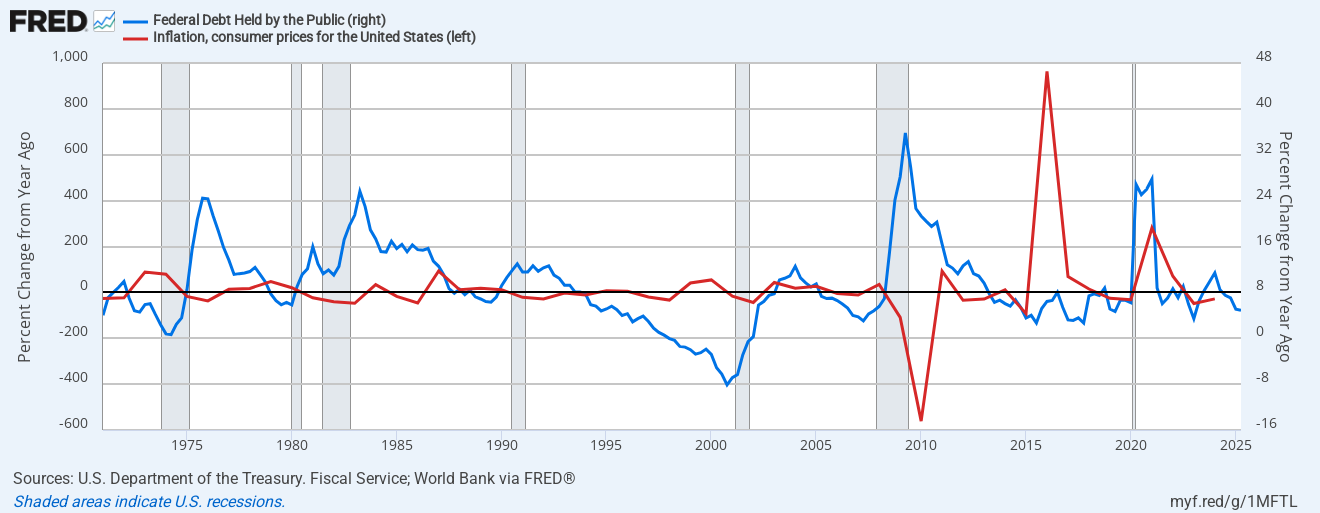
Reductions in federal deficits lead to recessions (vertical gray bars). Recessions are cured by increased federal deficits.
Federal deficits inject growth capital into the economy. While the federal government has unlimited currency, the economy needs a steady inflow of dollars for expansion.
Over the years, as federal deficits have increased, the Gross Domestic Product has also risen.
If federal deficits were economically harmful, one would not expect to see the graph above, which shows the economy’s growth paralleling the growth of deficits.
The reason is clear. GDP=Federal Spending + Nonfederal Spending + Net Exports.
III. Federal Deficit Spending Does Not Cause Inflation
Here are the reasons provided by the Trump administration for deporting illegal immigrants.
I. Undocumented immigrants smuggle drugs into America
How illegal drugs really enter America
First, we must acknowledge that deporting people who live here does little to prevent drug smuggling. To smuggle drugs, one must carry them across a border crossing, which someone already living here seldom would do.
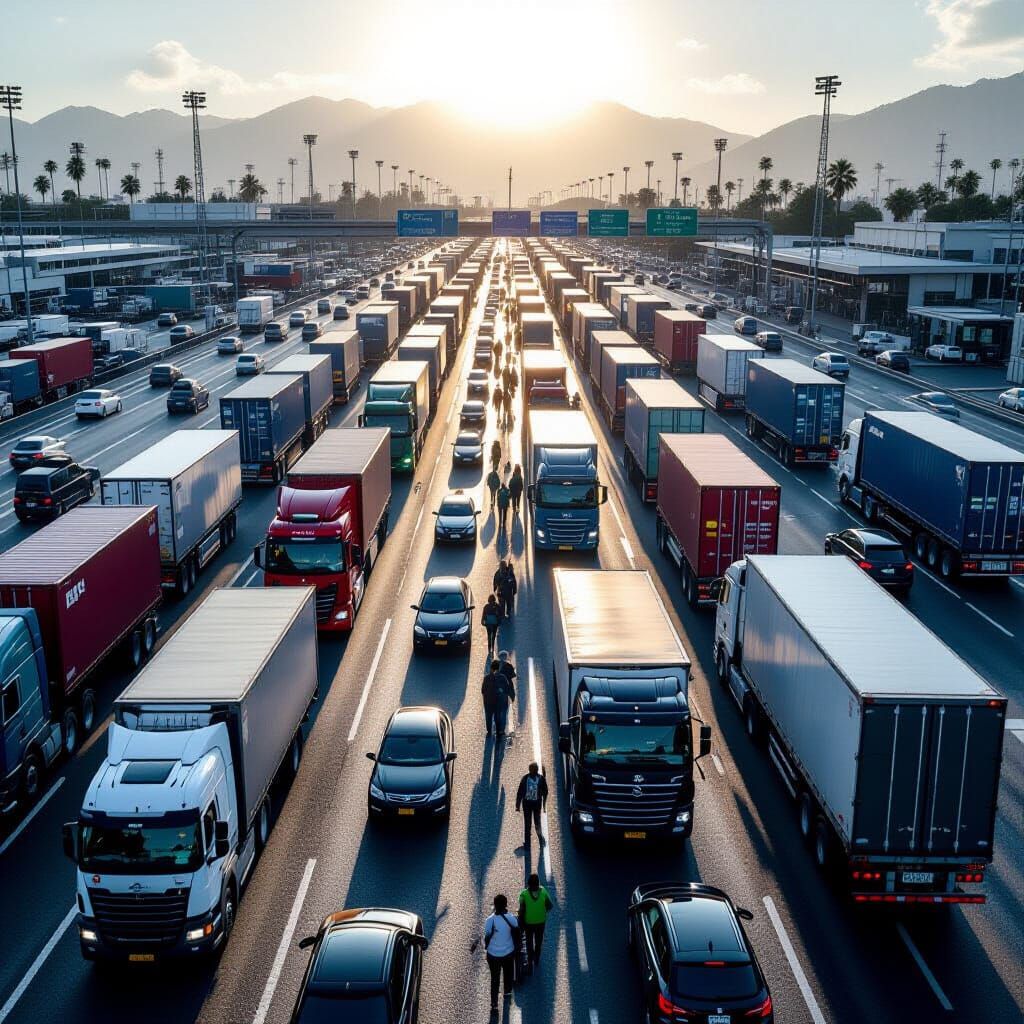
Federal data (DEA, CBP) show that the overwhelming majority of fentanyl, heroin, cocaine, and methamphetamine is smuggled through official ports of entry, hidden in cars, trucks, or commercial shipments — not carried across the desert by migrants on foot.CBP reports consistently show that more than 90% of fentanyl seizures occur at legal crossings.
A 2025 DEA report confirms that cartels utilize ports of entry in California and Arizona for large-scale smuggling operations.
DEA CBP records show that in the 2024 fiscal year alone, they seized over 19,600 pounds of fentanyl, a record amount—signaling the scale of interdiction efforts at legal entry points. The cartels rely on volume shipping through legal infrastructure, not backpacking with migrants.
Now, with illegal crossings nearly eliminated, virtually all drug smuggling is forced through legal ports and means.
II. Undocumented immigrants commit crimes
Studies from the Cato Institute, the National Academy of Sciences, and state-level crime data (e.g., Texas DPS reports) show undocumented immigrants have lower conviction and arrest rates than native-born Americans.
The reasons: the risk of deportation is high, so undocumented people generally avoid criminal entanglements.
A Reuters fact-check debunked claims that undocumented immigrants are responsible for thousands of killings annually. In reality, homicide rates among undocumented immigrants (around 1.9 per 100,000) are far lowerthan among U.S.-born individuals (around 4.8 per 100,000).
They do commit immigration-related offenses (being in the country unlawfully, using false papers), but violent crime and property crime rates are lower than U.S. citizens.
III. Undocumented immigrants don’t pay taxes.
False. They pay sales taxes, property taxes (either directly as owners or indirectly through rent), and payroll taxes.
The Social Security Administration estimates that undocumented workers contribute billions annually in Social Security and Medicare payroll taxes (via false or borrowed SSNs), benefits they can’t collect.
According to the Institute on Taxation and Economic Policy, in 2022, undocumented immigrants paid an estimated $96.7 billion in total taxes: $59.4 billion in federal taxes $37.3 billion in state and local taxes.
Specifically, they contributed: $25.7 billion in Social Security taxes $6.4 billion in Medicare taxes $1.8 billion in unemployment insurance taxes.
Furthermore, the Penn Wharton Budget Model reports that undocumented immigrants paid around $24 billion into Social Security in 2024—even though they can’t receive benefits.
Thus, on balance, immigrants contribute to the official Social Security fund.
IV. Undocumented immigrants use services like schools and hospitals, crowding out citizens.
It is true they use these services, but they also pay for them.
Schoolsare funded by state/local sales, income, and property taxes, which undocumented immigrants also must pay.
Hospitals: Though undocumented immigrants pay FICA taxes, they cannot use Medicare or Social Security benefits. They are more likely to live in poverty and tend to utilize emergency rooms for their healthcare needs. This does impose local costs, though immigrants use fewer health services per capita than citizens.
“Crowding out citizens” is a misleading term. The central problem arises when local governments do not utilize immigrants’ taxes to enhance local systems.
V. Undocumented workers depress wages and compete with citizens
Comprehensive wage-impact reviews, such as those by the Economic Policy Institute, show that immigration—including undocumented—has a minimal effect on native-born workers’ wages, even for those with low education levels.
Immigrants, particularly the undocumented, often work in physically demanding, manual occupations that do not overlap heavily with those held by native low-skilled workers, suggesting a complementary rather than competitive dynamic.
THE COSTSDeportation is massively expensive.
The Center for American Progress (CAP) estimates a cost of $315 billion for a one-time, comprehensive deportation effort, or $88 billion annually if implemented at a rate of 1 million deportations per year.
The Penn Wharton Budget Model calculates the average per-deportee cost to be between $70,000, encompassing arrests, detention/monitoring, legal processing, and transportation.
A major 2025 appropriations package allocated $75 billion over four years to ICE—this nearly triples its previous annual enforcement capabilities. Two-thirds of this funding ($45 billion) is slated for detention operations, with the remaining $30 billion for arrests, transport, and related enforcement.
In May 2025, the House passed a plan that adds over $150 billion over five years for immigration enforcement, with $59 billion earmarked specifically for detention and transportation, and $51 billion for border infrastructure.
ICE Air charters cost approximately $17,000/hour, with 5-hour flights translating to about $630 per deportee. Use of military aircraft like C-17s and C-130Es is far more expensive—some trips have been estimated at $852,000 for a single flight of up to 80 migrants.
A Guantanamo Bay detention of 40 migrants cost of $16 million, $400,000 per person, including transport, tents (at $3.1 million each), and security overhead.
The Joint Economic Committee estimates that deporting 8.3 million could shrink GDP by 7.4% by 2028, remove up to 1.5 million workers from the construction sector, and result in the loss of 44,000 native-born jobs for every 500,000 removals.
The costs of deporting 11 million people could total $1.1–$1.7 trillion in GDP loss, equivalent to a 4.2–6.8% decline in GDP.
The American Immigration Council found that undocumented immigrants contributed in 2022: $46.8 billion in federal taxes, $29.3 billion in state/local taxes, and had $256.8 billion in spending power, which would vanish if deported.
There appears to be sufficient funding for deportations, but insufficient funding for Social Security and Medicare. That, at least, is the claim of the current administration.
THE POLITICS
First, we need a scapegoat to instill fear in the people and draw them to our side.
The Trump administration has portrayed undocumented immigrants as a threat for political gain. This is an age-old tactic used by dictatorships: they label a group as dangerous to the nation and then position the dictator as the sole protector of the citizens.
Hitler did it with the Jews.
Stalin claimed kulaks (better-off peasants) as “enemies of the people” and traitors, justifying mass deportations, executions, and forced collectivization.
Mao Zedong claimed “counterrevolutionaries” and intellectuals were existential threats to the revolution, which enabled purges and “struggle sessions” during the Cultural Revolution.
Mussolini used fear of communists and anarchists to consolidate fascist control, presenting himself as the bulwark against chaos.
Milošević demonized Croats, Bosniaks, and Kosovars as existential threats to Serb survival, fueling ethnic cleansing in the 1990s.
Rwandan Hutu extremists claimed Tutsis were plotting genocide of Hutus, then carried out their own mass slaughter in “defense.”
WHAT IF WE PROVIDED A PATHWAY TO CITIZENSHIP
Instead of the time, effort, and costs (both financial and human—associated) of hunting down, convicting, jailing, and deporting undocumented immigrants, we could create a simpler and faster pathway to citizenship, similar to what our grandparents experienced.
A valuable asset to America.
What would that accomplish?
According to the Center for American Progress, legalization would raise GDP and economic output. It would increase productivity, consumer demand, and the quality of labor supply.
The Congressional Budget Office and multiple analyses find that legalization would increase federal receipts (including Social Security/Medicare receipts), reducing deficits relative to massive removals.
National Academies Press projects that aggregate effects on native wages would be small. The overall impact on U.S. native wages would be modest, with small downward pressure on the least-skilled native workers in some studies, but gains to the economy and to immigrants’ wages are larger.
A well-known modeling study conducted by the Center for American Progress in collaboration with UC-Davis and Giovanni Peri estimated that providing a pathway to citizenship for 10 million undocumented individuals could increase the U.S. GDP by up to $1.7 trillion over a decade.
This growth would be driven by factors such as improved labor productivity, greater attachment to the labor force, and increased consumer spending.
Studies from the Congressional Budget Office (CBO) and other analyses indicate that granting legal status to a significant number of undocumented immigrants leads to increased payroll and income tax revenues, as well as higher contributions to Social Security and Medicare.
This is primarily because having legal status tends to increase earnings, even when accounting for some growth in benefit expenditures.
NBER work and related papers suggest that legalization could significantly increase the private-sector GDP share.
A National Academies’ comprehensive review concluded that second-generation immigrants make strong economic contributions.
IN SUMMARY
Immigrants are often diligent individuals who make valuable contributions to the nation. They come here to create new lives and, in doing so, help build America.
Instead of inhumanely tracking them down, imprisoning, and deporting them, which destroys the lives of innocent, good people, America could harness their contributions for the benefit of all.






 #Monetary Sovereignty - Mitchell