How to be a climate and COVID denier by calling warnings, “panicked fearmongering.”

If you were in a burning building and people yelled at you, “Get out, the building is on fire,” I assume Bjorn Lomborg and Jordan B. Peterson would call that “panicked fearmongering.”

It is the only conclusion I can draw from the ridiculous Trumpian article published under their names.

Stop the panicked fearmongering if we want to make the world better By Bjorn Lomborg and Jordan B. Peterson August 4, 2023, 6:31pm Updated

The meaningful exchange of truly diverse ideas and perspectives has withered over recent decades.

Unorthodox thinking is increasingly trashed or disregarded, even as the chattering class’s fear- and force-predicated approaches repeatedly prove inadequate to cope with the true complexities and crises of the modern world.

We need instead to foster and promote critical thinking and constructive discussion.

Here is an example of the “unorthodox thinking, ” “critical thinking,” and “constructive discussion” the authors seem to promote: Unorthodox, yes. Critical, huh? Constructive, no. Thinking. Absolutely no.

We are making every effort to ensure that our new Alliance for Responsible Citizenship (ARC), an international coalition of politicians, business leaders, public intellectuals and cultural commentators, will help ensure that a broader range of perspectives can be heard globally.

It’s not the “range of perspectives” that is the problem. It’s the unscientific perspectives that killed hundreds of thousands of Americans.

Consider the world’s response to the pandemic.

A panic-stricken lockdown orthodoxy far too soon took hold, and those whose policy proposals deviated quickly were labeled “COVID deniers.”

Governments that went the farthest were feted by public intellectuals and in newspaper opinion pages.

Thus, we saw increases of inequality in income distribution and wealth, widespread loss of employment, substantive declines in spending and general deterioration in economic conditions; serious declines in mental health and wellbeing, delayed and diminished access to healthcare, and record high levels of domestic violence.

The problems mentioned in the previous paragraph were due to people sickening and dying from COVID, not to “panicked fearmongering.”

There seems to have been insufficient “fearmongering.”

Too many people, especially Republicans, agreed with Lomborg and Peterson and did not take “orthodox” vaccine, mask, and crowd avoidance information seriously.

Lomborg’s and Peterson’s “unorthodox,” “broader ranges of perspectives” killed thousands of Americans.

“Many experiments and facts have proven that masks are lifesavers for confined spaces with high population density and less ventilation.

The education of children was particularly affected: School closures, on average, robbed children of more than seven months of education.

The huge impact on kids’ knowledge could end up costing $17 trillion in lifetime earnings, per research by the World Bank, UNESCO, and UNICEF.

Poor children, girls, and children with disabilities suffered the largest losses.

Sadly, school classrooms are the “confined spaces with high population density and less ventilation that have proved to cost lives.

The question became, Would you risk your children’s lives for seven months of education?

We need to have a serious conversation about our manner of response before the next crisis (pandemic or otherwise) to ensure that the cure is not much worse than the disease.

Consider, too, the alarmist treatment of climate change.

Campaigners and news organizations play up fear in the form of floods, storms, and droughts while neglecting to mention that reductions in poverty and increases in resiliency mean that climate-related disasters kill ever fewer people: Over the past century, such deaths have dropped 97%.

Heatwaves capture the headlines. Globally, however, cold kills nine times more people.

The higher temperatures arguably characterizing this century have resulted in 166,000 fewer temperature-related deaths.

Fear-mongering and the suppression of truly inconvenient truths are pushing us dangerously toward the wrong solutions: Politicians and pundits call en masse for net-zero policies that will cost far beyond $100 trillion while producing benefits a fraction as large.

We need to be able to have an honest discussion of costs and benefits — a true reckoning with the facts to find the best solutions.

The “honest discussion” already has been, and is being, held, and the consensus is that global warming can be an extinction event for millions of species, including ours.

The disingenuous, highly misleading comment that more people die from cold than heat does not recognize what is happening to the world.

Consider just one effect, the melting of Antarctic ice: The chart shows that if all the ice in the Antarctic were to melt, sea levels would rise by 187 feet (57 meters).
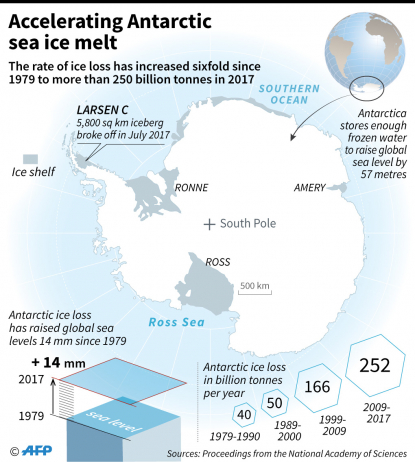
Do you live 187 feet above sea level?

Well, you may say not ALL the ice will melt. Maybe only 10% will melt, raising sea levels by “only” 18 feet.

Then again, we haven’t considered Arctic and Greenland ice.

Melting from the Arctic — and the Greenland ice sheet in particular — is the largest contributor to global sea level rise. 

“If you look at where humanity lives, a great proportion of humanity lives at the coastlines worldwide.
“The megacities are along coastlines: New York, Los Angeles, San Francisco.”

And that’s just sea-level rise. What about other problems?

The environmental conditions in the Arctic affect weather systems across the world.

The North and South poles act as the “freezers of the global system,” helping to circulate ocean waters around the planet in a way that helps to maintain the climates felt on land, Moon said.

“What happens in the Arctic doesn’t stay in the Arctic.”

The jet stream, a band of strong winds moving west to the east created by cold air meeting warmer air, helps regulate global weather.

In the continental U.S., the jet stream forms where generally colder and drier Arctic air meets warmer and more humid air from the Gulf.

But as temperatures in the Arctic warm, the jet stream, fueled by the temperature differences, weakens.

Rather than a steady stream of winds, the jet stream has become more “wavy,” allowing hot temperatures to extend usually far into the Arctic and frigid temperatures further south than usual.

The variability in the climate in the Arctic, specifically the weakening of the polar vortex, keeps cold air closer to the poles,

It likely led to the Texas freeze in February that led to millions without power and hundreds of deaths.

The study cited an “increasingly frequent number of episodes of extremely cold winter weather over the past four decades” in the U.S., despite temperatures rising overall.

As though sea level rise, species extinction, and more extreme weather aren’t bad enough, we also should look at disease:

Mosquitoes and other biting insects transmit many of the most important, devastating, and neglected human infectious diseases, including malaria, dengue fever, chikungunya, and West Nile virus.
Economic development and cooler temperatures have kept mosquito-borne diseases out of wealthier Northern Hemisphere countries, but climate change promises to tip the scales in the other direction.

As temperatures rise, malaria could be coming to your neighborhood.

And then there’s food:

Recent research suggests that adverse weather has canceled up to 30% of the expected increase in European crop growth.

But it is worrying that the most pronounced changes tend to be in countries, such as those in sub-Saharan Africa, including South Africa, that are at high risk of climate impacts on food availability and affordability.

This is particularly clear in the case of barley, maize, millet, pulses, rice, and wheat.

The countries most at risk of food shortages are also worst affected by rising temperatures.

This seems to bear out the finding from the world’s premier climate science advisers, the Intergovernmental Panel on Climate Change (IPCC), that the higher average global temperatures and more extreme weather events associated with climate change will reduce the reliability of food production.

No, Messrs. Lomborg and Peterson, the warnings about COVID and global warming should not be written off as simply “panicked fearmongering.”

When you disseminate false information from such right-wing sources as Fox News, Breitbart, QAnon, Donald Trump, and the GOP, you not only stain whatever reputations you may have, but you endanger lives.

If you prefer to follow the anti-science, right-wing, unorthodox voices,, you have my permission to inject yourself with ivermectin, bleach, and hydroxychloroquine, and by all means, avoid vaccination.

But please stop writing harmful nonsense.

Rodger Malcolm Mitchell Monetary Sovereignty

Twitter: @rodgermitchell Search #monetarysovereignty

Facebook: Rodger Malcolm Mitchell

……………………………………………………………………..

The Sole Purpose of Government Is to Improve and Protect the Lives of the People.

MONETARY SOVEREIGNTY
Why did Fitch downgrade U.S. “Debt”? It’s not what you may think.

The purpose of credit ratings is to assess the likelihood that an issuer of a debt document will adhere to the terms of the document. The U.S. debt documents consist of Treasury bills, bonds, and notes, including the Federal Reserve Notes you carry in your wallet, aka “money.” The value of U.S. debt/money is determined by the U.S. government’s full faith and credit, which includes:

A. –The government will accept only U.S. currency in payment of debts to the government B. –It unfailingly will pay all its dollar debts with U.S. dollars and will not default C. –It will force all your domestic creditors to accept U.S. dollars if you offer them to satisfy your debt. D. –It will not require domestic creditors to accept any other money E. –It will take action to protect the value of the dollar. F. –It will maintain a market for U.S. currency G. –It will continue to use U.S. currency and will not change to another currency. H. –All forms of U.S. currency will be reciprocal; that is, five $1 bills always will equal one $5 bill and vice versa.

The key to the downgrade is item “B,” the “not default” claim. The following article from Investor News attempts to explain why federal Treasuries were downgraded from AAA to AA+.

Credit Rating Alert: Why Did Fitch Downgrade U.S. Debt? Story by Josh Enomoto 

Primarily, the negative reassessment focuses on “the expected fiscal deterioration over the next three years,” a matter worsened by increasingly bitter political infighting.

The matter was not “worsened” by political infighting. The matter was entirely political infighting. As you will see, that was the sole reason for the downgrade.Editorial Cartoon: John Darkow (May 3, 2023) | Opinion | yakimaherald.com

Per the agency’s official statement, a “steady deterioration” in standards of governance during the past two decades imposes a dark cloud as policymakers struggle to navigate the extraordinarily difficult post-pandemic environment.

Specifically, “[t]he repeated debt-limit political standoffs and last-minute resolutions have eroded confidence in fiscal management.”

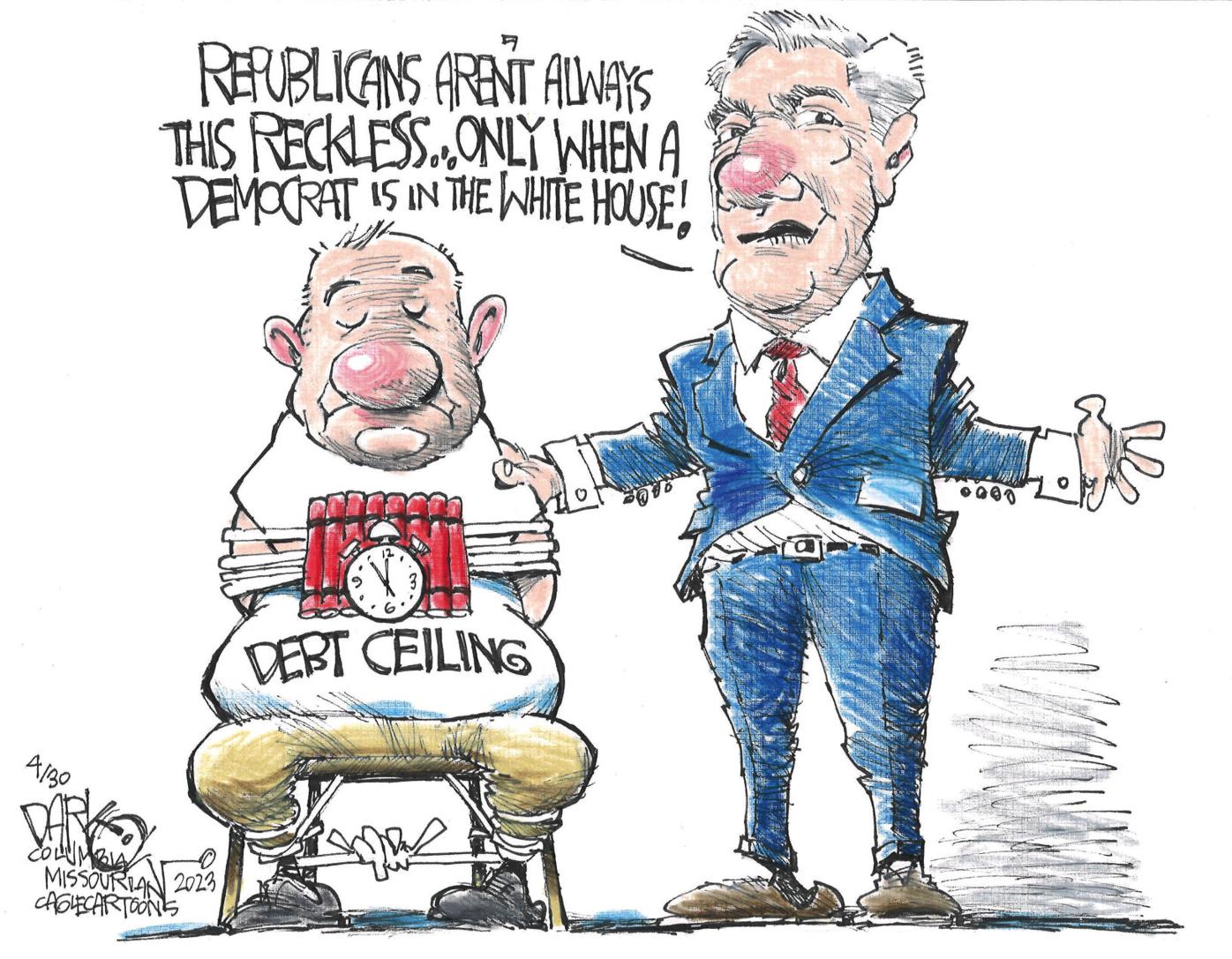
“Standards of governance” is the polite way to say that the GOP has become Trump-nuts, with such stellar brains as Matt Gaetz, Marjorie Taylor Greene, Lauren Boebert, Marsha Blackburn, et al leading the way. Really, would you lend to those people? The debt limit is 100% political. It is how the party not holding the Presidency exerts political power over the competing party. It has no other purpose.

As well, the combination of economic shocks and initiatives involving tax cuts and spending programs spiked the overall debt load.

Tax cuts and spending programs are irrelevant to the federal government’s ability to pay all its dollar debts. Even if the total “debt,” which stands at about $30 trillion, were instead only $1, that would have no effect on the federal government’s ability to pay. As the creator and issuer of the U.S. dollar (aka Monetarily Sovereign), the government has the infinite ability to create enough dollars to pay all its dollar-denominated debts. If, for instance, you sent a $50 trillion, or $100 trillion, invoice to the U.S. government today, it could pay that invoice today simply by passing laws and pressing computer keys.

Alan Greenspan: “A government cannot become insolvent with respect to obligations in its own currency.

Alan Greenspan: “There is nothing to prevent the federal government from creating as much money as it wants and paying it to somebody.”

Alan Greenspan: “The United States can pay any debt it has because we can always print the money to do that.”

Ben Bernanke: “The U.S. government has a technology, called a printing press (or, today, its electronic equivalent), that allows it to produce as many U.S. dollars as it wishes at essentially no cost.”

Quote from former Fed Chairman Ben Bernanke when he was on 60 Minutes: Scott Pelley: Is that tax money that the Fed is spending? Ben Bernanke: It’s not tax money… We simply use the computer to mark up the size of the account.

Statement from the St. Louis Fed: “As the sole manufacturer of dollars, whose debt is denominated in dollars, the U.S. government can never become insolvent, i.e., unable to pay its bills. In this sense, the government is not dependent on credit markets to remain operational.”

This infinite power is true not only of the U.S. federal government but also other Monetarily Sovereign entities. Consider the European Union, which is monetarily sovereign over the euro:

Question: I am wondering: can the ECB ever run out of money? Mario Draghi: Technically, no. We cannot run out of money.

No Monetarily Sovereign entity can run short of its sovereign currency unless it wishes to. Some elements of today’s Republican Party would like to see the U.S. economy fail, so they can claim, before elections, that the economic failure is the Democrat’s fault.

In addition, Fitch took into account the Federal Reserve’s efforts in combating historically high inflation into account regarding its latest credit rating decision.

“While headline inflation fell to 3% in June, core PCE inflation, the Fed’s key price index, remained stubbornly high at 4.1% yoy,” wrote the agency. As a result, this framework will likely preclude benchmark interest rate cuts until March of next year.

All inflations are caused by shortages of crucial goods and services, most often oil and food. So-called “core inflation” refers to this:

“Inflation is based on the consumer price index (CPI), covering the inflation of all the goods and services except the volatile food & fuel prices, excise duties, income tax, and other financial investments.

It guides the government in forecasting long-term inflation trends for a country.

Using “core inflation” as a forecasting tool is nonsensical because the primary causes of inflation are those “food & fuel prices, excise duties, income tax, and other financial investments.” It’s like predicting a baseball team’s wins while omitting runs-scored-and-allowed to get “core victories.”

In a possible reality check, the Fitch downgrade also incorporated recession risks. Based on the aforementioned tighter credit condition and a projected consumer spending slowdown, the U.S. economy may slip into a mild recession in the fourth quarter of 2023 and Q1 of 2024.

The predicted “mild recession and consumer spending slowdown have absolutely nothing to do with the federal government’s ability to service its Treasury paper. Zero. The only thing that affects debt service is the federal government’s willingness to service its debt.

As The Wall Street Journal pointed out, the Fitch downgrade represents the first by a major credit rating agency in more than a decade. In theory, the unfavorable reassessment clouds the outlook for the global market for Treasurys, which stands at $25 trillion.

Indeed, the WSJ states that “America’s reputation for reliably making good on its IOUs has cast Treasury bonds in an indispensable role in global markets: a safe-haven security offering nearly risk-free returns.”

The U.S. dollar is a safe-haven security only if the government wants it to be a safe-haven security. All those other factors — total debt, spending, inflation, taxes, etc. — are meaningless to that safe haven. There is but one question: Will the Republican party refuse, for political reasons, en masse, to authorize future payment. Period.

Treasury Secretary Janet Yellen blasted the Fitch downgrade as “arbitrary.” Yellen noted that the agency demonstrated deteriorating U.S. governance since 2018 but didn’t say anything until now. “The American economy is fundamentally strong,” she emphasized.

The downgrade was not arbitrary. The crazies have taken over the GOP, and Fitch merely is allowing for that craziness by, in effect, saying, “You have a political party that cares nothing about America’s credit rating, and instead, will do everything it can to destroy it. If I were Fitch, I too would have downgraded the U.S. credit rating, not because of any economic problems but solely because of the political situation, notably the craziness of the Trump-led GOP.

The New York Times op-ed writer and Nobel laureate Paul Krugman chimed in, calling the credit rating decision “bizarre.” Also, former Secretary of the Treasury Larry Summers, in an interview with Bloomberg, stated, “I can’t imagine any serious credit analyst is going to give this weight.”

Sorry, guys, it’s not bizarre. It’s legitimate and will continue to be legitimate so long as the Republicans are enslaved to their MAGA wing.

On paper, the credit rating falling appears rather ominous. However, Axios — while not dismissing the relevant concerns leading to the decision — stated that the Fitch downgrade is “largely symbolic.”

It’s symbolic but also a warning. If you invest in a T-bill, T-note, or T-bond, buy U.S. dollars, or sell something to the U.S., and will be paid in dollars — and if the crazies decide not to raise the so-called “debt ceiling” — you will lose money.

Also, it’s important to remember that credit rating agencies don’t always issue accurate prognostications. For instance, in October of last year, Fitch stated that it expected a mild recession to materialize in Q2 2023.

However, CNN recently reported that the economy picked up steam in Q2 “despite punishing rate hikes and still-high inflation.”

The wrong prediction of a mild recession may have been based on “core inflation,” which is irrelevant. If it was based on predicted shortages of oil and food, and those didn’t materialize, Fitch should have stated that. Bottom line: People are discouraged from buying the obligations of a crazy debtor. Wouldn’t you be? That unpredictable craziness, and not the size of the so-called “debt,” “core inflation,” or any other factor, are solely responsible for the value loss of the federal government’s full faith and credit. Eliminate the useless — no, harmful — debt limit, and/or get rid of the crazies, and the U.S. credit rating instantly will be AAA again. Rodger Malcolm Mitchell Monetary Sovereignty Twitter: @rodgermitchell Search #monetarysovereignty Facebook: Rodger Malcolm Mitchell

……………………………………………………………………..

The Sole Purpose of Government Is to Improve and Protect the Lives of the People.

MONETARY SOVEREIGNTY
A child’s picture book for those who tell you the federal debt is too high

Page 1.
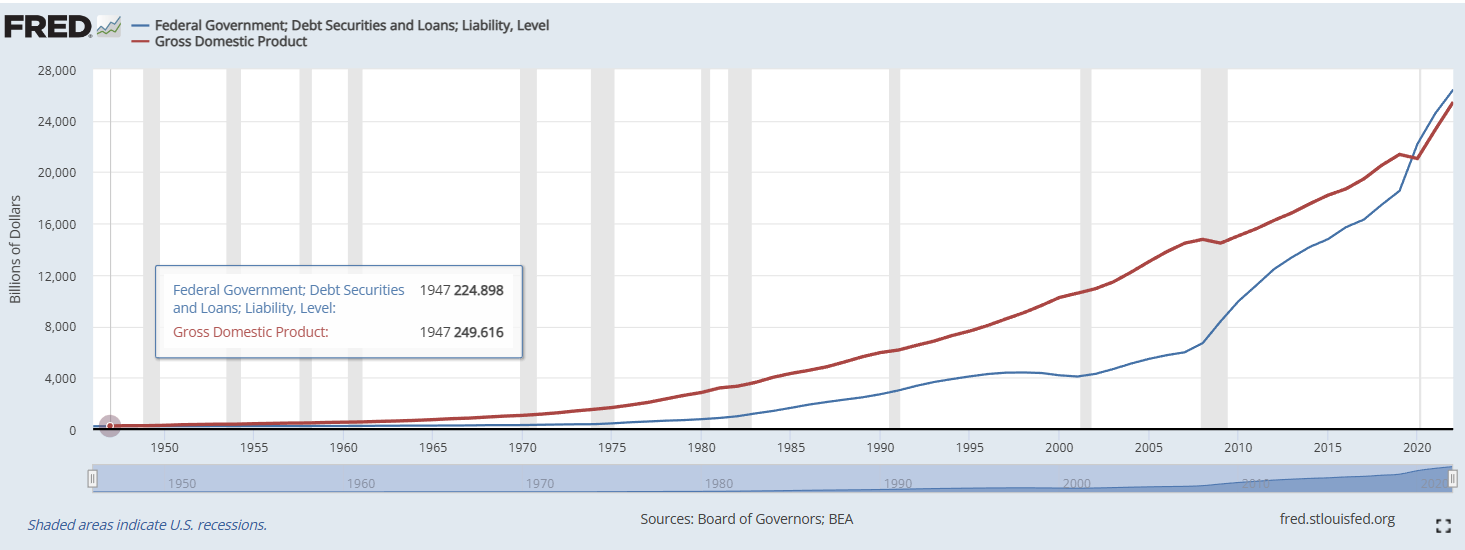
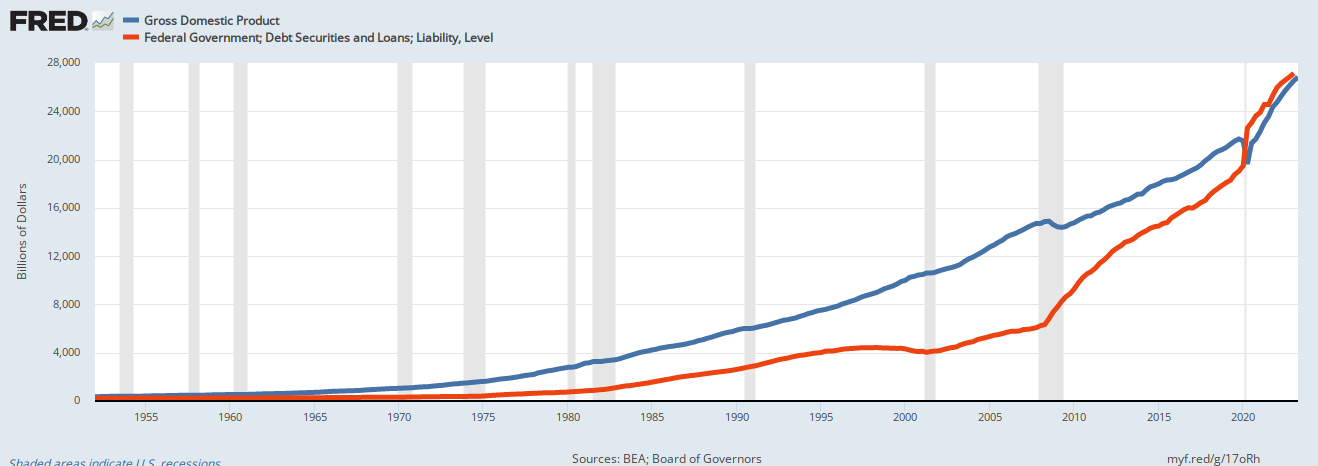
As federal debt (red) has risen, so has the economy (blue — GDP). Higher federal debt leads to higher GDP growth. The reason: GDP=Federal Spending +Non-federal Spending + Net Exports.
Page 2. The reason:
Economic growth and federal debt growth have been extraordinarily high since the end of the COVID recession. Despite efforts to reduce Federal Debt growth — efforts that, if successful, would reduce GDP growth — federal debt and GDP have continued to grow rapidly.
Page 3.
There is no relationship between federal debt and inflation. No data suggest that “too much” federal spending causes inflation.
Page 4.
A strong relationship exists between inflation (green) and oil prices (gray) as dictated by oil supply. Shortages cause price increases. Inflation is a general increase in prices. All inflations throughout history have been caused by shortages of crucial goods and services, usually energy and food.
Page 5.
Changes in federal debt (incorrectly called federal “borrowing”) do not reduce the availability of lending funds (yellow). There is no relationship between federal debt and the amount of lending.
Rodger Malcolm Mitchell Monetary Sovereignty Twitter: @rodgermitchell Search #monetarysovereignty Facebook: Rodger Malcolm Mitchell

……………………………………………………………………..

The Sole Purpose of Government Is to Improve and Protect the Lives of the People.

MONETARY SOVEREIGNTY

The Libertarians and the missing data


Here is a Libertarian article, as usual, complaining about the federal deficit. 

Why Did Joe Biden Stop Talking About the Deficit?

You can read the entire article by clicking the above link, but here are excerpts to give you the essence. Can you guess what crucial data is missing from the report?

The federal budget deficit has exploded under Biden’s watch, and he can no longer pretend otherwise. ERIC BOEHM | 7.19.2023

At times last summer, it seemed like the only thing President Joe Biden wanted to talk about was the federal budget deficit.

We’re on track to cut the federal deficit by another $1.5 trillion by the end of this fiscal year. The biggest decline ever in a single year, ever, in American history,” Biden claimed during a May 2022 press conference.

Later that same month, in a Wall Street Journal op-ed touting his economic program, Biden wrote that the deficit would fall by $1.7 trillion and repeated the “largest reduction in history”claim. That talking point was still getting heavy rotation in September when the president bragged on 60 Minutes about his deficit-cutting powers.

Of course, as Reason (and other outlets) clarified, the falling deficit was not the result of anything the president had done. There had been an unprecedented amount of federal spending in 2020 and 2021 due to the COVID-19 pandemic, and that spending drove the budget deficit to record highs: over $3.1 trillion in 2020 and more than $2.7 trillion in 2021.

As the pandemic passed and federal spending returned to more normal levels, so did the annual budget deficit. (In fact, the deficit would have fallen further last year if not for Biden’s policies, thanks to things like the infrastructure bill and last year’s federal budget.)

 The CBO projects that the deficit will ring in around $1.5 trillion when the current fiscal year wraps up on September 30.

Funny that Biden doesn’t want to talk about that.

It’s less funny that he’s also ignoring the trajectory of the federal deficit in future years. Rather than shrinking, the gap between federal revenue and federal spending is on course to widen dramatically in the coming decades.

Wow, the federal budget deficit must awful for the economy. Here is what Eric Boehm, the Libertarians, and the Congressional Budget Office claim:

That means the federal government will have to take on more debt. The rising cost of that debt will “slow economic growth, drive up interest payments to foreign holders of U.S. debt, elevate the risk of a fiscal crisis, increase the likelihood of other adverse effects that could occur more gradually, and make the nation’s fiscal position more vulnerable to an increase in interest rates,” the CBO warned last month.

That’s quite a claim. Have you figured out what’s missing?

Data. There is no data. Just assumptions.

Let’s examine those assumptions: Will federal deficit spending “slow economic growth”?

The term “economic growth” means Gross Domestic Product (GDP) growth. The formula for GDP is GDP = Federal Spending + Nonfederal Spending +Net Exports.

Look at that formula and explain to me the mechanism by which federal deficit spending will “slow economic growth.”

Unless you believe there is some magic way in which increased taxes can increase economic growth, there is no mechanism by which increased federal deficit spending can “slow economic growth.”

Federal deficit spending and GDP have risen since 1945

Will increased federal deficit spending “drive up interest payments to foreign holders of U.S. debt.” Yes, of course, it will. But is that supposed to be a problem?

Being uniquely Monetarily Sovereign, the federal government has infinite dollars. It pays all its dollar-denominated debts simply by pressing computer keys. No tax dollars are involved.

And despite the massive increase in deficits, the government never has and never will run short of dollars to pay interest.

Further, the federal government has absolute control over interest rates. The Fed sets rates arbitrarily to combat inflation, not to sell T-bonds.

The federal government has no need to sell any debt. It could stop offering T-securities tomorrow, and that would not affect the government’s ability to spend.

The sole purpose of T-securities is to provide a safe place to store unused dollars, which helps stabilize the dollar, not to provide spending money to the federal government/

(This is different from state/local government taxes, which do provide spending money to state/local governments.)

Will increased federal deficit spending “elevate the risk of a fiscal crisis”? What fiscal crisis? Unlike you and me. The government can’t run short of dollars. 

Liars love to use general language without data backup.

Will increased federal deficit spending “increase the likelihood of other adverse effects that could occur more gradually, and make the nation’s fiscal position more vulnerable to an increase in interest rates”?  What adverse effects?

The CBO Libertarians never say because there are none.

And what do they mean by the nation’s “fiscal position being vulnerable”? Again, they never say.

The warning is one big fat load of generalized poppycock, a vast word salad with zero meaning.

Why do they embarrass themselves by spewing such nonsense? Here’s one reason, probably the main reason:

Biden successfully blocked a House Republican attempt to impose stricter spending caps as part of that deal and refused to include entitlement spending—the real driver of long-term deficit growthin the negotiations.

Ah, yes. The “real driver” of deficit growth is entitlement spending, aka Social Security, Medicare, Medicaid, unemployment, and other “welfare” programs — all benefits to the middle- and lower-income groups.

Why do the Libertarians and the Republicans want to cut those programs? Why do they spread the nonsense that, somehow, the federal government can’t afford them, when the federal government can afford any payment denominated in U.S. dollars?

Statement from the St. Louis Fed: “As the sole manufacturer of dollars, whose debt is denominated in dollars, the U.S. government can never become insolvent, i.e., unable to pay its bills. In this sense, the government is not dependent on credit markets to remain operational.”

Get it? “Not dependent on credit markets. That’s Fed-speak meaning the government does not need to borrow, and in fact, does not borrow. It creates all the dollars it needs by pressing computer keys.

The reason has to do with Gap Psychology. The logic goes like this:

  1. “Rich” is a comparison, not an absolute. If you had $1,000, you would be rich if everyone else had $10, but you would be poor if everyone else had $10,000.
  2. To become more affluent, you must widen the Gap between you and those who have less while narrowing the Gap between you and those who have more.
  3. You can widen the Gap in two ways: Get more for yourself or make sure those below you have less.
  4. The rich, who run America, get richer by widening the Gap below them. This includes spreading the false tale that Social Security, Medicare, etc., must be cut. They spread the tale by bribing three influencers:
    • The media, bribed by advertising dollars and media ownership
    • The politicians, bribed by campaign contributions and promises of future employment
    • The economists, bribed by university contributions and lucrative jobs in “think tanks.”

Thus, the Big Lie (federal finances resemble personal and state/local government finances) is disseminated.

The public is led to believe their federal tax dollars fund federal spending. They don’t. The purpose of federal (as opposed to state/local) taxes is to control the economy by taxing what the federal government wishes to discourage and giving tax breaks to what the government wishes to help.

Additionally, federal taxes can help increase demand for the U.S. dollar by requiring taxes to be paid in dollars.

So, the entire article is based on lies. That is why it contains no historical data.

These general claims seem logical to the public because the claims apply to monetarily non-sovereign entities, not the Monetarily Sovereign U.S. government.

You never will see this graph presented by any Libertarian or Republican:

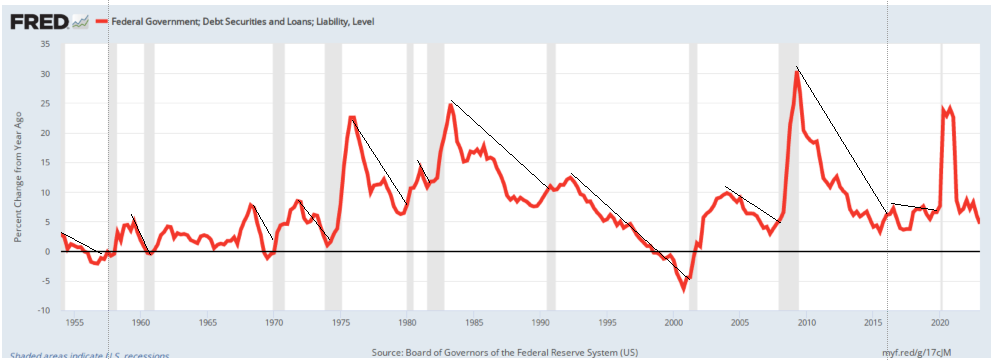
Before recessions (vertical gray bars), federal deficit growth declines, then increases to cure the recessions.

Note to politicians, media writers, and right-wing economists, you’ve done a great job lying to the public on behalf of the rich. You have helped make the rich richer. Congratulations.

One day, soon (I hope), the public will catch on to your lies.

At that time, the people will demand, vote for, and receive such benefits as Free Medicare, expanded Social Security, affordable food and housing, and free college education.

The rich already receive those benefits, courtesy of “friendly” tax laws.

The rest of the population soon will catch on to the fact that the federal government can supply all the benefits the rich receive, while collecting zero taxes.

The public just needs to see that they have been lied to.

Rodger Malcolm Mitchell
Monetary Sovereignty

Twitter: @rodgermitchell Search #monetarysovereignty
Facebook: Rodger Malcolm Mitchell

……………………………………………………………………..

The Sole Purpose of Government Is to Improve and Protect the Lives of the People.

MONETARY SOVEREIGNTY