The Federal Reserve fights inflation by raising interest rates. Here is an amalgam of what several sources say”
The Fed’s primary tool it can use to battle inflation is interest rates. It does so by setting the short-term borrowing rate for commercial banks, and then those banks pass it along to consumers and businesses.
That rate influences everything from interest on credit cards to mortgages and car loans, making borrowing more expensive.
Inflation is a general increase in prices. So, how does making borrowing more expensive affect inflation? Shouldn’t an increase in borrowing costs make products and services more expensive rather than less?
The answer is “Yes.” Interest is a cost that manufacturers, farmers, and services must add to prices, so they can make a profit.
The Fed aims to make borrowing more expensive so that consumers and businesses hold off on investing, thereby cooling off demand and bringing prices back in check.
How does reducing investments “cool off demand”?
Higher interest rates might reduce the demand for large consumer items, like houses and cars. But does reducing investments reduce your demand for food? Does it reduce your need for oil? For clothing?
Think of everything you buy? Which of those things will you buy less because interest rates went up? Probably, none.
The Fed believes that inflation is caused by (in their words) “an overheated economy.” But what is an overheated economy? Here is what the Bing Artificial Intelligence (AI) says:
An overheated economy is when the economy grows too fast. An overheated economy reaches the limits of how much output it can produce to meet the demand from consumers and businesses, as there are minimal unused resources.
In short, inflation is a supply problem. The Fed’s “overheated economy” is one where supply can’t meet demand.
The Fed’s inflation cure is to increase interest rates which reduces business investment and supply.
The Fed hopes that increasing interest rates will reduce demand more than supply, but what do we call reduced demand? Recession.
If the Fed’s approach is correct, we should see two things that we do not see:
We should see that rising interest rates do not cause recessions
We should see that falling interest rates do not cure recessions
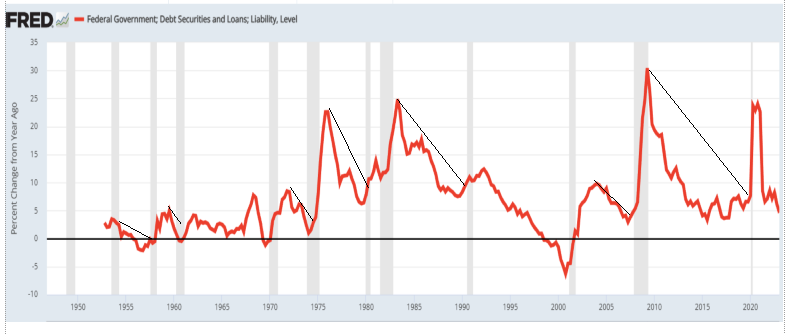
We should see that rising interest rates precede (i.e., cause precedes effect) falling inflation.
Look at the graph below, and you will see the opposite. In fact:
Rising interest rates lead to recessions (vertical gray bars).
As for #3, rising inflation precedes interest rate increases because the Fed reacts to inflation increases by raising rates.
Then afterinflation begins to come down, the Fed lowers rates.
While the Fed claims that rising interest rates cause inflation to fall, rising inflation leads to higher interest rates.
Imagine the car going faster causes the driver to press the gas pedal down further. Inflation causes the Fed to increase interest.
What isthe cause and cure for inflation if interest rate increases are recessionary and don’t cure inflation?
The cause and cure for inflation lie in the supply of oil.
The supply of oil is reflected in its price (black line). The shortages of oil parallel inflation (red line).
As opposed to common knowledge, the Fed’s interest rate increases do nothing to reduce inflation, which parallels oil prices and is determined by oil supply.
To the degree interest rate increases may reduce the oil demand, they cause recessions.
Until renewables become a more significant part of our energy supply, a reduced need for oil will signal recession.
Congress and the President have assigned the Fed the task of controlling inflation. But though the Fed doesn’t have the tools to manage inflation, Congress and the President do.
Short term, there should be federal incentives for drilling and refining oil. Longer term, the efforts to reduce oil usage via renewables should be accelerated with federal subsidies and tax credits.
More significant incentives for electric car purchases and usage, incentives for solar, wind, geothermal, and nuclear power production would do far more to reduce inflation, without a recession, than interest rate increases.
Congress and the President don’t want the inflation responsibility. The Fed does want the responsibility because it gives them greater power.
Currently, the Fed is like the child sitting in the back seat, furiously spinning his toy steering wheel. He thinks he steers the car, just as the Fed believes it steers the economy, when Congress, the President, and the world’s oil producers steer it.
The Fed’s money tinkering is but a blip on the screen.
Curing shortages, particularly oil shortages, but also renewable energy, food, computer chips, transportation, vital chemicals, and other shortages are needed to control inflation.
Who are the people most likely to believe conspiracy theories? Scientific American Magazine published an article on this subject.
The article is far too long, even for a summary to do it justice, but I’ll quote a few tidbits later in this post.
First, the question, what is a conspiracy theory? Gathering several definitions from the Internet, I submit this: A conspiracy theory is a heretofore secret explanation for a claimedevent or situation when other explanations are more probable or unknown.
Four factors are common to conspiracy theories:
There is an event or situation which may or may not be real or known.
If the event is real, it may be explainable by probable causes, which the conspiracy theory rejects.
The explanation uncovers a secret known only to a special group.
The believers in conspiracy theories wish not only to know the explanation but wish the explanation to be a pejorative about some person or group.
The most pervasive, long-lasting, and influential of all conspiracy theories are called “religions.”Less stable, though no less powerful, while in existence, are “cults.”
The attraction of a conspiracy theory, i.e., a religion or cult, lies in believers being part of an “in” group that knows the “truth” as presented by the theory.
Consider Judaism, which explains the universe’s existence as coming from the miraculous hand of one God rather than from universal evolution.
Christianity further explains this by adding Christ and more detailed sub-explanations and miracles. As far as I know, other religions tend to explain the universe in related manners.
A cult is a miniature version of a religion, generally having a living leader assume the role of a god.
A conservative is a person who adheres to traditional methods or views. A piousperson is most devoutly religious, that is, adheres most powerfully to the traditional practices or views of the religion (or cult).
Thus, those identified with conservatism are most predisposed to believe conspiracy theories and to profess extreme religiousness and patriotism.
The extremes of those beliefs often include, or perhaps rely on, exclusion, the notion that those who are not part of our club are inferior. The people who are the most pious, most conservative, and most involved in their exclusive group tend most to believe conspiracy theories about those who are not part of the group.
And that is the definition of bigotry.The members of the Ku Klux Klanwould go to church Sunday morning, hang a black man Sunday afternoon, and feel no remorse.
They are the people who believed they were patriots when they attacked Congress on January 6, and they still believe Donald Trump’s lies. His power comes as a hate monger who speaks to their fears and hatreds of those who aren’t in “the club.”
A few excerpts:
Stephan Lewandowsky was deep in denial. Nearly 10 years ago the cognitive scientist threw himself into a study of why some people refuse to accept the overwhelming evidence that the planet is warming, and humans are responsible.
As he delved into this climate change denialism, Lewandowsky discovered that many of the naysayers also believed in outlandish plots, such as the idea that the Apollo moon landing was a hoax created by the American government.
Lewandowsky’s findings brought these conspiracy theorists out of the woodwork. Offended by his claims, they criticized his integrity online and demanded that he be fired.
Lewandowsky discovered that his critics—in response to his assertions about their conspiratorial tendencies—were actually spreading new conspiracy theories about him.
These people accused him and his colleagues of faking survey responses and of conducting the research without ethical approval. When his personal website crashed, one blogger accused him of intentionally blocking critics from seeing it. None of it was true.
The ranting even included a death threat, and calls and e-mails to his university became so vicious that the administrative staff who fielded them asked their managers for help.
The dangerous consequences of the conspiratorial perspective—the idea that people or groups are colluding in hidden ways to produce a particular outcome—have become painfully clear.
The belief that the coronavirus pandemic is an elaborate hoaxdesigned to prevent the reelection of Donald Trump has incited some Americans to forgo important public health recommendations, costing lives.
The gunman who shot and killed 11 people and injured six others in a Pittsburgh synagogue in October 2018 justified his attack by claiming that Jewish people were stealthily supporting illegal immigrants.
A conspiracy theory positing that high-ranking Democratic Party officials were part of a child sex ring involving several Washington, D.C.–area restaurants incited one believer to fire an assault weapon inside a pizzeria.
When bombs were sent to prominent Democrats and Trump critics, as well as CNN, in October 2018, a number of high-profile conservatives quickly suggested that the explosives were really a “false flag,” a fake attack orchestrated by Democrats to mobilize their supporters during the U.S. midterm elections.
Donald Trump has suggested, among other things, that the father of Senator Ted Cruz of Texas helped to assassinate President John F. Kennedy and that Democrats funded the same migrant caravan traveling from Honduras to the U.S. that worried the Pittsburgh synagogue shooter.
Feelings of anxiety make people think more conspiratorially. Such feelings, along with a sense of disenfranchisement, currently grip many Americans.
A conspiracy theory can provide comfort by identifying a convenient scapegoat and thereby making the world seem more straightforward and controllable.
“People can assume that if these bad guys weren’t there, then everything would be fine, whereas if you don’t believe in a conspiracy theory, then you just have to say terrible things happen randomly.”
Conspiracy theorists believe plots are behind many situations. Some hold that the Apollo moon landing was fakedothers that the White House forced Supreme Court Justice Anthony Kennedy to retire.
Others claim that Trump slogans on a mail bomber’s van were put there to frame Republicans.
A national survey suggesting that 39 percent of Americans felt more anxious than they did a year ago, primarily about health, safety, finances, politics and relationships.
A 2017 report found that 63 percent of Americans were extremely worried about the future of the nation and that 59 percent considered that time the lowest point in U.S. history that they could remember.
Feeling alienated or unwanted seems to make conspiratorial thinking more attractive.
In 2017 Princeton University psychologists set up an experiment with trios of people. The researchers asked all participants to write two paragraphs describing themselves and then told them that their descriptions would be shared with the other two in their group, who would use that information to decide if they would work with the person in the future.
The “rejected” participants, feeling alienated, were more likely than the others to think the scenarios involved a coordinated conspiracy.
People who dislike the political party in power think more conspiratorially than those who support the controlling party.
Conspiratorial thinking can incite individuals to behave in a way that makes them feel even worse. People who are presented with conspiracy theories about climate change—scientists are just chasing grant money, for instance—are less likely to vote.
People who believe vaccine conspiracy theories, for example, say they are less inclined to vaccinate their kids, which creates pockets of infectious disease that put entire communities at risk.
Individuals who want to improve their analytic thinking skills should ask three key questions when interpreting conspiracy claims.
One: What is your evidence? Two: What is your source for that evidence? Three: What is the reasoning that links your evidence back to the claim?
False conspiracy theories have several hallmarks. First, the theories include contradictions. For example, some deniers of climate change argue that there is no scientific consensus on the issue while framing themselves as heroes pushing back against established consensus.
Both cannot be true.
A second telltale sign is when a contention is based on shaky assumptions. Trump, for instance, claimed that millions of illegal immigrants cast ballots in the 2016 presidential election and were the reason he lost the popular vote. Beyond the complete lack of evidence for such voting, his assumption was that multitudes of such votes—if they existed—would have been for his Democratic opponent.
Yet past polls of unauthorized Hispanic immigrants suggest that many of them would have voted for a Republican candidateover a Democratic one.
A third sign that a claim is a far-fetched theory, rather than an actual conspiracy, is that those who support it interpret evidence against their theory as evidence for it.
When the van of the convicted mail bomber Cesar Sayoc was found in Florida plastered with Trump stickers, for instance, some individuals said this helped to prove that Democrats were really behind the bombs.
Conspiracy theories are a human reaction to confusing times. If we look out for suspicious signatures and ask thoughtful questions about the stories we encounter, it is still possible to separate truth from lies.
It may not always be an easy task, but it is a crucial one for all of us.
The author of the following article, Veronique de Rugy, may need help understanding federal government finance, for she has written several articles in the same misleading vein.
The question: Is it ignorance or is it an agenda? Perhaps she needs to be more knowledgeable about federal finance. No problem. Most laypeople, and even many economists, suffer from that form of ignorance.
I suspect, however, that Ms. de Rugy is feigning ignorance and has an agenda, a pro-rich, pro-right, anti-poor agenda. You decide. Here are excerpts from her article:
Fitch Ratings just downgraded the U.S. government’s credit rating due in part to Congress’ erosion in governance.
Indeed, year after year, we see the same political theater unfold: last-minute deals, deficits, and, all too often, the passage of gigantic omnibus spending bills without proper scrutiny, repeated debt ceiling fights and threats of shutdown.
The blue line represents a standard measure of the economy, Gross Domestic Product (GDP). The red line represents what too often (and misleadingly) is termed “federal debt,” the “red ink” to which Ms. de Rugy refers.
We say “mistakenly termed debt” because it is unlike private debt. Federal “debt” is the total of deposits into privately owned, T-security accounts.
When you invest in a T-bill, T-note, or T-bond, you deposit your dollars into your T-security account at the U.S. Treasury.
This account is similar to your safe deposit box, where you deposit valuables. The bank does not touch the box’s contents, and they are not considered bank “debt,” though the bank owes you those contents in one minor sense.
Similarly, the federal government never touches the dollars held in your T-security account. Although some mistakenly refer to the dollars as borrowing, the federal government never borrows dollars.
Why would it? Given the federal government’s infinite power to create dollars at the touch of a computer key, borrowing dollars would be a ridiculous exercise:
Alan Greenspan: “A government cannot become insolvent with respect to obligations in its own currency.”
Alan Greenspan: “There is nothing to prevent the federal government from creating as much money as it wants and paying it to somebody.”
Alan Greenspan: “The United States can pay any debt it has because we can always print the money to do that.”
Ben Bernanke: “The U.S. government has a technology, called a printing press (or, today, its electronic equivalent), that allows it to produce as many U.S. dollars as it wishes at essentially no cost.”
Quote from former Fed Chairman Ben Bernanke when he was on 60 Minutes: Scott Pelley: Is that tax money that the Fed is spending? Ben Bernanke: It’s not tax money… We simply use the computer to mark up the size of the account.
Statement from the St. Louis Fed: “As the sole manufacturer of dollars, whose debt is denominated in dollars, the U.S. government can never become insolvent, i.e., unable to pay its bills. In this sense, the government is not dependent on credit markets to remain operational.”
“Not dependent on credit markets” is Fed-speak meaning, “We don’t borrow.”
So what is the purpose of T-securities, the total of which erroneously is called “debt”? T-security accounts”
They allow holders of unused dollars to store them in a safe, interest-paying account, which stabilizes the dollar
They help the Fed control interest rates.
That’s it. The purpose is not to provide the federal government with spending dollars. The government creates all it needs. All federal spending is done with newly created dollars. No spending uses the dollars in T-security accounts.
For this reason, the size of the misnamed “debt” is irrelevant. Whether total deposits equal $100 or $100 TRILLION, the government has the same real ability to return them to depositors.
That is why the debt ceiling is so outrageously foolish. Why limit the amount of deposits that will be accepted if the dollars neither are used nor scarce to the government?
The confusion comes with the word “debt.” Federal “debt” differs from personal debt as an ink pen is a pig pen. Different meanings for the identically spelled and pronounced word “pen.”
If someone thought they could write with a pig pen, that would be equivalent to someone thinking the federal government was burdened by its federal debt.
Since 1940, there never has been a time when the government has not had Ms. de Rugy’s “red ink.” The lines essentially parallel, which should be no surprise to anyone because the formula for GDP is:
GDP = Federal Spending + Nonfederal Spending + Net Exports.
Federal Spending adds dollars to the economy, as do Net Exports, and those added dollars stimulate Nonfederal Spending. The three terms work in concert to create economic growth.
Sadly, “debt” confuses some economists, who wrongly equate it with private sector or state/local government debt.
But while the private sector and state/local governments are monetarily non-sovereign (i.e. they do not have the infinite ability to create U.S. dollars), the federal government is Monetarily Sovereign (it does have that limitless ability).
The difference is that the private sector and state/local governments unintentionally can run short of dollars, the federal government cannot unintentionally run short. That is a huge difference.
Imagine you had the federal government’s ability to create dollars at will. Why would you ever worry about debt? You wouldn’t.
A billion dollars in debt. No problem. A trillion? Still fine. A trillion trillion. Again, no problem.
So why is Ms. de Rugy worried about the “debt” if it’s no problem for the federal government? Does she understand that the federal government pays all its debts by creating dollars? Here is what she wrote:
Fitch Ratings just downgraded the U.S. government’s credit rating due in part to Congress’ erosion in governance.
Indeed, year after year, we see the same political theaterunfold: last-minute deals, deficits, and, all too often, the passage of gigantic omnibus spending bills without proper scrutiny, repeated debt ceiling fights and threats of shutdown.
In the above two paragraphs, Ms. de Rugy properly explains the reason for the rating downgrade: Political theater, debt ceiling fights and threats of shutdown.
It isn’t that the federal “debt” is too high. The reason for the downgrade is the political theater, the debt ceiling fights, and the shutdown threats. The federal government politically has become an unreliable payer.
It always can pay, but it might not choose to pay.
But, having expressed the truth, Ms. de Rugy goes off the rails.
But these are just symptoms of a budget-making process that desperately needs reform. In a world where politicians are rarely told no when it comes to creating or expanding programs, most simply refuse to have their hands tied or behave as responsible stewards of your dollars.
The lack of oversight and the general absence of a long-term vision is creating inefficiency, waste, and red ink as far as the eye can see. Without fundamental reform, no one can stop it. So, let’s have some real reform.
Inefficiency, waste, and red ink have nothing to do with the federal government’s ability to pay. I suspect Ms. de Rugy knows this because here comes what I believe to be her agenda.
We need a comprehensive budget process under which programs like Social Security, Medicare, and Medicaid can no longer grow without meaningful oversight.
Combined with other mandatory, more-or-less automatic spending items, they comprise over 70 percent of the budget.
Thus, they must be included in the regular budget process and subjected to periodic review.
Only then will our elected representatives be forced to stop ignoring the side of the budget that requires their attention the most.
Her solution to the federal credit rating cut is to cut Social Security, Medicare, and other spending items (like Medicaid and anti-poverty initiatives).
In this, she has become a shill for the Republican Party, which is a shill for the rich people of America.
The GOP has tried to eliminate the popular ACA (aka Obamacare) for many years, but it’s a program that helps the less affluent, a significant voting bloc.
This is the party that gave massive tax cuts to the rich, falsely complains about the Social Security and Medicare “trust funds”supposedly running short of dollars, and consistently votes against anything that would help the poor (whom they deem “lazy takers.”)
Federal “trust funds” differ from private trust funds as federal debt differs from personal debt.
A federal trust fund is an accounting mechanism the federal government uses to track earmarked receipts (money designated for a specific purpose or program) and corresponding expenditures.
The largest and best-known funds finance Social Security, Medicare, highways and mass transit, and pensions for government employees.
Federal trust funds bear little resemblance to their private-sector counterparts.
In private-sector trust funds, receipts are deposited and assets are held and invested by trustees on behalf of the stated beneficiaries.
In federal trust funds, the federal government does not set aside the receipts or invest them in private assets.
Again, the public and many economists are confused about the words “trust fund.” A federal trust fund is not a real trust fund and cannot run short of dollars unless Congress and the President want it to.
So all the bleating about the Social Security and Medicare trust funds running short of money is nonsense. Congress and the President could add $100 trillion to those trust funds or eliminate them completely at the touch of a computer key.
Medicare and Social Security could be funded directly like the military, Congress, SCOTUS, and the White House, none of which are burdened with fake trust funds.
This would also help deal with the fact that entitlement spending is, as every serious observer knows, unsustainable. Unless reformed, these programs will drain wealth from the government and the economy.
Ensuring their sustainability must be part of any serious budget process reform.
The above statements to too wrong to be accidental. They are outright lies. The government has proved it has the infinite ability to pay for things. It has been sustaining federal deficit spending since 1940, and the economy has continues to grow.
And federal spending, which adds dollars to the economy, certainly does not “drain wealth” from the economy, nor does it drain wealth from a government with infinite dollars.
Since 1940, people like Ms. de Rugy have complained that the federal “debt” is an unsustainable, ticking time bomb. Year after year, the same complaint and the lies are proven wrong year after year.
But the de Rugys of the world never stop.
Enter a “Base Closure and Realignment Commission (BRAC)”-style fiscal commission, an idea promoted by the Cato Institute’s Romina Boccia.
This commission would be “tasked with a clear and attainable objective, such as stabilizing the growth in the debt at no more than the GDP of the country, and empowered with fast-track authority, such that its recommendations become self-executing upon presidential approval, without Congress having to affirmatively vote on their enactment,” Boccia explains.
Go to the Cato Institute’s website and you’ll be greeted with more misinformation like the above.
Besides the fact that the economy has grown faster than the “debt” (see the graph above), what is the purpose of this objective?
The federal government cannot run short of dollars. And think of the reality: CATO and de Rugy want a group of unelected political bureaucrats to determine how much Social Security and Medicare should be cut.
It’s unimaginably ignorant.
And think of the result. By formula, cutting federal spending cuts GDP,so we would enter an endless spiral of spending cuts, GDP cuts, spending cuts, GDP cuts ad infinitum.
The euro nations, Greece, Italy, and France tried this. It’s called “austerity,” a process that dooms a nation to recessions, to borrow Ms. de Rugy’s phrase, as far as the eye can see.
Cutting federal spending cuts GDP, and cuts to GDP are, by definition, a recession. Why do the rich-loving Republicans want recessions?
Because recessions actually make the rich richer. Here is how that works.
“Rich” is a comparative.A person with $100 is rich if everyone else has $1, but that person is poor if everyone else has $1,000—the Gap between the richer and the poorer measures how wealthy a person is.
Recessions widen the Gap between the rich and the rest. During recessions, desperate people will accept menial, low-paying, demanding jobs, while wealthy business owners continue to profit by paying low salaries.
Here is what happens to an economy when the federal “debt” doesn’t increase substantially:
“Debt” doesn’t need to fall for us to have a recession; even when debt GROWTH falls, we have recessions (vertical gray bars).
Not just reduced debt but reduced deficits cause recessions. Imagine what would happen to the economy if de Rugy’s bureaucrats started making cuts. The idea is so screwball that even de Rugy is unsure about it:
I’m uneasy about delegating the president’s power to appoint “experts.” But, Congress would retain some veto power.
If they disapprove of the proposal, the House and Senate can reject it through a joint resolution within a specified period. Whether it’s the best solution to address our fiscal problems remains to be seen, but it’s worth considering.
No, Ms. de Rugy, it’s not “worth considering” any more than economic suicide is worth considering.
There are many more budget reform ideas out there. I’ll leave you with one more. For years, Congress has failed to pass a budget, bringing the country to the brink of a government shutdown by fighting over the need for a continuing resolution.
This temporary measure extends previous funding levels for a few months.
Making continuing appropriations automatic in case of a lapse could remove the threat of shutdowns.
As explained in one senator’s proposal, if appropriations work isn’t done, “implement an automatic continuing resolution (CR), on rolling 14-day periods, based on the most current spending levels enacted in the previous fiscal year.”
Further, to avoid over-relying on CRs, “all Members of Congress must stay in Washington, D.C., and work until the spending bills are completed.”
The problem is the nutty debt limit law.Just eliminate that law and Congress could not easily bring the economy to its knees.
It’s time to completely rethink how we approach the federal budget, grounding our efforts in transparency, accountability, and fiscal responsibility.
Yes, it is time to rethink how we approach the federal budget. First, learn Monetary Sovereignty. By learning how federal financing works, we could help our poor, retired, sick, homeless, and hungry.
Economics is a remarkable science. In most sciences, exceptions to a hypothesis invalidate the hypothesis. For example, If a mineralogist said, “All diamonds are hard,” finding a soft diamond would invalidate the claim.
Not so with economics.
Rent controls have often been promoted and adopted to aid affordability, have failed in this mission. Yet, here they are again being proposed.
While it’s good news that some more economists have started incorporating “real world dynamics,” we’ll have to see what “Bidenomics” models say. That’s not looking promising. (By Jake Johnson, a staff writer for Common Dreams.)
More than 30 U.S. economists have signed a letter expressing support for strong federal tenant protections and rent control as housing costs remain sky-high, even amid broadly cooling inflation.
The profound economic and social consequences of government intervention in the nation’s housing markets have been documented in study after study over the past twenty-five years.
Due to this hard-earned experience, states and local jurisdictions from Massachusetts to California have banned or greatly constrained rent control.
Nevertheless, a number of communities around the country continue to impose rent controls, usually with the stated goal of preserving affordable housing for low- and middle-income families.
Rent control does not advance this important goal.
On the contrary, rent control has reduced both the quality and quantity of available housing in many communities.
Rent control falls under the broad category of “government price controls.”
Most prices for most things are market controlled. In a capitalist economy, a seller or owner charges an amount that will maximize his/her profits.
This takes into consideration the number of customers each price level will attract. For example, an apartment renting for $1o million a month will entice few, if any, renters, while the same apartment renting for $1 thousand a month might attract thousands of renters.
Many factors are involved, among which are: Number and size of rooms, number of full or partial bathrooms, location, condition, views, furnishings, and other lease terms.
By their very purpose, government price controls create prices that not only don’t consider these elements realistically but largely ignore the owners’ need for profits.
Since the whole purpose is to cut rents below market rates, which squeezes landlord’s profits, the landlord can’t set prices according to the number and size of rooms, bathrooms, condition, etc., so to remain profitable, he must set those criteria to the price — exactly backward of everyday capitalism.
While he can’t change the location, he often can subdivide the rooms’ sizes and bathrooms and primarily cut back on condition. Rather than improving or even maintaining condition to obtain higher rents, he now must allow condition to deteriorate to allow for lower rents.
Government rent controls comprise the Communist approach to housing with predictable results. The slumification of available housing, in which poorer condition and lower prices attract poorer and poorer residents, willing to accept degraded condition in exchange for too-low prices.
The economists note in their letter, released Thursday, that the median rent in the U.S. “has surpassed $2,000 for the first time, and there is not a single state where a worker earning a full-time minimum wage salary can afford a modest two-bedroom apartment.”
“We have seen corporate landlords—who own a larger share of the rental market than ever before—use inflation as an excuse to hike rents and reap excess profits beyond what should be considered fair and reasonable,” the letter continues. “Renters are struggling as a result.”
This is the classic economists’ “cart-pulling-the-horse” scenario.
Problem: Apartments are unaffordable for lower-income people. Solution: Cut the rental cost of apartments.
That this never has worked and cannot work does not deter the economists who seemingly view Socialistic control as a reasonable strategy for aiding the poor.
A more reasonable, Capitalistic solution would be:
Problem: Apartments are unaffordable for many lower-income people. Solution: Increase their net income.
This can be accomplished by reducing the amount of money people must give to the government while increasing the amount of money people receive from the government.
The federal government is Monetarily Sovereign. It cannot run short of dollars. Even if all federal tax collections dropped to $0, the federal government could continue spending, or even triple its spending, forever.
So rather than taking dollars from landlords, who are monetarily NON-sovereign, the same dollars should be taken from the government.
Rather than cutting rents by XX dollars, increase renters’ net income by those same XX dollars. The net affordability result would be the same, but landlords would not be forced to skimp on the things that make apartments more attractive.
Here are some ways in which net income can be increased:
Eliminate the FICA tax. It comes out of workers’ pockets.
Provide comprehensive, no-deductible health care insurance to every man, woman, and child in America.
Provide Social Security to every man, woman, and child in America.
Provide tax deductions to renters similar to the mortgage tax benefits homeowners receive.
All of these would allow low gross-income renters to afford heretofore unaffordable apartments while allowing the market, not the government, to determine rents.
And none of them requires the socialistic government control that rent controls demand.
Although nothing that economists do surprises me, I am astounded to see the name James K. Galbraith in the misguided list.
He fully understands the power of Monetary Sovereignty to solve the rent problem. I plan to contact him to get his responses; if he responds, I’ll print them.
The letter’s signatories—including Mark Paul of Rutgers University, James K. Galbraith of the University of Texas at Austin, and Isabella Weber of the University of Massachusetts Amherst—call on the Federal Housing Finance Agency (FHFA) to require rent regulations as a condition for federally-backed mortgages and reject the “economics 101 model that predicts rent regulations will have negative effects on the housing sector,” likening it to typical arguments against raising the minimum wage.
Yes, the arguments against raising the minimum raise are similar in that they require the private, for-profit sector to pay for a net-income problem that the no-profit-needed federal government easily can and should solve.
And if the problem is “corporate landlords” controlling vast swaths of rental apartments, anti-monopoly laws could include local rental properties.
“Empirical research on local rent control policies in San Francisco, CA and New York, NY found that rent regulations lower housing costs for households living in regulated units,” the economists wrote.
“In Cambridge, MA, empirical research showed that the repeal of rent stabilization laws resulted in an average rent increase of $131 for tenants.”
Yes, of course, prices went down. That is the whole purpose and the whole problem. The economists’ “solution” makes the tacit assumption that all landlords are price gougers who should be punished or, at least, seriously controlled.
Given that “Fannie Mae and Freddie Mac mortgages on the secondary market support nearly half of the rental units in the U.S.,” they argued, “Government Sponsored Entities (GSEs) have the influence needed to meaningfully change the trajectory of the housing crisis.”
The “housing crisis,” like inflation itself, is almost entirely due to a lack of supply, exacerbated by price controls. Shall we also cure the “food crisis” by forcing farmers to receive less for their crops?
The economists’ letter is part of a broader push by tenant rights groups and housing justice organizations to secure federal protections against egregious rent hikes and wrongful evictions.
Rent controls don’t differentiate between “egregious rent hikes” and reasonable rent hikes. They are a huge knife that slices through rents, regardless of egregiousness.
Earlier this week, 17 U.S. senators wrote to the FHFA that “renters also have too few protections, making them vulnerable to steep rent increases and deteriorating housing conditions—factors that are out of their control.”
While rent increases can be prevented by rent controls, have these same economists even considered what will happen to “deteriorating housing conditions.”
More than 140 academics, over 70 climate researchers, and dozens of local elected officials have joined the call for nationwide rent regulations.
Perhaps these “academics” need a refresher course in supply and demand.
Tara Raghuveer, director of the Homes Guarantee campaign at People’s Action, said Thursday, “Tenants are coming for rent regulations, and everyone from senators to economists agrees: tenant protections are common sense.”
Tenants don’t understand the relationships among income, profits, supply, and condition, but senators and economists should.
“Due to lack of regulation, affordable housing is lost quicker than it can be built,” said Raghuveer. “Corporate landlords call the shots with federal financing through Fannie Mae and Freddie Mac. That’s why tenants spent this summer organizing to win what we need: federal tenant protections like caps on annual rent increases.”
Builders and landlords go where the money is. Give renters more money, and more housing units will be built. No one wants to build a housing unit that will receive government-limited rent.
In late May, the FHFA requested public input on tenant protections at multifamily properties with mortgages backed by GSEs.
Tenants with the Homes Guarantee campaign responded by knocking on more than 4,000 doors at GSE-backed properties and organizing more than 2,000 comments supporting tenant protections and rent regulations.
Next, shall we knock on 8,000 doors and ask eaters whether farmers should cut their food prices??
“The system as we know it today has failed everyday people, many of whom make impossible choices between rent and food, their homes or their medications,” said Raghuveer.
“The status quo is not working for the people, it is only working for the profiteers, and it is time for change. It is time for the federal government to change that system, correct the imbalance of power between landlords and tenants, protect tenants, and stabilize the American economy.”
Isn’t this exactly what the purveyors of Communism promise? “We, the government, will protect you from those greedy business owners charging you too much.”
It simply is nonsense that punishes the people it’s supposed to help.




 #Monetary Sovereignty - Mitchell