A recent article in the 14 February 2026 issue of New Scientist Magazine asks a fundamental question: “What makes a mind?” by Conor Feehly
The article makes several interesting points about “mind,” “consciousness” and “thinking” that in many ways parallel the ideas of “WHERE IS CONSCIOUSNESS?”, “Your entire body is your brain,” “Struggles with consciousness, will power and things not understood.” and earlier similar posts.
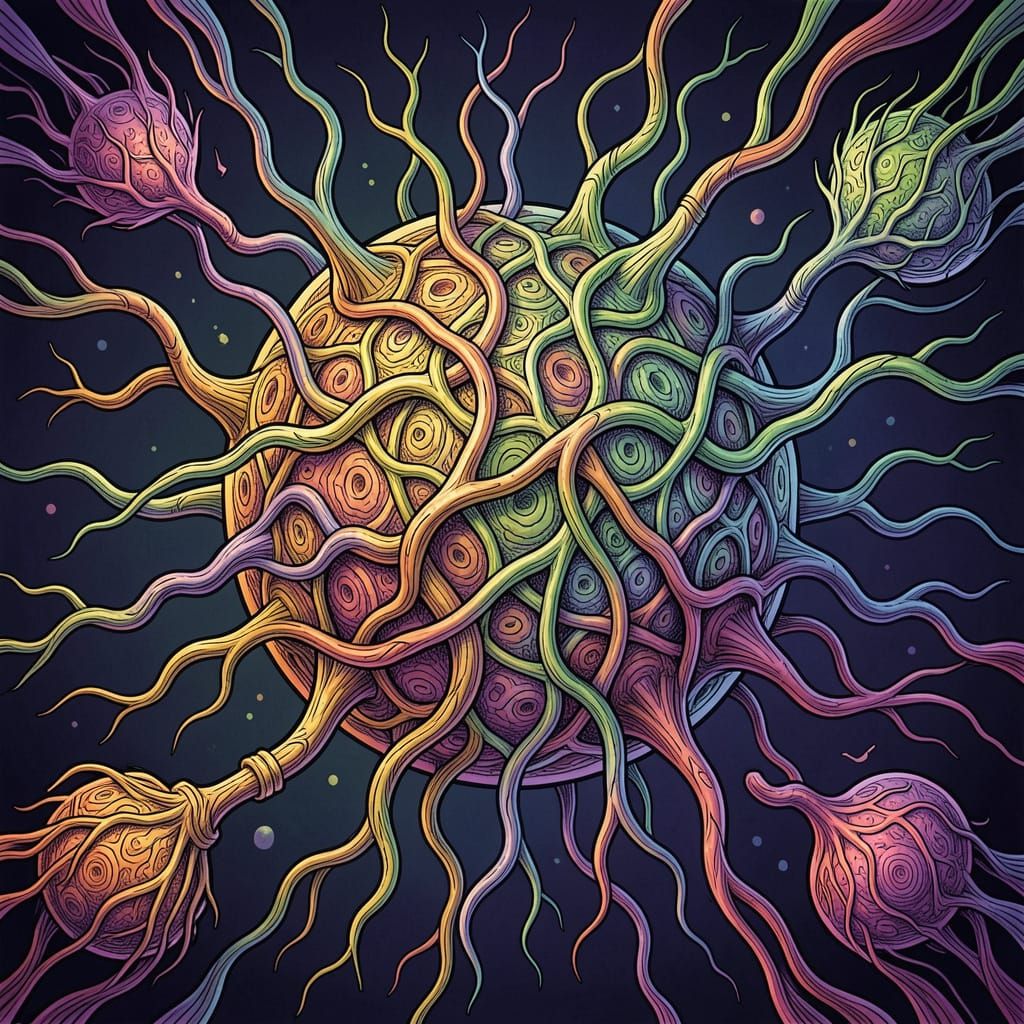
Traditionally, scientists assumed that minds require complex brains. However, the article suggests that the threshold may be much lower. Some researchers now define a mind not in terms of awareness but in terms of agency—the ability of a system to:
- Receive information from its environment
- Process that information, and
- Act in ways that pursue those goals, not in terms of awareness but in terms of agency—the ability of a system to seemingly learn from the results of its actions.
Under this definition, even simple living organisms may possess primitive forms of mind. For example, bacteria can detect chemical gradients and move toward nutrients. Because their behavior changes depending on past conditions, scientists sometimes describe them as having memory and acting toward goals.
This approach pushes the origin of mind downward from humans and animals to all living systems.
A Problem of Language
However, this explanation may rely heavily on anthropomorphic language—words originally created to describe human experience.
Terms such as “goal,” “memory, “decision,” and “information” come from psychology. When applied to molecules or cells, they may unintentionally suggest the presence of an internal “self” directing behavior.
For example, does a bacterium really have a goal of finding food? Does an iron filing have the goal of moving toward a magnet? Does a stone have the goal of rolling downhill?
Similarly, the term “memory” can be misleading. In physics and chemistry, what scientists call memory is simply the current state of a system reflecting its previous interactions.
An iron filing “remembers” the magnet only in the sense that its position has changed because of the magnet’s presence. No extra-mental property is required. Everything involved is physics and chemistry, not metaphysics.
Using psychological language for physical processes may therefore confuse the issue by introducing concepts that are not actually present in the underlying mechanisms. This linguistic problem has parallels in other fields.
In quantum physics, the terms “wave” and “particle” evoke familiar images that do not accurately describe quantum behavior. In economics, words such as “debt,” “deficit,” “borrow,” and “owe” can create misunderstandings when applied to Monetarily Sovereign currency systems.
In each case, the words shape our thinking and may lead us toward mistaken conclusions.
A Simpler Hypothesis
Instead of introducing concepts like goals or memory, it may be simpler to start from a more fundamental principle:
Stimulus → Response → Response → Response . . . ∞
Each response becomes the stimulus for the next response, producing an unbroken causal chain. Examples of this appear throughout nature: A photon strikes an atom → the atom emits another photon. Gravity affects an object → the object accelerates. Chemical molecules react → new molecules form.
Every interaction produces another interaction. In physics language, this chain could also be described as: Event → Event → Event
The two descriptions mean essentially the same thing. A response is simply an event, and each event becomes the cause of– the stimulus for — the next event.
Consciousness as Degree of Responsiveness
Within this framework, consciousness does not magically appear at some stage of biological evolution. Instead, everything responds to stimuli, but systems differ in the complexity of their responses.
A subatomic particle may have a simple physical interaction. An atom has a chemical interaction. A cell has a metabolic response. An organism has a behavioral response, A brain has a highly integrated response
Consciousness may therefore be understood as a very complex and highly integrated form of responsiveness. The mind is not a fundamentally new ingredient in the universe. It is a complex pattern within the chain of interactions that exists everywhere. Consciousness is pure chemistry and physics. Nothing metaphysical there.
Removing the Boundary Between Matter and Mind
Many scientific explanations assume a boundary, such as: matter → life → mind
But the stimulus–response framework suggests a smoother progression: response → complex response → recursive response → integrated response → mind
Rather than appearing suddenly, consciousness emerges gradually as systems become more complex and interconnected.
The “Everything” Problem
Any theory that claims to apply universally faces a common criticism. If someone says, “Everything is consciousness,” critics may reply that the concept becomes meaningless because it distinguishes nothing.
The stimulus–response framework avoids this trap by distinguishing degrees of complexity.
Everything participates in causal responses, but certain systems—such as brains—form extremely dense complex networks of recursive responses.
Higher consciousness, therefore, represents a special level of complexity, not a universal property identical in all things.
A Deeper Possibility
This perspective also connects to a broader speculative idea about the nature of the universe. It may be that matter itself is not the most fundamental component of reality.
Instead, the universe may fundamentally consist of events unfolding in time. Modern theoretical physics increasingly describes reality as a network of interactions rather than a collection of objects.
In that picture: event → event → event → event. . . . ∞ Objects such as particles and atoms may be stable patterns within this ongoing network of events.
Matter would then resemble a whirlpool in water—a persistent pattern within a flowing process.
Gravity, Time, and the Structure of Reality
This perspective suggests another possibility: that Gravity and Time may be the universe’s deepest structural features. In Einstein’s theory, Gravity is not a force in the traditional sense but a property of spacetime itself.
If you were to ask, “At the most basic level, what is everything made of — every atom, every force, everything — you would search for something that appears everywhere and in everything, and that search would take you to Gravity and Time. Both affect everything and appear everywhere.
The post, “Everything: Gravity, Change and the Glass Hammer describes how comples swirls in Gravity and Time may be the ultimate foundation of all existence — all matter, all fields, all energy.
If Einstein’s spacetime forms the framework within which events occur, then the universe may ultimately consist of:
gravity + time
↓
spacetime structure
↓
networks of events
↓
stable patterns
↓
complex feedback systems
↓
consciousness
In this view, consciousness is not something mysteriously added to the universe. It would be the responsiveness that operates everywhere in nature.
Theoretical biologist Michael Levin and his colleagues at Tufts University in Massachusetts recently applied cognitive tools to systems far simpler than even basic, single-celled organisms – systems that most of us would consider to be inanimate.
Levin and his colleagues modelled 29 different GRNs derived from biological data in a set of computer simulations. They trained each GRN to associate the presence of a neutral drug, which doesn’t trigger a response, with a functional drug that does, by repeatedly simultaneously stimulating nodes in the network.
In this way, they eventually achieved the desired behavioural change in each GRN in the absence of the functional drug, such as getting a dog to salivate with a ticking metronome and no food. In other words, their experiment showed that GRNs can learn: adapting their behaviour in a way that requires a kind of memory. “These are examples of cognition, for sure,” says Levin. “You’re not going to have a scintillating conversation with a GRN, but it’s something, it’s not zero.”
Thus, consciousness, i.e., Stimulus—>Response, was shown not to be limited to life, and certainly not limited to human life. It is a measurable chemical-physical process that tends to increase with complexity and may ultimately be composed of two elements: Gravity and Time.
Conclusion
The New Scientist article suggests that “mind” may arise wherever living systems display goal-directed behavior and memory. However, the language used in such explanations may unintentionally introduce psychological concepts into purely physical processes.
An alternative view begins with a simpler principle: the universe may consist of a continuous chain of stimulus and response, or equivalently, a network of events influencing later events.
As these chains of interaction become increasingly complex and recursive, they may give rise to the phenomena we call mind and consciousness.
Consciousness may not have emerged magically during biological evolution; instead, it could represent a highly integrated pattern of gravity and time (i.e., stimulus → response) within the universe’s ongoing network of events.
Rodger Malcolm Mitchell
Twitter: @rodgermitchell
Search #monetarysovereignty
Facebook: Rodger Malcolm Mitchell;
MUCK RACK: https://muckrack.com/rodger-malcolm-mitchell;
……………………………………………………………………..
A Government’s Sole Purpose is to Improve and Protect The People’s Lives.
MONETARY SOVEREIGNTY



 #Monetary Sovereignty - Mitchell