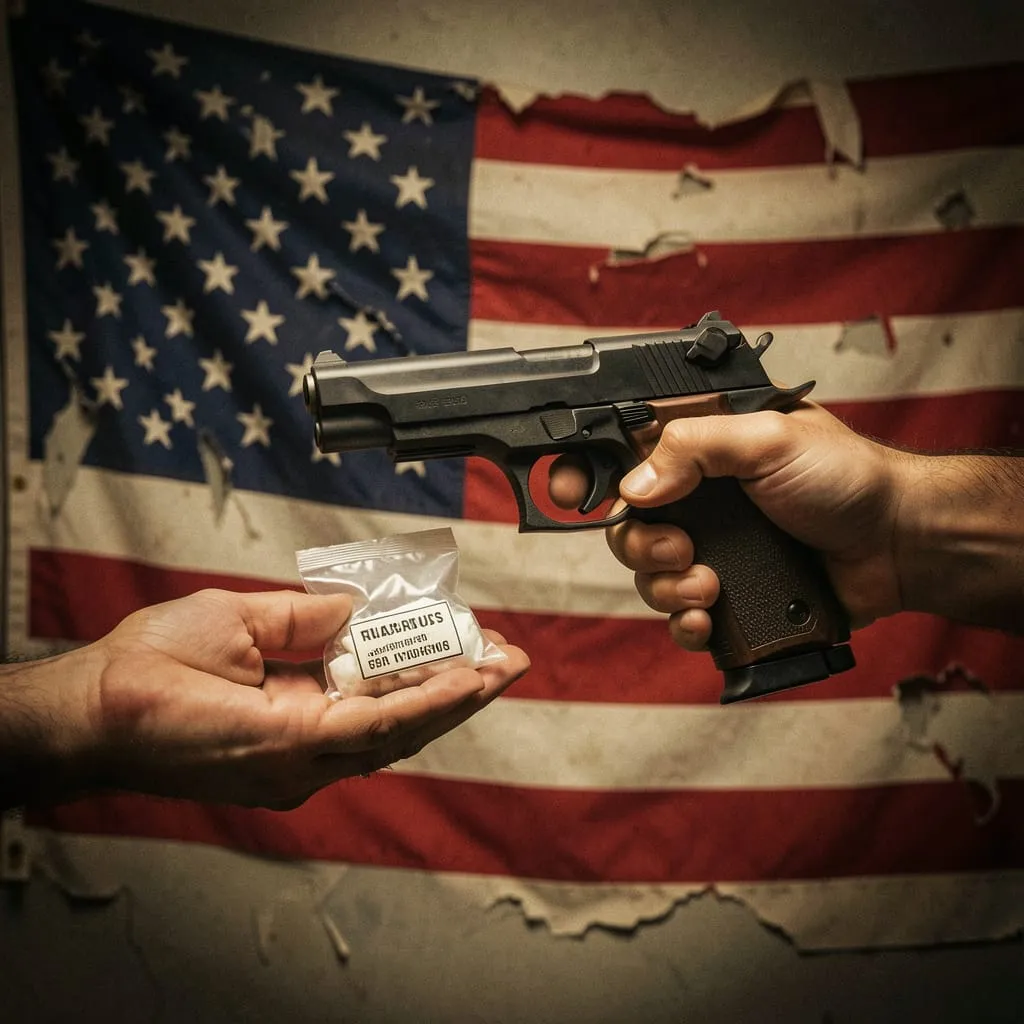
Guns South, Drugs North — and the Asymmetry We Don’t See
Public debate about the U.S.–Mexico border usually focuses on one direction: Drugs flowing north. American leaders routinely demand that Mexico (and tens of other less-wealthy nations) “do more” to stop narcotics from entering the United States. Tariffs are threatened. Pressure is applied. Blame is assigned.
But there is another flow — guns moving south. And when you examine both directions together, a structural asymmetry appears. This isn’t a moral argument. It’s a systems argument.
Two Flows, Two Harms, One Nation Controls
The United States is experiencing an extraordinary drug overdose crisis. In recent years, annual overdose deaths have exceeded 100,000, largely driven by synthetic opioids like fentanyl. That is an enormous public health catastrophe.
Mexico, by contrast, experiences relatively low overdose mortality. Its drug-related harm primarily manifests as violence — tens of thousands of homicides per year, the vast majority committed with firearms.
The pattern is clear: Drugs largely flow north and contribute to overdose deaths in the United States. Guns largely flow south and contribute to homicide deaths in Mexico.
Both countries suffer. Both countries export harm. Both countries are affected by forces beyond their borders. But that’s where the symmetry ends.
Upstream Control
Each country has authority over upstream variables within its own jurisdiction.
The United States has the ability, but not the willingness, to regulate firearm manufacturing and sales domestically.
Mexico: Has the willingness, but not the ability to police its own territory.
If a nation demands that another country suppress upstream factors affecting its security, while declining to address upstream factors within its own control that affect the other, that is a structural asymmetry.
The U.S. government regularly pressures Mexico to stop drugs at the source. At the same time, American law strongly protects domestic gun manufacturing and sales, including legal shields that limit manufacturer liability. Efforts to tighten bulk purchasing, tracking, or export leakage encounter political resistance.
Mexico’s government, for its part, has deployed military forces against drug cartels at enormous human cost. It has suffered assassinations of officials, police corruption, and institutional strain.
By contrast, America has done nothing to stop gun sales to Mexico. In fact, American law encourages gun manufacturing and sales.
The asymmetry lies not in suffering — both countries suffer — but in expectations about who must change.
Mexico wants to stop the drug trade. Its efforts have cost it money and lives. America does not want to stop the gun trade.
Individual Choice vs. Structural Incentives
Drug harm in the United States is ultimately the result of individual choice. “Just don’t start.” Don’t take that first drug. Don’t become so addicted that stopping becomes impossible.
Gun violence in Mexico is not something the individual Mexican can prevent. Innocent people’s lives are destroyed in the gun wars.
If downstream outcomes are undesirable — overdose deaths in the U.S., homicide deaths in Mexico — then upstream stimuli must be examined.
Drug demand, harm-reduction policy, and treatment infrastructure in the U.S. Firearm manufacturing volume, distribution rules, and export leakage in the U.S.
The Blind Spot
That is why I have problems with the “both sides” equivalence, some may claim. A Mexican citizen can do everything possible to avoid gun violence and still be caught in the crossfire. By contrast, Americans are not born addicts. At some point, they decide to take drugs.
The American public often sees drugs as an external invasion, though it begins at home, with people haveing the option not to engage.. But Americans rarely see guns flowing south as an export of harm.
The United States demands aggressive suppression of drug flows from Mexico. Consistency would suggest a parallel willingness to address firearm flows that contribute to violence abroad.
The first step is recognizing where responsibility really lies. Contrary to President Trump’s claims, the American government is not an innocent party in the gun/drug exchange war.
Rodger Malcolm Mitchell
Twitter: @rodgermitchell
Search #monetarysovereignty
Facebook: Rodger Malcolm Mitchell;
MUCK RACK: https://muckrack.com/rodger-malcolm-mitchell;
……………………………………………………………………..
A Government’s Sole Purpose is to Improve and Protect The People’s Lives.
MONETARY SOVEREIGNTY
 #Monetary Sovereignty - Mitchell
You overlooked, or just remained silent on one of the real causes of addiction — wealth inequity. Those who have wealth demand more wealth. Those with no wealth try their best to get along, but poverty is a losing game. The poorer you are, the poorer you are going to be. This is a fact of life, and not everyone can cope with it on their own. They need a little help to get away from the real world. And street drugs are available everywhere. The so-called “War on Drugs” is a sham(e). If the government/police wanted to win the war, they could shut down the drug traders. But drugs are one of their main “raison d’etre” for having so many police officers. if there were no more traffickers, drug transporters, drug sellers, drug users or drug cartels, there would be no need for half the police officers. I know. Fifty years ago I was involved in two of those categories. The police hassled us on the fringes, but those in the trafficking/transporting business, they weren’t hassled at all.
So who is really responsible for the drug-related deaths in North America and beyond? The only answer is “All Of Us.” We allow the police to go after the little guys. We allow the drug trade to grow. And we allow drug users to need those drugs in order to live from day to day.
Do not get me wrong, wealth inequity is not the only reason for addiction, there are plenty of others. But as the cops always way on TV, follow the money. It does not only lead to drug cartels, it also goes to the wealthy in numerous ways.
As for the gun manufacturers, transporters, buyers and users, without them the economies of several countries would collapse. And America is at the top of the list. The US government will never shut them down. Not until the American public demands they get shut down. And as long as a large percentage of that population are gun owners, legally or not, no anti-gun law will ever be passed. Money is the greatest factor in the gun trade.
LikeLike
When a crooked Supreme Court eliminated the first eleven words of the Second Amendment, we were doomed.
LikeLike
You, Americans, need to stop the Orange Fool. He is MURDERING INNOCENT PEOPLE!
LikeLike