How those much-discussed taxes/tariffs, interest rates, debt and deficits affect the U.S. economy:
I. The Effects of Taxes: If you are a regular reader of this blog, you know that while state/local taxes fund state/local government spending, federal taxes — income taxes, FICA, and luxury taxes– do not pay for anything.
The U.S. federal government, uniquely being Monetarily Sovereign, has no need for, nor use of, any income. It creates all its spending dollars through Congressional voting, Presidential approval, and computer-based additions to federal accounts.
Though not funding federal spending, the three purposes of federal taxes are:
- To control the economy by taxing what the government wishes to limit and by giving tax breaks to what the government wishes to encourage.
- To support the demand for the U.S. dollar by requiring that dollars be used to pay taxes.
- To convince those below the “wealthy” threshold that federal spending is constrained by tax collections and borrowing.
Gap Psychology describes the desire to distance oneself from those lower in any scale and to come closer to those above. That process is how people become richer.
Fake “trust funds” like the Social Security “trust fund” and the Medicare “trust fund,” supposedly funded by FICA, serve no real purpose and are, in fact, not trust funds at all.
Misleading claims about their impending insolvency prevent you from accessing a comprehensive, no-deductible Medicare plan for all ages, as well as a more generous Social Security plan available to everyone, regardless of age.
To quote from the Peter G. Peterson Foundation web site:
“A federal trust fund is an accounting mechanism used by the federal government to track earmarked receipts (money designated for a specific purpose or program) and corresponding expenditures.“The largest and best-known trust funds finance Social Security, portions of Medicare, highways and mass transit, and pensions for government employees.
“Federal trust funds bear little resemblance to their private-sector counterparts, and therefore the name can be misleading.
“A ‘trust fund’ implies a secure source of funding. However, a federal trust fund is simply an accounting mechanism used to track inflows and outflows for specific programs.
“In private-sector trust funds, receipts are deposited and assets are held and invested by trustees on behalf of the stated beneficiaries.
“In federal trust funds, the federal government does not set aside the receipts or invest them in private assets.
“Rather, the receipts are recorded as accounting credits in the trust funds, and then combined with other receipts that the Treasury collects and spends.
“Further, the federal government owns the accounts and can, by changing the law, unilaterally alter the purposes of the accounts and raise or lower collections and expenditures.”
In short, the federal government can do anything it wants with the so-called trust funds, and the claims of impending insolvency of any federal trust fund are a lie.
Federal debt is fundamentally different from personal or business debt. It represents the total amount held in Treasury security accounts owned by depositors.
While increased federal debt is often viewed negatively, it is, in fact, necessary for economic growth.
Federal deficits lead to federal debt and are the result of the federal government spending more dollars into the economy than it takes out in taxes.

Federal taxes take dollars from the private sector (aka “the economy”). Economic growth, as measured by Gross Domestic Product, requires an increasing supply of dollars. (GDP=Federal Spending+Nonfederal Spending+Net Exports).
Taking dollars from the economy reduces Nonfederal spending, which leads to recessions, and those recessions are cured by federal deficit spending.

In summary, federal spending increases GDP, federal taxes reduce GDP and are recessionary. The federal government does not spend federal taxes.
II. The effects of tariffs.
Tariffs are sales taxes on imports. Like all sales taxes, tariffs increase the cost of sales, and ultimately, this cost is paid by buyers. In short, tariffs are inflationary and recessionary.
The Monetarily Sovereign U.S. government does not rely on any form of income, meaning that the tariffs it collects do not benefit U.S. taxpayers. Although Donald Trump may boast about the revenue from tariffs, that money ultimately comes from U.S. consumers through inflation.
It does not lead to lower taxes or fund any government expenses.
Tariffs can be used to penalize competitors of U.S. businesses by increasing the prices of imported goods. However, if the goal is to support American companies, a more effective approach would be to subsidize the American companies directly.
This method would not lead to inflation and would instead promote economic growth.
In summary, the tariffs Trump likes to boast about hurt American consumers. Imagine a billionaire father boasting to his son about taking pennies from his son’s piggy bank.III. The effects of interest rates
It widely is believed that raising interest rates mitigates against inflation. The logic is:
- Higher rates increase the demand for federal Treasury Securities
- These securities must be purchased with dollars.
- This increases the demand for dollars, making dollars more valuable.
- A more valuable (aka “stronger”) dollar is deflationary.
The Fed claims that higher rates “cool” the economy, meaning higher rates reduce demand. But the inflation problem is not a “hot” economy or too much demand. The problem is too little supply. See Supply.
To address inflation, shortages of crucial goods and services must be addressed. The federal government must provide aid to the energy, farm, transportation, etc., sectors wherever shortages occur.
IV. The effects of deficits and debt
Reflexively, we all hate “being in debt,” and then we take out a mortgage. But somehow that mortgage seems OK as compared to a loan from a Mafia loanshark,
When someone frets about the federal debt being too high, they actually are complaining about interest-paying deposits into T-security accounts. These are the safest (in terms of loss of principal) known.
The federal government holds those deposits until maturity, never touching them because they belong to the depositor, then sends them back (i.e., “pays them off”). This is not a burden on the federal government and does not involve taxpayers in any way.
So, why do people worry about the size of the federal “debt”? Because of that nasty (and wrong) word “debt.” The public mistakenly equates it with personal debt.
Unlike a traditional debtor, the federal government never borrows dollars. Why would it, given the infinite ability to create dollars? If you owned a legal money-printing machine, would you ever borrow dollars? Of course not. You simply would print all you need.
In a previous post, I gave the example of the board game Monopoly®. By rule, the Bank cannot run short of dollars. So, when we once opened the box to discover that the Monopoly money was missing, we simply played without physical dollars. We used a table like this:
We began by giving eveyone $4,000, that is we wrote $4,000 in their column, which 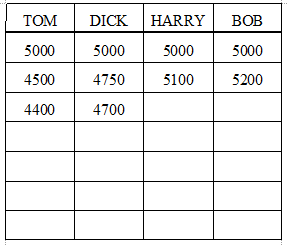 is the same thing.
Then, when people bought and sold property, we added or subtracted from their column, exactly the same way U.S. dollars are handled.
The Bank had no column because there was no need.
And just as the Bank couldn’t run short of dollars, so too can the U.S. federal government never run short of dollars.
And just as there was no need to levy taxes in Monopoly (though for playing variety, the rules do provide for taxes) nether the Monopoly Bank nor the federal government had any use for tax dollars.
That said, in the real world, taxes serve several functions, though none of them provide the government with spending money. (We describe this in paragraph I. above.)
We mention the Monopoly game to demonstrate the ridiculousness of worrying about federal “debt.” The debt could be 50 trillion or a trillion trillion, and neither would threaten the solvency of the U.S. government.
The best thing that can happen to the economy is for the federal government to run deficits. They grow the federal debt, and that is how a healthy economy grows.
Summary:- The federal government, being Monetarily Sovereign, has the unlimited ability to create dollars. It never can run short. Federal taxes and taxpayers do not fund federal spending. They slow economic growth.
The three purposes of federal taxes are: Control of the economy, assure demand for the dollar, and fool the public into believing benefits are unaffordable for the federal government.
- Tariffs are recessionary taxes ultimately paid by consumers. Protection of domestic business can be better accomplished by direct government support for those businesses. Such support would facilitate economic growth.
- Raising interest rates increases costs, and thus does not fight inflation. High interest rates discourage borrowing but add growth dollars to the economy.
- The federal debt is neither federal nor debt, and is not a burden on the federal government or on taxpayers. It is deposits into T-security accounts, the contents of which remain the property of the depositors.
“Paying off” the federal debt easily is accomplished by simply returning the dollars in those accounts. Reducing the debt creates depressions and recessions. The federal defict merely refers to the number of growth dollars the federal government creates.
Rodger Malcolm Mitchell
Twitter: @rodgermitchell
Search #monetarysovereignty
Facebook: Rodger Malcolm Mitchell;
MUCK RACK: https://muckrack.com/rodger-malcolm-mitchell;
……………………………………………………………………..
A Government’s Sole Purpose is to Improve and Protect The People’s Lives.
MONETARY SOVEREIGNTY
 #Monetary Sovereignty - Mitchell
Gee, who woulda thunk it? They are literally the new Gestapo now!
LikeLike