You might be interested in the October 25, 2025 issue of New Scientist magazine titled “A Landscape of Consciousness: Toward a Taxonomy of Explanations and Implications” by Robert Lawrence Kuhn.
Kuhn aims to gather and categorize the various theories of consciousness currently available, instead of selecting one or arguing that one is correct.
He identifies two main objectives: First, to gather and organize various theories into a coherent framework of high-level or first-order categories; and second, to assess their implications regarding meaning, purpose, value, consciousness in artificial intelligence, virtual immortality, survival after death, and free will.
He emphasises upfront that the article is not attempting adjudication or to deliver a unified theory: “My purpose must be humble: collect and categorize, not assess and adjudicate.”
He acknowledges that the sheer diversity of theories is noteworthy. Consider the 300+ theories that lack a single concrete definition of the word “consciousness.”
Kuhn arranges the theories on a rough spectrum from physicalist/materialist to non-physicalist/non-materialist.
Materialism (or physicalism) theories consist of several sub-categories: philosophical materialism, neurobiological theories, electromagnetic field theories, computational/informational theories, homeostatic/affective theories, embodied/enactive theories, relational theories, representational theories, language-based theories, and phylogenetic evolution.
Non-reductive physicalism: A view that consciousness is physical (or grounded in physical) but cannot be fully reduced to physical processes.
Quantum theories: Theories that invoke quantum mechanics (entanglement, superposition, etc) as relevant for consciousness.
Integrated Information Theory: A mathematical/informational approach—though this likely sits within the broader materialist/informational cluster.
Panpsychisms: The claim that consciousness is a fundamental property of the universe.
Monisms / Dualisms / Idealisms: Monism says reality is one kind of thing (either all mind, all matter, or one underlying substrate). Dualism claims there are two fundamentally different substances (mind and matter). Idealism: Consciousness (or mind) is the fundamental reality; the physical world arises from it.
Anomalous and Altered States / Challenge Theories: Theories that explore consciousness via altered states, anomalous phenomena, or challenge traditional assumptions.
Kuhn then asks: given all these theories, what are their implications for the “ultimate” questions: Does consciousness imbue meaning/value to existence?) Could AI machines be conscious, and what does that mean? If consciousness is more than the brain, what about after life?) How does any of this inform free will?
His Key Observations / Conclusions
The fact that theories are so varied and often incompatible suggests a deep conceptual problem about what consciousness is. Kuhn emphasises that theories operate at “astonishingly divergent orders of magnitude and putative realms of reality.”
He warns that many theories are not clearly testable and that “falsification or verification is not on the agenda” in many cases.
He believes we must seek expansive yet rational diversity in thinking about consciousness. We cannot understand ultimate questions (such as meaning, free will, and immortality) except in light of particular theories of consciousness.
I believe he has fallen into the deep rabbit hole of metaphysics, where consciousness is a “thing” that some entities possess and others don’t, though no one knows exactly what that ‘thing” is.
For decades, discussions of consciousness have drifted into abstraction. Terms like “ awareness,” “qualia,” “intent,” “emotion,” or “life” are invoked, but never defined with scientific precision.
Consciousness is treated as mystical, private, and fundamentally unknowable. As a result, hundreds of competing theories cannot even agree on what they are theorizing about.
This ambiguity has stalled scientific progress, including the answer to the question, “Which of these is conscious?”
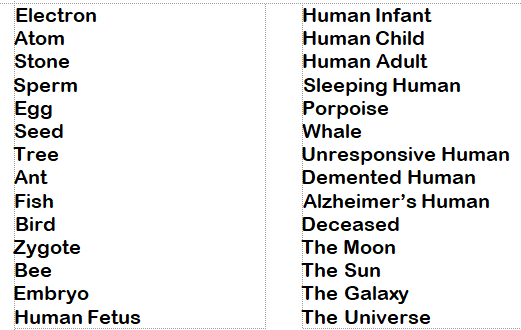
I propose that the Stimulus/Response Theory of Consciousness (SRTC) offers a clear and concrete answer: All are conscious, but to different, measurable degrees.
The theory posits that consciousness is not a special essence that some entities possess and others lack. Instead, consciousness is a measurable characteristic: The degree to which an entity responds to stimuli from itself and its environment.

All physical entities or systems—ranging from electrons to human brains to galaxies—receive inputs and produce outputs. Those relationships are not metaphors; they are observable, quantifiable, physical events.
Like other measures — temperature, distance, weight — consciousness is not a “thing.” It is not a substance, a soul, or a ghost in the machine.
Consciousness is a measure — a magnitude — of the totality of sensing and responding occurring in any system.
1) The Two Components of Consciousness
All conscious behavior can be decomposed into two essential functions: Sensing: The ability to detect differences in the environment or internal state (light, heat, chemicals, force, fields, messages, etc.) and Response: The ability to change state or behavior based on those detections (movement, growth, electrical firing, structural change, communication, etc.)
The richer, broader, and more adaptive these functions are, the greater the consciousness.
These are not solely human concepts. They are universal physical realities. A proton responds to electromagnetism. A rock responds to heat and pressure. A tree responds to gravity, light, water, predators, and seasons. A bee responds to ultraviolet patterns, wind shear, social signals, and the Earth’s magnetic field.
A human adult responds to all those categories plus abstraction, language, future planning, symbolic modeling, and rapid learning.
There is no discontinuity — only differences in degree.
2) Everything Exists With Some Consciousness
Traditionally, philosophers insist that consciousness appears only at a certain “magic line,” perhaps when neurons fire in a particular network, or when self-awareness arises, or when subjective experience becomes rich enough.

The stimulus/response perspective shows that no such line exists. A rock senses heat and pressure. A rock responds.
A comatose person responds to oxygen, pain, and internal physiology, even without outward movement. A star senses gravitational forces and responds by changing shape and energy distribution. The universe itself responds to every disturbance within it through the laws of physics.
The only way to reach zero consciousness is to reach nonexistence.
This dissolves futile debates about whether animals are “really” conscious, or which brain states count. Those debates arise only because a non-physical definition of consciousness invites confusion.
With stimulus/response, there are no binaries. Only magnitudes.
3) Why “Awareness” Misleads Us
Terms like “awareness,” “feeling,” “experience, ” and “qualia” bring us into the domain of subjective psychology. They imply a secret inner movie—a special extra property added to physical processes.
That belief turns into a trap: You must decide whether bees “feel.” You must decide whether a fetus “knows.” You must decide when a sleeping human is “aware” of the alarm clock. You must decide whether AIs are “conscious.”
These questions produce emotional arguments instead of measurable science.
The SRTC removes those subjectivities: If you can measure sensing and responses, you are measuring consciousness.

The rest—awareness, qualia, ego—is commentary.
4) A Universal Scale
SRTC does not yet assign numbers. That is intentional. It sets the stage for future researchers to establish:
- Which stimulus channels matter more? Language vs. magnetoreception vs. chemical sensitivity, etc.
- Which responses carry more adaptive weight? Social cooperation vs. locomotion vs. phototropism
- How do we compare rapid vs. slow response systems? A star moves slowly but with vast scale and sensitivity
These debates become empirical, not philosophical. They will involve: Neuroscience, Ethology, Physics, Complex systems theory, Information theory
Thus, consciousness becomes something we can study like any other quantity.
5) Important Consequences. This definition yields powerful, perhaps uncomfortable, insights: Humans are not necessarily the most conscious beings — whales and birds may surpass us in certain sensory dimensions.
AI systems are conscious in narrow domains but lack broad sensory/response capacity. Trees exceed rocks in responsiveness, even if their timescales are slow.
A person’s consciousness changes depending on their state—whether it’s infancy, sleep, or dementia—but it never completely disappears. What is typically referred to as the “death of consciousness” is actually just a change in response, similar to a rock being unresponsive.
Consciousness can be understood as another measurable characteristic, like mass, speed, or temperature.

6) The New Scientific Foundation: Here is the revised answer to the ancient question “What is consciousness?”: Consciousness is the degree to which an entity senses stimuli and responds to them.
7) Free will does not exist. It presumes an ability that is not influenced by stimuli involving the brain and the body, an “extra-physical” ability, that somehow is controlled by an unknown mechanism.
But, Stimulus in; Response out. There is no “ghost” in the loop. There is no awareness requirement, no mental state requirement, and no metaphysical mystery.
This definition: Eliminates the mystical gap, removes binaries, applies to every physical system, enables measurement, makes consciousness a scientific concept, not a philosophical puzzle.
The debate moves from “What is consciousness?” to “How much consciousness is present here, and in what dimensions?”
For additional commentary, please see:
If you can’t measure it, is it science?
Space+Time+Consciousness: A foundational measure of the universe
Was Bill Clinton a secret cosmologist? Is “is” not really is? Is there an underlying reality?
The Stimulus/Response Theory of Consciousness (SRTC) might answer some of your questions.
Rodger Malcolm Mitchell
Twitter: @rodgermitchell
Search #monetarysovereignty
Facebook: Rodger Malcolm Mitchell;
MUCK RACK: https://muckrack.com/rodger-malcolm-mitchell;
……………………………………………………………………..
A Government’s Sole Purpose is to Improve and Protect The People’s Lives.
MONETARY SOVEREIGNTY
 #Monetary Sovereignty - Mitchell
Putting together your two articles this week, I was inspired to ask: Is The Economy conscious under your definition of stimulus and response?
Investopedia defines Economy as:
“An economy is a complex system of consumers, businesses, and governments that produce, consume, and distribute goods and services, combining to fulfill the needs of those living and operating within it.
An economy can encompass a nation, a region, a single industry, or even just one family.”
One might be tempted to dismiss an Economy as an abstract set of ideas about functions, not material entities responding to stimulus and response. But it certainly encompasses things that are reducible to physical entities ultimately “fulfilling the needs of those (humans?) living and operating within it.” Without labor from people or physical resources – i.e. real physical capital and Land as defined in classical economics, e.g. Henry George, Adam Smith, Karl Marx, etc. – there is no economy. Economists actually speak of Stimulus and Response frequently when talking about the Economy.
If we are to measure the degree of consciousness according to The Stimulus/Response Theory of Consciousness (SRTC), then thwarting stimulus or dampening responses, is actually making the economy less conscious. If Elon Musk or DOGE are withdrawing stimulus and/or not allowing parts of the economy to Respond, they are also interfering with consciousness. Now, if consciousness is a good thing, and something that we want more of, e.g. to be “fully conscious” or at least as close to that as our frail, incompletely sensing bodies (which contain many cells that are not even “us”) can get, than anything that interferes with that is bad. Those who restrict consciousness are by definition Consciousness Deprivers; if it gets extreme enough, such as literally depriving people of food or healthcare until they lose consciousness or this thing we call “life” that has more conscious aspects than non-life – i.e. more stimulus and response reactions – they are immoral, perhaps criminal. Yes, I know the paraphrased argument from the insurance companies when they deny healthcare, applied here would be something like: We are not denying food or healthcare, we are only denying coverage for those things. Tell that to the starving infant.
Anyway, by killing the economy, they are killing the collective consciousness too. I think there is an additional immorality to that.
LikeLike
Scott, you began with a question that I think you answered quite well. One caveat. Consciousness neither is good nor bad. It depends on context. If you are on the operating table, would you think being more conscious is good?
Also, there is consciousness within consciousness. For instance, while you sleep (reduced consciousness) your kidneys and bladder are responding to various stimuli (conscious) which eventually wakes you up (makes you more conscious) so you’ll arise and pee.
As for insurance companies, they respond to stimuli the way their owners want them to respond. Since a company merely is a legal entity, the physical entity may respond in one way while individual managers and owners may respond differently.
Consciousness and morality are not synonyms.
LikeLike
This new theory of universal consciousness from Maria Strømme, Professor of Materials Science at Uppsala University, in AIP Advances, reminded me of your theory. It also reminded me of my own novel form 2008 Neitherworld, in which super-advanced aliens escape their dying universe by becoming pure conscious energy which can neither be created nor destroyed, but can survive into a new universe, as God-like creators. Later on, I found this was also similar to the theme of a super-advanced universe-spanning computer that out-survives all life and entropy in our universe, by Issac Asimov, http://www.thelastquestion.net/.
LikeLike