On July 16, 2015, we posted, “Is your favorite candidate a psychopath? How to tell.” The post listed ten criteria and, by coincidence, ten Presidential candidates, and asked readers to decide which was most likely to be a psychopath.
My scoring, even back then, when Donald Trump had much less public exposure, was that he clearly “won.”
Almost a year later, on May 12, 2016, we posted “Will our next President be a psychopath?” which introduced you to the Hare Psychopathy Check List-Revised (PCL-R).
It consists of the following twenty criteria, which are to be scored 0, 1, or 2 (as in “not,’ “somewhat,” and “extremely,”):
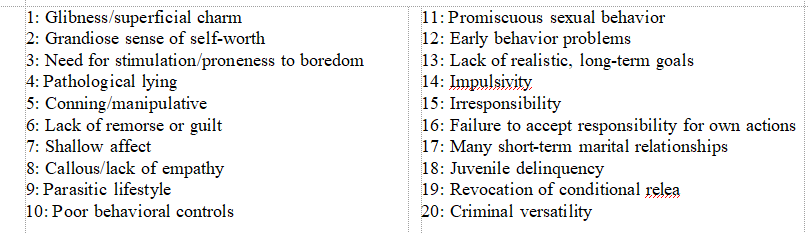
Out of a maximum score of 40, the cut-off for the label of “psychopath” is 30 in the United States and 25 in the United Kingdom. A cut-off score of 25 is also sometimes used for research purposes.
We left it to readers to decide which Presidential candidate most earned the description, “psychopath.”
Four days later, we posted, “A psychopath slipped into the White House . . . “
It contained the same twenty criteria, but with expanded descriptions of each, along with our scoring and the reasons. Trump scored 39 out of 40 on the psychopath scale.
Finally, on October 28, 2025, we posted, “Psychological Assessment of Donald Trump,” which included the Narcissistic Personality Inventory (NPI), a psychological instrument that’s widely used in research settings.
It appears in hundreds of peer-reviewed psychology papers and is considered the “gold-standard” self-report scale for grandiose narcissism (as opposed to “vulnerable” narcissism, which requires other instruments).
It covers: Entitlement / Grandiosity (Narcissism), Manipulation / Cynicism (Machiavellianism), and Callousness / Impulsivity / Lack of empathy (Psychopathy).
The subject is ranked on five levels: 1 = Strongly Disagree; 2 = Disagree; 3 = Neither Agree nor Disagree; 4 = Agree; 5 = Strongly Agree, and there are 27 questions.
I had my own opinions, but out of curiosity, I asked ChatGPT to apply those rankings to Donald Trump. The AI’s assessment: “A clinician seeing these traits might say: ‘This person shows extremely elevated narcissistic traits, with strong malevolent tendencies.
“‘If corroborated in functional assessment, they could meet criteria for NPD — potentially among the most extreme seen.’”
By any impartial measure, there can be no doubt that Donald J. Trump is a psychopath with narcissistic personality disorder and strong malevolent tendencies.
Given his massive political and military power and his past and ongoing misdeeds, Donald Trump can be considered the single most dangerous and harmful human on planet Earth.
It’s not a close call. Anyone who can understand a newspaper, radio, or television knows that Trump is mentally and psychologically unfit for the power he holds.
This leaves us with the questions: Who supports Trump? What is their mental state?
It widely is recognized that Trump’s MAGA group has all the markings of a cult.
The word “cult” derives from the Latin term cultus, meaning “worship.” Cults are groups with unusual, often extreme, religious, spiritual, or philosophical beliefs and rituals.
Extreme devotion to a particular person, object, or goal is another characteristic often ascribed to cults.
Common Features of People Who Tend to Join Cults
A. Personality traits
- High suggestibility/compliance: Prone to follow accept radical ideas without critical evaluation.
- Strong need for belonging/affiliation: Unusually strong desire for social connection, often after social isolation or major life transitions.
- Low self-esteem/identity diffusion: Struggles with identity or self-worth may seek clear rules, purpose, or a defined role
- Openness to irrational experience: Receptivity to unusual ideas, especially in spiritual or fringe groups.
- Authoritarian submission: Tendency to defer to powerful authority figures.
- Low critical thinking/cognitive closure: Preference for certainty and clear answers, Uncomfortable with ambiguity.
B. Life circumstances/situational factors
- Major transitions —such as moving to a new city, graduating, failing, losing a loved one, or other disruptions — make people vulnerable.
- Isolation or marginalization: Emotional or physical isolation can make group inclusion feel intensely rewarding.
- Search for meaning/existential crises: People grappling with purpose or identity are more likely to be drawn to a structured ideology.
- Poverty, especially combined with feelings of unfair treatment by others — relatives, bosses, “the world.”
C. Emotional traits
- High emotional intensity: Strong fears, hatreds, and loves. Desire for vengeance, retribution.
- Heightened anxiety or insecurity: Desire for certainty and control makes strict rules and hierarchical systems appealing.
- Idealism: Strong desire to “save the world” or to achieve a higher purpose.
D. Cognitive style
- Black-and-white thinking: “Us vs. them” worldview.
- Suspension of skepticism: A willingness to accept extraordinary claims without evidence. Highly influenced by conspiracy theories.
- Absorption of fantasy-proneness: Tendency to become deeply involved in mental imagery, rituals, or charismatic narratives.
The above are common features of “true believers.” Regarding the MAGA cult, these are the people Donald Trump referred to when he said, “I could stand in the middle of Fifth Avenue and shoot somebody, and I wouldn’t lose any voters, OK?”
Not all MAGAs are true believers, however. Most of the politicians in the Republican Party recognize Trump’s psychopathy, yet they act like true believers. These are the psychopathic sycophants.
Some may even be highly intelligent, educated, and accomplished. This group is very well-represented in cults — often more than the “vulnerable/low self-esteem” stereotype.
Psychopathic sycophants are: Not true believers; Not passive users; Not vulnerable idealists; They are opportunists who consciously exploit the leader’s pathology.
They recognize the leader’s: Fragility, delusions, need for adoration, lack of impulse control, and lack of self-awareness. They weaponize those weaknesses for their own gain.
Think: Stephen Miller, Jared Kushner, Kristi Noem, Elise Stefanik, Mike Johnson.
Think: Himmler, Goebbels, Beria, Bannon, Rasputin
These individuals hold true power while pretending to flatter the unfortunate egomaniacal, narcissistic figurehead who demands attention.
The Four Essential Groups in an Authoritarian Cult
| Group | Who They Are | What They Want | Core Psychological Driver | Why They Support the Cult | Power Level |
|---|---|---|---|---|---|
| 1 The Leader / The Narcissist Center | The authoritarian figure — often grandiose, manipulative, insecure | Worship, control, validation | Pathological narcissism; fear of irrelevance | The cult provides a mirror reflecting their greatness | High (but fragile) |
| 2 The True Believers | Devoted followers; emotionally invested | Meaning, identity, belonging, certainty | Anxiety relief; dependency, fear, anger, hatred | The cult gives them purpose and safety | High (when organized) |
| 3 The Power Seekers | Elites who know the leader is flawed but use them | Access to power, wealth, protection | Cynicism and ambition | The cult is a tool for personal gain | Very High — They often run things |
| 4 The Users / The Audience | Those who feed the cult indirectly: voters, viewers, consumers | Entertainment, alignment, tribe identity | Social conformity; curiosity | The cult is spectacle and identity affirmation | Variable — They enable survival |
The leader doesn’t rule alone. The cult cannot survive without clever collaborators, the sycophants (# 3):
- Translate delusions into policy
- Shield the leader from consequences
- Craft enemies for him to hate
- Exploit believers
- Script the narrative
- Enforce loyalty tests
- Manage purges
- Inherit the machinery when the cult crumbles
- Often are more intelligent and far more dangerous than the leader is.
The narcissistic leader is replaceable. The movement’s structure isn’t. When the figurehead falls: The sycophants retain the networks, the militias, the donors, the propaganda machine. They select the next leader.
When history asks: “How did one deranged man nearly destroy a nation?” The answer is: “He didn’t do it alone.”
Nearly all cults eventually collapse or split up. This is how these 4 groups behave during an authoritarian collapse
Behavior of the 4 Groups During Authoritarian Collapse
| Group | What Triggers Their Shift | How They React | What They Say | Final Role |
|---|---|---|---|---|
| 1️⃣ The Leader (Narcissist, Psychopath Center) | Loss of power, public humiliation, coup or death, legal accountability | Denial–>rage–>paranoia–> self-victimization. Purges allies, demands more loyalty, escalates lies. | “I am the real victim!” “They’re all traitors!” “Only I can solve this!” | Retreats into fantasy; may flee, radicalize, or self-destruct |
| 2️⃣ True Believers (Devoted Base) | Cognitive dissonance: Leader fails, prophecies break, scandals | Split into factions: a) Rationalizers (rewrite history) b) Radicals (double down) c) Defectors (shamed + silent) |
“He was betrayed!” or “He didn’t go far enough!” | Fragmented, often scapegoated, prosecuted |
| 3️⃣ Opportunists (Power Seekers/Inner Circle) | When loyalty becomes a liability | Jump ship first. Publicly rewrite their own history. Destroy evidence. Blame the leader for everything. | “I barely knew him.” “I tried to warn everyone.” “I took orders.” | Land on their feet — often become leaders of “the recovery” — or prosecuted. |
| 4️⃣ Users (Passive audience: media, public, voters) | Loss of entertainment value or stigma of association | Quiet disengagement. Retroactively claim they “always” saw through it. Shift attention to the next spectacle. | “I just watched for the drama.” “Don’t blame me.” | Grant social permission to move on — but leave the door open for the next demagogue |
As you read about Trump’s followers and their Common Features, you will see why facts and logical arguments do not influence them. They were not persuaded by logic but rather by their own psychological needs.
People do not leave a cult when they see the truth. They leave when the cost of believing outweighs the comfort it provides.
Trump gives his followers what they believe they need, so to sway them requires replacement. They will not willingly go into the “void” of a world without Trump.
MAGAs will regretfully leave the cult for these reasons:
- Betrayal by the Leader: The leader violates the follower’s core expectations: Breaking the cult’s own rules, corruption / self-enrichment, abandoning followers during a crisis
- Direct Personal Harm to the Member: Financial ruin, Legal trouble, Loss of family, Emotional or physical abuse
- Witnessing Harm to Innocents: Especially to children or loyal fellow members.
- Repeated Contradictions: Failed predictions, Broken promises, Internal inconsistencies, Constant shifting of the narrative
- Loss of Community Reinforcement: Friends leave, Media support shifts, Authority figures break ranks
- A Trusted Messenger From the Outside: A friend or loved one expresses care, not superiority, concern not facts or pity.
- A Soft Landing: A place to go — socially, emotionally, practically.
Deprogramming fails when leaving means isolation or loss of identity and support.
MAGAs do not support Trump because of logic. They support him because he fills a need or a void in their lives.
Rodger Malcolm Mitchell
Twitter: @rodgermitchell
Search #monetarysovereignty
Facebook: Rodger Malcolm Mitchell;
MUCK RACK: https://muckrack.com/rodger-malcolm-mitchell;
……………………………………………………………………..
A Government’s Sole Purpose is to Improve and Protect The People’s Lives.
MONETARY SOVEREIGNTY
 #Monetary Sovereignty - Mitchell
The NY Times uses a dozen parameters, scored by several scholars, to determine that Trump has moved the U.S. about halfway between a democracy and an authoritarian regime: https://www.nytimes.com/interactive/2025/10/31/opinion/trump-autocracy-democracy-report.html
While I was reading this, I was thinking the term “authoritarianism” is not sufficient to label what Trump is doing; it makes him and other authoritarians he admires, like Putin, Kim Jung Un etc. seem like just stern headmasters. A more correct term might be “despotism” if not now, than soon.
Here is how Grok (from potential despot Elon Musk’s X platform) defines the differences:
“Authoritarianism and despotism are both forms of non-democratic governance characterized by concentrated power and limited political freedoms, but they differ in scope, structure, and the nature of rule. Authoritarianism is a political system that rejects political plurality, relies on strong central power to preserve the status quo, and undermines elements like democracy, separation of powers, civil liberties, and the rule of law.
en.wikipedia.org It can manifest as autocratic (rule by one) or oligarchic (rule by a small group), often involving a ruling party, military, or elite that maintains control through repression, manipulation of institutions, and exclusion of challengers.
en.wikipedia.org Key features include limited political pluralism (e.g., constraints on parties and interest groups), emotional appeals for legitimacy, suppression of opposition, and ill-defined executive powers that expand authority.
en.wikipedia.org Authoritarian regimes may maintain a facade of democratic elements, such as rigged elections or nominal legislatures, to entrench power, and they often use propaganda, fear, and economic incentives to sustain stability. en.wikipedia.org +1 Examples include modern hybrid regimes where some competition exists but is heavily controlled.DespotismDespotism refers to a form of government where a single entity—typically an individual—holds absolute power, ruling arbitrarily without fixed laws or institutional restraints.
en.wikipedia.org It is often pejorative, implying tyrannical, oppressive rule based on personal whim, caprice, and cruelty, with subordinates fully subject to the despot’s will. en.wikipedia.org +1 Historical examples include figures like Pol Pot or Suharto, where power is exercised through repression, corruption, and unchecked authority.
en.wikipedia.org Unlike systems with even minimal legal frameworks, despotism emphasizes personal control and arbitrary decision-making.Key Differences
Relationship: Despotism is sometimes viewed as a subtype or extreme form of authoritarianism (or autocracy), where the repressive elements become highly personalized and tyrannical, but authoritarianism allows for more varied implementations beyond pure personal despotism. en.wikipedia.org +2
Scope and Structure: Authoritarianism is broader and can involve rule by an individual, elite group, party, or military, often with some institutional elements or limited pluralism to maintain control. en.wikipedia.org +1 Despotism is more narrowly focused on absolute, personal rule by a single despot, without meaningful institutions or checks, emphasizing unrestrained individual authority. en.wikipedia.org +1
Nature of Power: In authoritarianism, power may be centralized but can include manipulated systems like elections or bureaucracies for legitimacy and stability. en.wikipedia.org Despotism relies on arbitrary, whim-based governance, often more overtly cruel and lacking any pretense of legal or institutional bounds. en.wikipedia.org +2″
LikeLike
Excellent comment, Scott.
You might also enjoy reading Paul Krugman’s article, “We’re Number Two.” It shows just how disastrous Trump’s lack of coherent direction has been.
LikeLiked by 1 person
Yes, I read Krugman’s substack daily too. It’s still hard for Americans to stop believing we are not the world’s leader in anything anymore, except for our geographic lottery win by conquering the most resource rich and naturally protected land – by two oceans – in the world. But now we can’t even brag about having friendly allies north and south. Do we have any allies anymore at all?
America was already losing the green energy race, though as Krugman points out, Biden’s policies and bills reversed a lot of that, until Trump vigorously cancelled them all.
I have an adjoining theory about why Trump seems to hell bent on destroying America; and even he cannot be so dumb as to believe all or most of his policies are actually helping people. Trump is used to getting whatever he wanted throughout his life, by bullying, lying or suing etc.
But there’s one force he cannot cheat, which comes for us all, and I think he’s increasingly haunted by it. The Mad King is lashing out at everything he can, because of the one force that he can’t defeat: death.
LikeLiked by 1 person
Additionally, he wants history to remember him, which I am sure it will, just as it remembers Hitler, Mussolini, et al, as examples.
May the force be strong — and quickly.
LikeLiked by 1 person