 I could have saved myself a lot of pain and a lot of bad tennis, too.
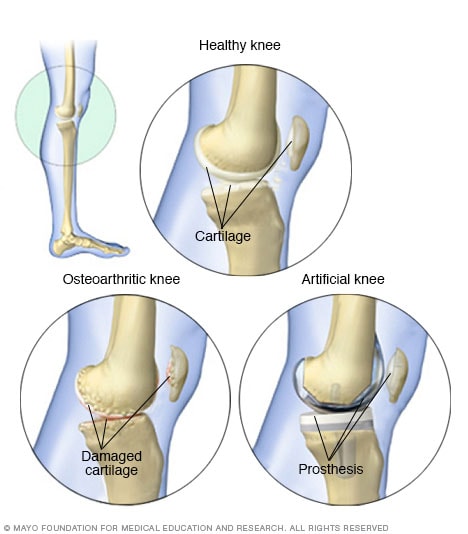
You should know that “knee replacement” does not usually involve replacing the knee. Most replacements involve merely inserting pads called “prothesis” in three places: On each bone and behind the knee cap, as shown above.
I asked my friend to tell me his doctor’s name, and I scheduled a visit. Here is how to choose a doctor for your knee replacement:
I could have saved myself a lot of pain and a lot of bad tennis, too.
You should know that “knee replacement” does not usually involve replacing the knee. Most replacements involve merely inserting pads called “prothesis” in three places: On each bone and behind the knee cap, as shown above.
I asked my friend to tell me his doctor’s name, and I scheduled a visit. Here is how to choose a doctor for your knee replacement:
1. Talk to people who have had the procedure. 2. Choose a doctor who has done thousands of knees.
Don’t pick the one who does knees, elbows, wrists, ankles, shoulders, and or fingers. Pick the one who does KNEES only, and I mean thousands of knees. My doctor did 60-70 knees a month. I felt confident that when he opened me up, he wouldn’t say, “Oh, my gosh, I’ve never seen that before.” Instead, he might say, “Well, only one in a thousand patients has that rare condition, but I’ve already done a couple hundred of those, so no big deal.” After consulting with, and choosing, the doctor, schedule two things:1. The operation(s). 2. The rehab.
I advise going to a rehab place, where you can live for two weeks rather than home rehab. The rehab is very important for your recovery, and you want it to take place under the best care where you will not be left to your own lazy devices. Many rehab places are quite busy, so early scheduling is advisable. The operation itself is quick — about a half hour per knee. I advise doing both knees (if you have pain in both knees) at the same time. There is no benefit to doing one at a time. You’re able to walk, immediately. And why stretch out the recovery period? When I woke from the surgery a nurse was standing at my bedside. She said, “Now, let’s walk.” And though I still was a bit groggy, walk we did. Slow, faster, then even up and down stairs — an 80+ year old man walking stairs ten minutes after surgery! Surprising, but not unusual, I was told. The good news is that the pain killer still was in my blood stream, so I felt no pain at all. The next day I would start to feel pain. Here is where you can find some good advice for your recovery period. Read it. Everyone is different. I had pain the first week, but they gave me all the pain killer I wanted. I even had a pain pump at my bedside, and when I felt pain, I pressed a button for more. Total control. Don’t worry, you won’t become addicted because you won’t be on it that long if you’re just taking if for pain. Anyway, you won’t like how icky you feel with those drugs in your body, so you’ll tend to use only what you need. Most insurance requires you to be in the hospital for three days, after which you’ll be able to transition to a rehab facility or home. Again, I recommend the rehab facility for a better recovery. After a week or so, my pain eased considerably, but the rehab hurt. They push you to straighten your leg all the way, and then bend it so your heel touches your butt. Even when you think you can’t do it, they do it for you. Lots of pain for a couple days. I did a lot of groaning. And then the pain eases and eases and after two weeks it’s just about gone. In a month I was back to tennis, and have had no pain since. I can run as well as ever in my life, and looking back I regret not having the surgery sooner. I think the average replacement lasts 10 – 20 years. I’m on my 10th and 11th years with my right and left knees (which, as I said, I should have done simultaneously) and so far, so good. Being 89, there is a good chance my knees will outlive me. Good luck. Rodger Malcolm Mitchell Monetary Sovereignty Twitter: @rodgermitchell Search #monetarysovereignty Facebook: Rodger Malcolm Mitchell……………………………………………………………………..
The Sole Purpose of Government Is to Improve and Protect the Lives of the People.
MONETARY SOVEREIGNTY
 #Monetary Sovereignty - Mitchell
Thanks for the info Rodger. I’m 66 and have had both of my hips replaced and have not regretted doing them. I had them done by a surgeon who only does hips, so I completely agree with your premise that only have a specialist who does one type of surgery do your replacement surgery.
LikeLike
Yes, we all are built slightly differently. You don’t want your doctor opening you up and thinking, “I wonder how to fix that?” If I were to have a hip done, I’d want the guy who already had done a thousand of them and has seen everything.
LikeLike
Thank you! Very helpful.
LikeLike
Good luck, Charles.
LikeLike
Happy birthday! Assuming it’s your birthday! Thank you for your awesome blog, I love it!
LikeLike
Thanks Tim, I’ll save it for a restaurant visit so I can get a free dessert and a serenade.
LikeLike
Ironically, I just found out. I have no joint space between my knees and at 50 They of course encourage physical therapy and other things. And I will follow through on that. But one question I did ask the physical therapist on our first appointment today. Is why Would I not just get my cartilage replaced. Because I know it’s not gonna grow back and I’m young. I can recover better. And I have good insurance right now?
LikeLike
You are asking the right question. Physical therapy is unlikely to help — and even could hurt — arthritic knees. Ask an orthopedist rather than a therapist about this.
LikeLike
Nothing to do with knees but something I came across in an article that MS can and would have solved in our economy if it had not been vetoed:
Richard Nixon vetoed the bipartisan 1971 Comprehensive Child Development Act.
That legislation would have begun creating a federally funded, locally run network of affordable childcare options. Instead, childcare needs spiked as mothers flocked to the labor force of a changing economy
LikeLike
The false notion that the federal government needs to save dollars, has killed, tortured, starved, impoverished, and prevented the education of millions of Americans. It is the single, most damaging myth in America’s history, and it still is being promulgated by politicians, educators, and the media.
If ever the American people discover how much that pernicious lie has cost them, they will turn on the bastards promulgating it, and most of America’s greatest problems will be solved.
LikeLike