–With your approval, the government steals dollars from you

Mitchell’s laws:
●The more budgets are cut and taxes increased, the weaker an economy becomes.

●Until the 99% understand the need for federal deficits, the upper 1% will rule.
●To survive long term, a monetarily non-sovereign government must have a positive balance of payments.
●Austerity = poverty and leads to civil disorder.
●Those, who do not understand the differences between Monetary Sovereignty and monetary non-sovereignty, do not understand economics.

==========================================================================================================================================

Here is yet another example of how the government, with the unquestioning approval of the voters, steals dollars out of the economy

Yahoo Finance
Treasury says to raise $5 billion from AIG stock sale

WASHINGTON (Reuters) – The U.S. Treasury Department said on Friday it expects to raise $5 billion from its sale of American International Group (AIG) stock, cutting the government’s stake in the bailed-out insurer to 55 percent.

Translation: The U.S. Treasury, which creates dollars, and so, does not need to receive dollars from anyone, expects to drain $5 billion from the U.S. economy.

The sale, which would bring a profit of about $300 million to the U.S. Treasury, comes as President Barack Obama campaigns for a second term and has been forced to defend his administration’s decision to use taxpayer money to prop up companies during the crisis.

Translation: $300 million of those dollars are in addition to the dollars the Treasury previously had pumped into the economy as a stimulus. So our struggling economy has now been “unstimulated” by the previous stimulus plus an extra $300 million drained out.

The Treasury Department priced the offering at $30.50 a share, six percent above the $28.72 price needed for the U.S. government to break even on its investment in the insurer.

Translation: The Treasury hopes to drain as many stimulus dollars out of the economy as possible.

AIG intends to buy up to $3 billion of the offering.

Translation: Although taxes weaken the economy, AIG intends to pay $3 billion in extra taxes.

The sale of 163.9 million shares of AIG stock will reduce the government’s holding in the insurer to 55 percent from 61 percent. The offering is expected to close next week.

Translation: The Treasury will continue to drain many billions of dollars from the economy.

The insurer received multiple bailouts under both the Obama and Bush administrations, with the government pledging as much as $182 billion in aid. After the latest sale, the Treasury’s investment in AIG will be about $25 billion.

Translation: The economy received multiple stimuli under both the Obama and Bush administrations. Since then, the Treasury has drained all but $25 billion of that stimulus. The Treasury still intends to drain $25 billion more out of the economy.

The Obama administration has been unwinding its position in the politically unpopular financial crisis bailout programs. More than 300 small banks have yet to repay taxpayers. The administration could sell its remaining stake in AIG this year but has been adamant in saying it will not act for political reasons.

Translation: “Politically unpopular” means the voters have not been told the truth: The economy needs the dollars and the federal government does not. When 300 small banks pay extra tax to the government, the economy will suffer even more. The administration’s political reasons for not acting are simple: It knows the economy would suffer, and that would help sink President Obama’s reelection chances.

Summary: The upper income 1% wants the economy to tank, because that opens the gap between the 1% and the 99%. As we have explained previously, absolute income is less important than comparative income. The 1% prefers the income gap to open, even if that means they themselves lose a bit of income.

The administrate, being beholden to the 1%, also wants the gap to open, but realizes the resultant economic decline would mitigate against reelection, so will hold off on further austerity measures until after November.

And the 99%, having been brainwashed by the 1%, not only approves of anti-stimulus, money draining, they insist on it.

Rodger Malcolm Mitchell
Monetary Sovereignty


==========================================================================================================================================
No nation can tax itself into prosperity, nor grow without money growth. Monetary Sovereignty: Cutting federal deficits to grow the economy is like applying leeches to cure anemia. Two key equations in economics:
Federal Deficits – Net Imports = Net Private Savings
Gross Domestic Product = Federal Spending + Private Investment and Consumption + Net exports

#MONETARY SOVEREIGNTY
–I’m really surprised to find myself disagreeing with Marshall Auerback about minimum wage

Mitchell’s laws:
●The more budgets are cut and taxes increased, the weaker an economy becomes.

●Until the 99% understand the need for federal deficits, the upper 1% will rule.
●To survive long term, a monetarily non-sovereign government must have a positive balance of payments.
●Austerity = poverty and leads to civil disorder.
●Those, who do not understand the differences between Monetary Sovereignty and monetary non-sovereignty, do not understand economics.

==========================================================================================================================================

Marshall Auerback is a hedge fund manager who seems to understand the fundamentals of Monetary Sovereignty and economics in general. So I was a taken aback by his article referenced in the Naked Capitalism blog site:

Top 5 Reasons Why Raising the Minimum Wage Is Good for You and Me

In recent months, a number of states have again taken the lead on measures to raise the minimum wage. Massachusetts is moving toward a minimum of $10 per hour. Other measures are on the table in New York, Illinois, New Jersey, Connecticut and Missouri. Meanwhile Sen. Tom Harkin, D-Iowa, is pressing for the federal minimum wage to rise to $9.80 per hour by 2014.

Here are five reasons why we should cheer for working America getting a raise.

1. Good for Families: According to economist James Galbraith, raising the minimum wage would raise the incomes of 28 million Americans. Women would particularly benefit because they tend to work for lower wages than men. As Galbraith sees it, raising the minimum wage is family friendly policy:

With more family income, some people would choose to retire, go back to school, or have children, making it easier for others who need jobs to find them. Working families would have more time for community life, including politics; Americans would start to reclaim the middle-class political organization that they once had. Because payroll- and income-tax revenues would rise, the federal deficit would come down. Social Security worries would fade.

Wait a second, “Raising the minimum wage would raise the incomes of 28 million Americans,” and raising people’s pay encourages them to retire? Am I the only one who sees a disconnect, here?

With higher pay, working families will have more time for politics? Huh? And reducing the federal deficit is a good thing? Marshall, have you forgotten all you know about Monetary Sovereignty?

2. Good for Economic Recovery: To get the economy back on track, spending power has to be in the hands of those who actually spend in the real economy. That means regular people, not the super-wealthy who tend to hoard wealth or invest in financial products.

Every “investment in financial products” transfers dollars from one person to another. The dollars keep moving, from one bank account to the next, and during this process, some are spent.

Minimum wage makes automation more attractive, which leads to unemployment.

3. Helps People Get Out of Debt: As our economy has become increasingly directed toward Wall Street and the so-called FIRE (finance, insurance, real estate) sectors, more wealth has migrated to the top 1 percent. On top of that, real wages have increasingly lagged behind the growth in productivity. It is also clear that hours worked and persons employed in the “productive” sector have been in decline over the last few decades.

This all may be true, but is irrelevant to the question of minimum wage, which generally is paid to people with the lowest productivity (their productivity is not enhanced by computers). Giving them raises won’t increase their productivity, nor will it have a meaningful effect on the income gap.

An increase of a couple of dollars per hour or more in the minimum wage could make huge improvements in the difficult existence of the working poor, perhaps allowing them to exit the debt treadmill and stand a better chance of eventually rising into a revitalized middle-class.

Or, they could be fired as too expensive — to be replaced by machines.

Admittedly, corporate profits might suffer a little and some businesses at the lowest end might disappear. That said, corporate profits as a percentage of national economic output are already at an all-time record levels. And it’s questionable whether such levels of profitability can be sustained. Firms have lots of unused capacity lying around because people can’t afford to buy products and services. Sluggish sales growth is directly connected to lagging wage rates.

Raising the minimum wage will do little to correct “lagging wage rates,” most of which are far above the minimum rate. Firms have unused capacity, which mitigates against inflation. Reduce that capacity, and prices will rise, hurting all workers.

At the same time, dependence on food stamps has surged by over 14 million over the same period. And “financial engineering” has helped to create a significant escalation in debt being borne by the private sector, particularly consumers.

Food stamp usage has surged because we still are in a recession. Raising the minimum wage merely reduced business profits, but does nothing to cure the recession. Increased federal deficit spending is needed for that.

4. Protects Workers From Abuse: A higher minimum wage would also help to mitigate the abusive, exploitative working practices of a number of employers, who take advantage of the currently low minimum wage to seek cut-rate help. Such employers often use undocumented labor, which further undermines America’s working poor.

By definition, the current minimum wage always is “low,” so employers paying the minimum wage always can be accused of “taking advantage. Undocumented labor will not be helped by increases in the legal minimum wage.

5. Justice for Working Americans: The past 30 years have witnessed a dramatic redistribution of national and personal income in favor of profits for the rich. At the same time, this period has been associated with a dramatic decline in the performance of the US economy. To raise the minimum wage would be literally the minimum we could do for those who have suffered from the economic crisis: the working population. It would be an act of justice.

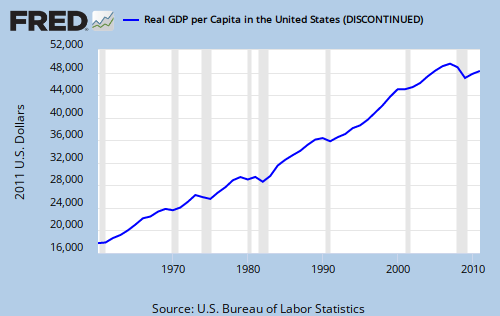
He says the past 30 years have “been associated with a dramatic decline in the performance of the US economy”? Really? His definition of “performance” must be different from mine. Here is the Real (inflation adjusted) Per Capita Gross Domestic Product for the past 50 years:

Monetary Sovereignty

That looks like pretty good performance growth, but for the current recession period.

Bottom line, minimum wage laws do have some benefit. They prevent employers from being too exploitative and paying desperate workers starvation wages. But there is a downside — a major downside: Businesses measure production value of each asset, including employees.

As employee costs goes up, businesses look for alternatives, like mechanization and shipping jobs overseas. So minimum wage runs head-on into unemployment. Further, it does nothing at all, for the vast majority of people who already receive more than minimum wage, but still are part of the 99% lower income group.

Finally, minimum wage does not add dollars to the economy, so is not stimulative. It may, in fact, subtract dollars from the economy, as overseas payrolls increase.

All 5 of Mr. Auerback’s goals can be accomplished with the following nine steps, none of which involve minimum wage:

1. Eliminate FICA (Click here)
2. Medicare — parts A, B & D — for everyone
3. Send every American citizen an annual check for $5,000 or give every state $5,000 per capita (Click here)
4. Long-term nursing care for everyone
5. Free education (including post-grad) for everyone
6. Salary for attending school (Click here)
7. Eliminate corporate taxes
8. Increase the standard income tax deduction annually
9. Increase federal spending on the myriad initiatives that benefit America

In short, the solutions lie with added government deficit spending, not with added burdens to business.

Rodger Malcolm Mitchell
Monetary Sovereignty


==========================================================================================================================================
No nation can tax itself into prosperity, nor grow without money growth. Monetary Sovereignty: Cutting federal deficits to grow the economy is like applying leeches to cure anemia. Two key equations in economics:
Federal Deficits – Net Imports = Net Private Savings
Gross Domestic Product = Federal Spending + Private Investment and Consumption + Net exports

#MONETARY SOVEREIGNTY

–New Paradigm II: What are your plans for the Age of Disemployment?

Mitchell’s laws:
●The more budgets are cut and taxes increased, the weaker an economy becomes.

●Until the 99% understand the need for federal deficits, the upper 1% will rule.
●To survive long term, a monetarily non-sovereign government must have a positive balance of payments.
●Austerity = poverty and leads to civil disorder.
●Those, who do not understand the differences between Monetary Sovereignty and monetary non-sovereignty, do not understand economics.

==========================================================================================================================================

In The new paradigm: Disemployment. Less work; more life we discussed the fact that computers are becoming smarter and each year are able to do more of what we’d thought only humans could do.

For example:

SCIENTIFIC AMERICAN
Machines that think for themselves
New techniques for teaching computers how to learn are beating the experts
By Yaser S. Abu-Mostafa | June 20, 2012

Machine learning is a branch of computer science that combs through data sets to make predictions about the future. It is used to identify economic trends, personalize recommendations and build computers that appear to think.

A couple of years ago the directors of a women’s clothing company asked me to help them develop better fashion recommendations for their clients. No one in their right mind would seek my personal advice in an area I know so little about—I am, after all, a male computer scientist—but they were not asking for my personal advice.

They were asking for my machine-learning advice, and I obliged. Based purely on sales figures and client surveys, I was able to recommend to women whom I have never met fashion items I have never seen. My recommendations beat the performance of professional stylists.

Advances in machine learning over the past decade have transformed the field. Indeed, machine-learning techniques are responsible for making computers “smarter” than humans at so many of the tasks we wish to pursue. Witness Watson, the IBM computer system that used machine learning to beat the best Jeopardy players in the world.

The need for professional stylists has just been reduced somewhat.

Then there’s:

My New Scientist
Robots move into the mining business
30 July 2012 by Michael Moore and Michael Reilly

The dirty, back-breaking work of extracting minerals from the Earth is being taken over by machines. Trucks nearly as tall as three-storey buildings are a common sight rumbling through the dusty, red-hued landscape of the Pilbara region in Australia.

But look carefully at some of them: the cabs are empty of human occupants. The trucks are part of mining giant Rio Tinto’s Mine of the Future initiative. The firm is betting $500 million that robots are the future of mining.

South Africa’s famously deep gold and platinum mines are still mostly worked by people. Each day after blasting is complete, a foreman descends into the fresh tunnels, tapping the roof and listening for a hollow thud that could indicate a hanging wall is in danger of collapsing.

But entry inspections are often rushed, because miners’ pay is tied to hitting benchmarks in a timely fashion. Some 14 miners have died already this year in such “ground falls”, according to the country’s Department of Mineral Resources.

To keep miners out of harm’s way, Declan Vogt of the Council for Scientific and Industrial Research in Auckland Park, Johannesburg, South Africa, and colleagues have built a robot that can navigate the 1-metre-high tunnels on tank-like treads and scan rock faces for weaknesses with a thermal camera. “Rock that is firmly attached to its surroundings will cool more slowly than rock that is broken,” says Vogt.

When weaknesses are spotted, the robot can tap on them with a long arm, and use microphones to listen to the sound it makes. On-board neural network software trained by mine inspectors will recognise if the area is safe.

“Our vision is of a fleet of small robots doing various tasks,” including mining and hauling ore, Vogt says.

Swedish firm Sandvik has deployed a mixture of autonomous heavy equipment and robot vehicles in several mines around the world over the last few years. If all goes as planned, within the next decade some mines will be designed not to suit people, but to accommodate the needs and abilities of robots.

Thousands of miners will be safer — but unemployed. Then consider this:

ScienceNews
Paralyzed woman grips, sips coffee with robot arm
Human brain-computer interface enables useful movement
By Rachel Ehrenberg June 16th, 2012;

Directing a robotic arm with her thoughts, a paralyzed woman named Cathy can pick up a bottle of coffee and sip it through a straw, a simple task that she hasn’t done on her own for nearly 15 years. The technology that brought about the feat is a brain-computer interface system: A computer decodes signals from a tiny chip implanted in the woman’s brain, translating her thoughts into actions that are carried out by the robot arm.

Visualize one manager, running an entire robotic factory with her thoughts. She might lounge on a beach, looking at a screen that can show her every inch of the operation.

The factory computers run everything, but on those rare occasions, when the computers encounter a circumstance they’ve not seen, the human supervisor thinks, “Shut down belt #6.” The belt stops

The computers (using machine learning) now know that when this rare circumstance occurs again, they’ll shut down belt #6. If they’re wrong, the human will think of the correct solution, further teaching the computers.

Eventually, computerized machines will do it all. Even that one manager will be unemployed. World unemployment will rise one more tiny notch.

Is this a bad thing or a good thing? I say it’s a good thing.

I am unemployed, but my unemployment is known as “retirement.” I no longer need to work for money, so I don’t. My “work” is this blog, tennis, reading, my family, travel. For me, unemployment is freedom.

How would you like to be able to spend the rest of your years doing whatever pleases you? Given that opportunity, “unemployment” would not be a problem; unemployment would be your goal.

We view unemployment as a problem, because we can’t visualize a world where people don’t work for money. But look around you. Millions of people don’t need to work for money, and most of them lead pretty nice lives.

But, our leaders devise plans to make us all work for money. They want to “cure” our freedom not to be forced to work for money. It’s as though there were some moral imperative that makes working for money good and not working for money bad.

Once, that might have been true. But no more. Our leaders should devise plans to anticipate the future — plans that help us deal with not needing to work for money.

How? By providing either the things we buy for money, or by providing the money itself.

Stretch your imagination and visualize all the things you pay for: Food, clothing, shelter, health care, amusement. What if you were given some of those things and already had the money to pay for others. Wouldn’t your life be better?

What if federally provided computers, programmed with massive data about human afflictions, tested your body, to locate problems. Might you enjoy a healthier life?

What if everyone’s housing cost less, because human labor no longer was need to build houses? Might you enjoy a better home?

What if food and clothing were less expensive, because machines did all the farming, designing, sewing, shipping and selling?

I have just described doctor, carpenter, plumber, roofer, designer, salesperson, shipper and farmer unemployment. Is that a bad thing or a good thing?

Bottom line: I believe the focus on “curing” unemployment is misdirected and harmful. It’s like focusing on the creation of a better horse cart, in the age of automobiles.

Our future is not one of full employment. Our future is one of disemployment — something closer to what I have, now.

Even my Modern Monetary Theory (MMT) friends propose a cure for unemployment called Jobs Guarantee (JG). They are well meaning, but do not consider the future of technology. Better they should propose a QLG (Quality of Life Guarantee).

Our leaders should focus on ways to improve our lives with less mandatory work. Employment, as a basic goal, is becoming obsolete. The basic goal is the improvement of our lives.

We are at a fork in the road. The government can focus on, plan for, and invest in, new technology and appropriate laws. Or it can pretend technology has plateaued, and continue to improve horse carts.

In an ideal world, each of us should be able to do what pleases us most (so long as others are not injured, of course). If working for money pleases you, so be it. But if there are other things that please you more, the ideal world would allow you to do them. Either way, disemployment is coming, whether we like it or not.

When our leaders speak of curing unemployment, your question should be, “What are your plans for making my life and my children’s lives more enjoyable, more comfortable, safer, healthier — better? What are your plans for the coming age of disemployment?

Rodger Malcolm Mitchell
Monetary Sovereignty


==========================================================================================================================================
No nation can tax itself into prosperity, nor grow without money growth. Monetary Sovereignty: Cutting federal deficits to grow the economy is like applying leeches to cure anemia. Two key equations in economics:
Federal Deficits – Net Imports = Net Private Savings
Gross Domestic Product = Federal Spending + Private Investment and Consumption + Net exports

#MONETARY SOVEREIGNTY

Trying to survive in this world of debt-hawk finger pointing and voter remorse. GO BIG!!

Mitchell’s laws:
●The more budgets are cut and taxes increased, the weaker an economy becomes.

●Until the 99% understand the need for federal deficits, the upper 1% will rule.
●To survive long term, a monetarily non-sovereign government must have a positive balance of payments.
●Austerity = poverty and leads to civil disorder.
●Those, who do not understand the differences between Monetary Sovereignty and monetary non-sovereignty, do not understand economics.

==========================================================================================================================================

There probably is a word for saying you want something but don’t.

The word for really wanting something, then when you get it, not wanting it any more is “remorse,” as in “buyer’s remorse” But what is it when you pretend to want something (for ulterior reasons), but know that if you get it, you’ll hate it?

Perhaps we should stick with “remorse,” as in debt-hawk remorse. Who can forget the loud-mouth blusterers lying about the “unsustainable deficit,” Who can forget the phony demands of Congress and the debt-hawk blogs, that we not only cut the deficit, but “GO BIG”?

Who can forget the sickening panderers to the idiot Tea Party — their groveling became so extreme, these lickspittle politicians attempted to outdo each other in rejecting all hope of compromise — just to brown up to right wing? Ah, profiles in courage.

Now, those same lickspittle politicians, having destroyed the lives of the lower 99% income group, look for a whipping boy.

C-SPAN
DEFICIT & ECONOMY
Leaders Urge Deficit Reduction Committee to “Go Big”

WASHINGTON, DC, Wednesday, September 21, 2011 (Note the date)

On Capitol Hill the deficit reduction “super committee” continues its work – and today the New America Foundation hosted a discussion with a bipartisan group of current and former members of Congress and White House officials who urged the joint committee to “Go Big” and seek deficit reductions of $4 trillion or more.

Translation: “Even a $4 trillion deficit cut isn’t enough. We want more, more, more. Maybe $5 trillion. Or $6 trillion. Sky’s the limit. (Tea Party, are you watching? Is my nose in deep enough?)

“But a funny thing happened on the way to the Tea Party. Someone used the magic words “fiscal cliff,” and well duh, we discovered cutting deficits (i.e. bleeding the anemic patient) will hurt the economy. Who’da thunk?”

What is the Fiscal Cliff?
By Thomas Kenny, About.com Guide

“Fiscal cliff” is the popular shorthand term used to describe the conundrum that the U.S. government will face at the end of 2012.

Possible Effects of the Fiscal Cliff

The effect on the economy could be dramatic. While the combination of higher taxes and spending cuts would reduce the deficit by an estimated $560 billion, the CBO estimates that the policies set to go into effect would cut gross domestic product (GDP) by four percentage points in 2013, sending the economy into a recession (i.e., negative growth).

A Wall St. Journal article from May 16, 2012 estimates the following impact in dollar terms: “In all, according to an analysis by J.P. Morgan economist Michael Feroli, $280 billion would be pulled out of the economy by the sunsetting of the Bush tax cuts; $125 million from the expiration of the Obama payroll-tax holiday; $40 million from the expiration of emergency unemployment benefits; and $98 billion from Budget Control Act spending cuts.

Amid an already-fragile recovery and elevated unemployment, the economy is not in a position to avoid this type of shock.

Translation: “We Tea Party sycophants bravely demanded that the government “Go Big!” Even a $4 trillion deficit reduction wasn’t sufficient. Now, facing a puny deficit reduction of less than 15% of our “Go Big” amount, we’ve begun to panic.

“Nobody told us deficit reduction pulls money out of the pockets of the public. How were we supposed to know that?

“Sure, we voted for the law. In fact we insisted on it at the threat of filibuster. In further fact, $4 trillion wasn’t enough. But, this isn’t our fault. It’s the fault of you voters. You’re the ones who wanted to cut the deficit. You should have known better.”

The cost of indecision is likely to have an effect on the economy before 2013 even begins. The CBO anticipates that a lack of resolution will cause households and businesses to begin changing their spending in anticipation of the changes, possible reducing GDP by a full half-percent in the second half of 2012.

Translation: “We pretend the deficit reduction is too sudden. When we said, GO BIG!, we really meant, “GO BIG!, but go really, really slowly big. Like BIG that takes many years.

“Yes, we know, taking dollars out of the economy, no matter how slowly, will hurt the economy. And yes, we know the American public — especially the lower income 99% — will take a terrible beating (though the upper 1% will be O.K.)

“But the important point is: The right wing in Congress, can’t lose. When the American worker falls over the fiscal cliff, we’ll blame Obama, you voters will believe us, and we’ll get elected. Simple.

“Right wing politics is the most fun when the President is clueless, his party is wimpy and the voters are ignorant.

GO BIG!! GO BIG!! GO BIG!!”

Rodger Malcolm Mitchell
Monetary Sovereignty


==========================================================================================================================================
No nation can tax itself into prosperity, nor grow without money growth. Monetary Sovereignty: Cutting federal deficits to grow the economy is like applying leeches to cure anemia. Two key equations in economics:
Federal Deficits – Net Imports = Net Private Savings
Gross Domestic Product = Federal Spending + Private Investment and Consumption + Net exports

#MONETARY SOVEREIGNTY