–Have you bribed a politician lately?

Mitchell’s laws:
●The more budgets are cut and taxes increased, the weaker an economy becomes.

●Austerity starves the economy to feed the government, and leads to civil disorder.
●Until the 99% understand the need for federal deficits, the upper 1% will rule.
●To survive long term, a monetarily non-sovereign government must have a positive balance of payments.
●Those, who do not understand the differences between Monetary Sovereignty and monetary non-sovereignty, do not understand economics.

==========================================================================================================================================

Have you bribed a politician lately?

The Washington Post published an interesting article titled, When is a campaign contribution a bribe?
By Robert Barnes, Published: August 12

A few excerpts:

Former Alabama governor Don Siegelman heads back to prison next month, contrite about and embarrassed by his bribery conviction. But when he faced resentencing earlier this month, he still was not quite ready to concede that he knowingly broke the law.

“If I had known I was coming close to the line where a campaign contribution becomes a bribe and a crime, I would have stopped,” Siegelman told U.S. District Judge Mark Fuller, who sentenced Siegelman to 6 1/2 years in prison.

Federal law makes it a crime to corruptly solicit or accept money with the intent of being rewarded or influenced in official actions.

In 1991, (the Supreme Court) ruled that a campaign contribution could be a bribe if prosecutors proved a quid pro quo — that the contribution was “made in return for an explicit promise or undertaking by the official to perform or not to perform an official act.”

In a subsequent case, Justice Anthony Kennedy said the quid pro quo need not be expressly stated. But lower courts have differed, since then, on exactly what standards apply.

In Siegelman’s case, the contribution at issue was to his pet project, a lottery referendum measure that would help education. Richard Scrushy, a health-care facility magnate who had been appointed to a state hospital facility planning board by previous Republican governors, gave $500,000 to the referendum campaign. Siegelman, a Democrat, later reappointed him to the board.

Let’s say you understand that the Romney/Ryan ticket is a shill for the upper 1% income group, and intends to slash benefits for the 99% under the guise of “fiscal responsibility.” You are part of the lower 99% who would be hurt by cuts to Medicare and Social Security, so you send in your $25 donation to re-elect Obama.

Later, Obama votes to expand Medicare and Social Security. You keep your benefits. Have you bribed the President?

Let’s say you are one of the Koch brothers who, to quote an article in The New Yorker, “believe in drastically lower personal and corporate taxes, minimal social services for the needy, and much less oversight of industry—especially environmental regulation. These views dovetail with the brothers’ corporate interests.”

So you give $100 million to the campaigns of numerous right-wing politicians, all of whom express their undying gratitude by voting to drill for oil in ecologically sensitive lands, cut taxes on the wealthy and on corporations, and reduce Medicare, Social Security, Medicaid and aid to the poor.

Have you bribed these politicians?

You may try to find an answer, but you will fail. No matter how you twist and turn the semantics of what constitutes a bribe and what merely is free speech, you will not be able to find a boundary.

For instance, you might say a bribe involves a direct quid pro quo, in which something specific is promised in return for something else specific. Does this include giving money to someone who has promised to give you money if elected? Does “direct quid pro quo” include the tax savings right wing politicians have promised to the Kochs?

I submit that everyone, who gives money to a politician, does it for the same reason: They want that politician to do something to benefit someone. There is no bright line difference between the Alabama governor who reappointed a guy to yet another term on a board, the Koch brothers who essentially bribe the entire right wing, the gal who slips a cash-filled envelope to the small town mayor to get a job for her brother. – and you, who gave $25 to the politician who promises not to cut your Medicare.

While there is no clear solution, there may be some partial solutions – some steps in the right direction. And they have to do with money, and with what I consider the false belief that giving money is a form of free speech.

The 1st Amendment says, “Congress shall make no law . . abridging the freedom of speech, or of the press . . . “ That’s it. In my innocense, I would include talking and writing as “speech.” Although money supposedly “talks,” somehow I don’t consider giving a politician money, to be a form of speech – especially when the money is so big it simply cannot be ignored by the recipient.

The Dalberg quote, “Power tends to corrupt, and absolute power corrupts absolutely,” could be refashioned. “Money corrupts, and big time money corrupts big time.” While your $25 contribution to Obama, may not elicit a quid pro quo, is there any doubt that a million dollar contribution to a politician will get that politician to do almost anything?

Sadly, the Supreme Court does not recognize the difference between $25 and $100 million – something like not recognizing the difference between a machine gun and a Nerf gun – so in removing limits from campaign contributions, the Court, in essence said, “Guns are legal, Nerf guns, machine guns, all he same to us.”

Further, while I disagree that giving money is free speech, previous Supreme Courts have held that even some speech can be proscribed. Oliver Wendell Holmes, Jr. famously said, “The most stringent protection of free speech would not protect a man falsely shouting fire in a theater and causing a panic.”

Yes, even “free speech” is not endlessly free. There are limits. Similarly, there can and should be limits on the “free speech” of political donations.

My suggestion: A limit of $10 per person to each candidate. That would level the playing field. A rich man would have no more “free speech” than would a poor man. Not enough to influence a vote, that $10 worth of “free speech” would tell the politician how you feel.

Rather than being a bribe, that $10 would be “free speech” in its purest form — not a total solution, but perhaps a start.

Rodger Malcolm Mitchell
Monetary Sovereignty


==========================================================================================================================================
No nation can tax itself into prosperity, nor grow without money growth. Monetary Sovereignty: Cutting federal deficits to grow the economy is like applying leeches to cure anemia. Two key equations in economics:
Federal Deficits – Net Imports = Net Private Savings
Gross Domestic Product = Federal Spending + Private Investment and Consumption + Net exports

#MONETARY SOVEREIGNTY
–The indecisive and the deceptive join forces to increase the gap between the 1% and the 99%

Mitchell’s laws:
●The more budgets are cut and taxes increased, the weaker an economy becomes.

●Austerity starves the economy to feed the government
●Austerity leads to civil disorder.
●Until the 99% understand the need for federal deficits, the upper 1% will rule.
●To survive long term, a monetarily non-sovereign government must have a positive balance of payments.
●Those, who do not understand the differences between Monetary Sovereignty and monetary non-sovereignty, do not understand economics.

==========================================================================================================================================

Which is worse: No plan or a disastrous plan? With the Romney/Ryan team, you get both, and both have the same goal: To increase the income gap between the upper 1% and the lower 99% by starving the economy.

Mitt Romney (the indecisive) has become notorious for changing directions. He has stood firmly on both sides of nearly every important issue. Depending on his audience, he has been:

For and against raising the minimum wage
For and against stem cell research
For and against women’s choice
For and against health care mandates
For and against Romneycare
For and against Ronald Reagan (really!)
For and against (and for, again) a pathway to citizenship for immigrants
For and against Bush’s tax cuts
For and against a ban on assault rifles
A believer and non-believer in the dangers of global warming
A signer and non-signer of the Americans for Tax Reform pledge

In all cases where his decision would affect the economy, he has turned toward the 1% and against the 99%.

Now that we have a Presidential candidate with no plan, we have a vice presidential candidate with his disastrous “starve-the-economy-to-feed-the-government” plan, a frightening attempt to lift the 1% at the expense of the 99%, i.e to increase the gap.

Here is Paul Ryan, in his own words:

The Path to Prosperity:
A Blueprint for American Renewal, House Budget Committee – Fiscal Year 2013 Budget Resolution

To pay for the public sector’s growth, Washington must immediately tax the private sector or else borrow and impose taxes later to pay down the debt. Unfortunately, the President refuses to take responsibility for avoiding the debt-fueled crisis before us

Translation: “I want you to believe the federal budget is like your personal budget, though the federal government is the creator of the dollar and you are the user of the dollar.

“I do not want you to understand that the misnamed federal ‘deficit’ actually is our economy’s source of personal income, and without this income, there could be no dollars to spend or to lend. We would be a nation without money.

“In short, I certainly don’t want you to understand Monetary Sovereignty, and why reducing that misnamed ‘deficit’ will starve the economy.”

Our budget: Cuts government spending to protect hardworking taxpayers;
Strengthens health and retirement security by taking power away from government bureaucrats and empowering patients instead with control over their own care.

Translation: “I will ’empower’ you to pay more out of your own shallow pocket to fund your health care, so the federal government can pay less out of it’s deep pocket.”

At its core, this plan of action is about putting an end to empty promises from a bankrupt government,

Translation: “Yes I know it is impossible for a government that creates dollars to go bankrupt. It never has nor ever will bounce a check. But I don’t want you to know that, so I use scare language.”

(My budget) cuts spending by $5 trillion relative to the President’s budget

Translation: “My budget cuts private savings by $5 trillion relative to the President’s budget.” (Basic economic equation: Federal Deficits – Net Imports = Net Private Savings)

For years, bad policies advanced by both political parties have contributed to an irresponsible build–up of debt in the economy, and this debt now poses a fundamental challenge to the American way of life. This build–up of debt has manifested its effects in both the private and public sectors. In 2008, excessive leverage in the financial sector overwhelmed many banks, businesses and families.

Translation: “I want you to confuse you. That’s why I talk about banks, businesses and families, when I really am referring to the so-called ‘federal debt,’ which is not at all like personal debt.

I hope you never discover that ‘federal debt’ is just the total amount invested in Treasury securities, and has nothing whatsoever to do with your taxes or with the government’s ability to pay its bills. The word ‘debt’ has two different meanings, but you should ignore that.”

In Europe, the accumulation of public–sector debt now threatens to cause an even bigger calamity than the one caused by private– sector debt in 2008. The world’s new “toxic asset” is the sovereign debt of irresponsible European governments, infecting the balance sheets of major banks and threatening the stability of the global economy.

Translation: “Nations like Greece, France, Italy, Ireland, Spain and Portual have huge sovereign debts, but here’s something I hope you don’t find out. They use the euro, which is not their sovereign currency, so they can’t pay their debts. The U.S. uses the dollar, which is our sovereign currency, so we can pay any size debt.”

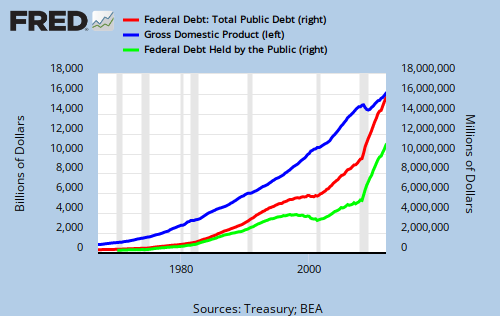
Total federal debt has now surpassed the size of the entire U.S. economy.

Translation: “Another little lie I hope you don’t discover – well actually two little lies:

“1. Total federal debt’ includes dollars the government owes to itself. It’s like your checking account owing money to your savings account. But I use Total debt to scare you, because it’s a bigger number, and

“2. Actually, this has happened in the past – 1967 – with no effect on the economy. The reason: Federal debt is just dollars invested in things like T-bills, which has no relationship to the economy. It’s like comparing dollars invested in Walmart stock with Gross Domestic Product – completely meaningless – but I’ve fooled you by misusing the word ‘debt,’ haven’t I?”

Monetary Sovereignty

The blue line is Gross Domestic Product. The red line is TOTAL “debt” (i.e. investment in Treasury securities, including investments by the government itself). The green line is investments in T-securities by those not in the government.

Republicans offered a budget last year that would lift the crushing burden of debt and restore economic growth

Translation: “We’ll reduce investment in T-securities by starving the economy. The misnamed ‘debt’ (investment in T-securities) is no burden at all, ‘crushing’ or otherwise, but we use flamboyant language to scare you into giving up your money.

Too great a percentage of America’s vast natural resources remain locked behind bureaucratic barriers and red tape. This budget lifts moratoriums on safe, responsible energy exploration in the United States, ends Washington policies that drive up gas prices, and unlocks American energy production to help lower costs, create jobs and reduce dependence on foreign oil.

Translation: “To hell with the ecology. To hell with our forests, clean water, clean air and the hundreds of species that are going extinct. Let’s dig those open-pit mines and chop down those trees and pollute. And ‘drill baby, drill.’ It’s what the 1% wants.”

(My budget) strengthens Medicaid, food stamps and job–training programs by providing states with greater flexibility to help recipients build self–sufficient futures for themselves and their families. This budget ends that misguided approach and instead converts the federal share of Medicaid spending into a block grant, thus freeing states to tailor their Medicaid programs to the unique needs of their own populations.

Translation: “The federal government, which has the unlimited ability to pay its bills, will shift the financial burden to the states, which already are going broke. This is what I mean by ‘flexibility’ and ‘freeing states.’”

Medicare is facing an unprecedented fiscal challenge. Its failed reliance on bureaucratic price controls, combined with rising health care costs, is jeopardizing seniors’ access to critical care and threatening to bankrupt the system – and ultimately the nation.

The risk to Social Security, driven by demographic changes, is nearer at hand than most acknowledge. This budget heads off a crisis by calling on the President and both chambers of Congress to ensure the solvency of this critical program.

Translation: You don’t know this, but Medicare and Social Security are federal agencies. Like all other federal agencies — Congress, the White House, the Supreme Court, the military et al –- Medicare and Social Security never can be insolvent unless the government wills it.

“Even if FICA taxes dropped to $0, and benefits tripled, Medicare and Social Security still could continue paying their bills, forever. But because Medicare, Medicaid and Social Security benefit the 99% more than the 1%, these plans need to be cut. How else can we increase the income gap?”

Individual tax reform: The current code for individuals is too complicated, with high marginal rates that discourage hard work and entrepreneurship. This budget embraces the widely acknowledged principles of pro–growth tax reform by proposing to consolidate tax brackets and lower tax rates, with just two rates of 10 and 25 percent, while clearing out the burdensome tangle of loopholes that distort economic activity.

Translation: “‘Consolidate tax brackets’ means: ‘Lower the rate paid by the 1% and raise the rate paid by the 99%.’

And let’s eliminate those ‘burdensome’ loopholes like the mortgage interest deduction, the health insurance premium deduction, the charity deduction, the energy savings deduction, tax preparation fees, disaster area deductions, the retirement tax credit — you know, all those ‘too complicated’ things that can lower your taxes.”

This budget charts a sustainable path forward, ultimately erases the budget deficit completely, and begins paying down the national debt.

Translation: “We want taxes to be greater than spending, i.e to starve the economy to feed the government. As the supply of money declines, the 99% will starve, but the 1% will have far more of their wealth in non-money properties. I’m just hoping you’ll vote to be slaves of the 1%.”

Bottom line: Romney, being the Zelig of American politics, does not have the chops to be the President of the United States. But as a danger to America, he does not compare with Ryan, whose plan would destroy the lives of the middle and lower classes.

I believe the nation is in danger. If you are part of, or even care about, the lower 99% income group, you would suffer greatly under a Romney/Ryan authority.

Rodger Malcolm Mitchell
Monetary Sovereignty


==========================================================================================================================================
No nation can tax itself into prosperity, nor grow without money growth. Monetary Sovereignty: Cutting federal deficits to grow the economy is like applying leeches to cure anemia. Two key equations in economics:
Federal Deficits – Net Imports = Net Private Savings
Gross Domestic Product = Federal Spending + Private Investment and Consumption + Net exports

#MONETARY SOVEREIGNTY

–Why starve the economy to feed the governement?

Mitchell’s laws:
●The more budgets are cut and taxes increased, the weaker an economy becomes.

●Austerity starves the economy to feed the government
●Austerity leads to civil disorder.
●Until the 99% understand the need for federal deficits, the upper 1% will rule.
●To survive long term, a monetarily non-sovereign government must have a positive balance of payments.
●Those, who do not understand the differences between Monetary Sovereignty and monetary non-sovereignty, do not understand economics.

==========================================================================================================================================

Why starve the economy to feed the government?

Federal spending sends dollars into the economy. Federal taxes take dollars out of the economy. When federal spending exceeds taxes, more dollars go into the economy than come out. This is the government’s deficit and the economy’s profit.

Our political leaders, the media and the old-line professors are fixated on the health of the federal government’s finances. They are fixated on what they call the “federal deficit” and the “federal debt.” But the problem is not the finances of the government which, being Monetarily Sovereign, never can run short of dollars. The problem is the finances of the economy which already has run short of dollars.

The bigger the so-called federal “deficit,” the bigger the economy’s profit. Why worry about the federal “deficit,” when we really should worry about the economy’s lack of profit?

The federal government is not in recession. The economy is in recession. So why starve the economy to feed the government?

Unemployment is not a problem for the federal government; unemployment is a problem for the economy. So why do the Tea Party, the Republicans and even the Democrats starve the economy to feed the government?

Poverty, loss of home, bankruptcy, illiteracy are not problems for the government; they are problems for the economy. So why cut the federal deficit and starve the economy to feed the government?

When federal spending exceeds taxes the economy makes a profit. To recover from the recession and to grow, the economy needs profits. So why cut spending and increase taxes? Why starve the economy to feed the government?

The right wing claims to love Americans and to hate big government. But their plans involve “deficit” cutting, which starves the economy and feeds the government. Why feed what you hate while starving what you claim to love?

We should stop worrying about the federal “deficit.” Instead, we must worry about the economy’s lack of profit. The government doesn’t need the money. The economy needs the money.

We must stop starving the economy to feed the government.

Rodger Malcolm Mitchell
Monetary Sovereignty


==========================================================================================================================================
No nation can tax itself into prosperity, nor grow without money growth. Monetary Sovereignty: Cutting federal deficits to grow the economy is like applying leeches to cure anemia. Two key equations in economics:
Federal Deficits – Net Imports = Net Private Savings
Gross Domestic Product = Federal Spending + Private Investment and Consumption + Net exports

#MONETARY SOVEREIGNTY

–Did you know the economy is running a $1.2 trillion profit?

Mitchell’s laws:
●The more budgets are cut and taxes increased, the weaker an economy becomes.

●Until the 99% understand the need for federal deficits, the upper 1% will rule.
●To survive long term, a monetarily non-sovereign government must have a positive balance of payments.
●Austerity = poverty and leads to civil disorder.
●Those, who do not understand the differences between Monetary Sovereignty and monetary non-sovereignty, do not understand economics.

==========================================================================================================================================

I just saw the results of a poll supposedly answered by 500,000 respondents. (Disclosure: The poll was conducted by a man named Bob Livingston, who says he “is an ultra-conservative American who specializes in health issues such as nutritional supplements and alternatives to drugs.” So, consider the source.)

Most of the questions were worded with a right-wing bias, so the answers are too suspect for inclusion, here. But one caught my attention:

Where do you feel government should most focus to speed economic recovery?
26% voted: Job creation.
14% voted: Tax code overhaul.
42% voted: Reduced government spending.
7% voted: Infrastructure spending.
3% voted: Deficit reduction.
2% voted: New stimulus.
4% voted: Other.
2% voted: Homeowner assistance.

The 99% lower income group seems to believe reductions in federal spending (aka “austerity”) magically will stimulate economic growth, and that Social Security, Medicare and Medicaid benefits, which put spending money directly into consumers’ pockets, somehow reduce economic growth. And, military spending, which pays soldiers’ salaries, and pays thousands of military suppliers to employ millions of Americans, magically increases unemployment.

The 99% believes the federal government should spend less – Less to build and repair our roads, bridges and dams. Less to inspect our food and our medicines. Less to inspect banks and financial brokers. Less to defend America against enemy nations and terrorists.

Less to catch and imprison criminals. Less to create and monitor patents and copyrights. Less to help victims of floods, hurricanes, fires, tornados and earthquakes. Less to pay for our courts. Less to pay for educational services. Less to protect our bank deposits. Less for the Library of Congress and federally supported museums.

Less for disease prevention/cure, research and development. Less for occupational safety. Less for science. Less to preserve national parks. Less airplane control

The list goes on and on. The Tea/Republicans demand “less government.” The media demand a reduction in the federal “deficit.” They tell the 99% this all somehow can be accomplished with “less waste” or some other pie-in-the-sky mantra and the 99% parrot what the media and politicians tell them, not realizing they are demanding to commit economic suicide.

Greece’s awful experience with austerity matches Italy’s, France’s, Ireland’s and the UK’s. So is the problem one of mere stupidity, or is something else at work?

Today’s Chicago Tribune contained an outstanding and quite relevant article titled,
Dumb and dumber, The ‘low-information’ voter, by George Lakoff, professor of cognitive science and linguistics at the University of California at Berkeley.

Here are a few excerpts:

The term (“Low income voters” –LIV) is mainly used by liberals to refer to those who vote conservative against their interests and the best interests of the nation. It assumes they vote that way because they lack sufficient information about issues. The assumption being, of course, that if only they had the real facts, they would vote differently — for both their own best interests and those of the nation.

Liberals tend to attribute the problem in large part to conscious Republican efforts at misinformation — say, on Fox News or talk radio — and in part to faulty information gleaned from friends, family and random sources.

These assumptions come in the form of what cognitive linguists call “frames.” Frame analysis was developed by my colleague at the University of California at Berkeley, the great linguist Charles Fillmore. In the mid-1970s, Fillmore observed that every word, or fixed linguistic expression, is defined relative to a mental structure called a “frame,” which is characterized by a fixed neural circuit in the brain.

This is not just about politics. Imagine telling a Midwestern farmhand who has never heard of acupuncture that his chronic pain can be alleviated by having a doctor stick needles in him. That would probably make about as much sense to him as saying the best way for the government to deal with a huge budget deficit is to spend more money.

Facts must fit existing frame-circuits fixed in the brain if they are to be comprehended. When President Richard Nixon told the American people, “I am not a crook,” most thought of him as a crook. He activated the “crook frame,” with himself in the role of the crook.

This is why attack works a whole lot better than denial. Frames don’t work by formal logic. In logic, negation wipes out what is negated. With frames, negation strengthens what is negated. If you come up to a friend and whisper in his ear out of the blue, “Your wife is not having an affair,” you’re raising the issue of whether his wife is having an affair. Likewise, in saying, “I’m against tax relief,” one is still framing taxation as an affliction to be relieved.

All politics rests on morality. (See: The battle of money is being fought on the field of morality) Political leaders propose policies — whether regulating large banks or loosening deportation laws — because they believe them to be right. The problem, of course, is that conservatives and liberals have different ideas of what is right: from same-sex marriage to machine-gun ownership.

Progressives believe democracy starts with caring about one’s fellow citizens and acting responsibly for oneself and other citizens. Government is seen as a means for the public to provide things crucial for a decent private life and private enterprise: roads, bridges, infrastructure of many kinds, public education, public health, public transportation, a judicial system, firefighters, a patent agency, and so on.

Conservatives see democracy as giving them the liberty to pursue their own interests without necessarily being responsible for the interests of others. They believe in personal, not social, responsibility. Their liberty must be protected, and liberals are trying to take it away by going after their gun rights, private property rights, rights to run their businesses as they choose, and so on.

The liberal use of the term “low-information voters” reveals they need to recognize that conservatives have a moral system that is different from theirs and that they vote on the basis of it.

Second, they need to notice that many liberal Democrats vote on the basis of as little information as the Republicans they are calling LIVs. Third, they need to understand how brains work: If the facts don’t fit morally based frame-circuits, it’s the frame-circuits that stay and the facts that go out the window.

Fourth, liberals who speak of LIVs need to understand that many voters, Democrats as well as Republicans, vote on the basis of values and character rather than policies, material advantages and facts. In short, they vote on the basis of trust — trust in both whom they vote for and the sources of information about whom to vote for.

Cursing conservative low-information voters for not voting for liberal policies is a fool’s errand for all these reasons.

So how do political parties best inform and influence voters who have both moral systems but switch back and forth? The trick is what you’re already seeing on your television: the consistent and repetitive use of language that activates frames and moral systems. Never use the other side’s language. And always say out loud the moral framing needed for comprehending the facts.

For example, healthcare is a matter of freedom and life. If you have cancer and no healthcare, you are not free and you could die! With the right narrative, it is a powerful message, and one that tells a deep truth.

And, like it says on the back of the shampoo bottle — repeat as necessary. Brains don’t change without repetition.

Many who understand Monetary Sovereignty hope people will act in their own best interests – as we see these interests. They hope people want healthcare more than the freedom not to have healthcare. They hope people understand that a federal “deficit” and federal “debt” are not at all like personal deficits and personal debt. They hope it is necessary only show why a federal deficit is required for economic growth and a federal debt isn’t necessary at all.

Those hopes have been misguided. Two years ago, I wrote a post titled Talking past each other. In it, I said:

Those who oppose same-sex marriage focus on what they believe to be religious/moral factors. They quote the Leviticus passage, “Do not lie with a man as one lies with a woman.” Those who support same-sex marriage focus on what they believe to be legal/moral factors. Many laws grant special privileges to married couples, not offered to unmarrieds. This is felt to be a violation of the 14th Amendment’s, “equal protection clause.”

Although the above is something of an oversimplification, it is impossible for people to agree, when they’re arguing about two different things. More examples:

Israelis and Palestinians may disagree on some facts (“Who was here first? Who fired first?), but fundamentally, the Jews really are talking about the Holocaust and Jewish survival (“Never again”) and the Palestinians really are talking about choice and Palestinian survival (“We have nowhere else to go.”) They are talking past each other.

The pro-lifers are talking about morals (“Do not murder.”) and the pro-choicers are talking about science (“An embryo is not yet a sentient human”) and morals (“Don’t bring an unwanted baby into the world.”) They are talking past each other.

Democrats feel caring for people is good for the economy. Republicans feel caring for the economy is good for people. They are talking past each other, and when people talk past each other, they don’t hear each other.

The 99% will not understand Monetary Sovereignty so long as the 1% pound away using words like “federal deficit” and “federal debt.” Rather than “federal deficit,” we repeatedly should use something like “profit.” A “profit” is what we all receive when the government gives us more dollars than we give the government. Rather than saying the government is running a deficit, we should say the economy is running a profit.

Rather than “federal debt.” call it something like “investments.” The so-called debt merely is the total of T-security accounts – opened for the purpose of investment. Rather than saying the government is in debt, say the government has sold investments.

The author, Professor Lakoff, is right. Monetary Sovereignty must be backed by facts but it cannot be sold with facts alone. It must be framed and it must be repeated. Rather than focusing on government finances, the frame should be personal finances.

The U.S. government has sold $11 trillion worth of investments, and this year, the economy is running a $1.2 trillion profit. Based on the size of our economy, it needs more profit than that to grow. And, to increase profit requires more tax reductions and increased federal spending.

Rodger Malcolm Mitchell
Monetary Sovereignty


==========================================================================================================================================
No nation can tax itself into prosperity, nor grow without money growth. Monetary Sovereignty: Cutting federal deficits to grow the economy is like applying leeches to cure anemia. Two key equations in economics:
Federal Deficits – Net Imports = Net Private Savings
Gross Domestic Product = Federal Spending + Private Investment and Consumption + Net exports

#MONETARY SOVEREIGNTY