–Who needs federal employees? Not Congress. Not the President. Not us.

Mitchell’s laws: The more budgets are cut and taxes increased, the weaker an economy becomes. Until the 99% understand the need for deficits, the 1% will rule. To survive long term, a monetarily non-sovereign government must have a positive balance of payments. Austerity = poverty and leads to civil disorder. Those, who do not understand the differences between Monetary Sovereignty and monetary non-sovereignty, do not understand economics.
==========================================================================================================================================

The myth: We really don’t need government workers. They are lazy bureaucrats, who do nothing but shuffle paper.

This myth, often repeated in various forms, by those who know nothing of federal services, together with the John Boehner boldfaced lie that the federal government is “broke,” has led to:

Washington Post
More federal pay freeze plans pushed in House
By Eric Yoder

Federal pay rates would be frozen for the third straight year in 2013 under several plans that advanced in the House on Wednesday.

A spending bill covering general government matters for the upcoming fiscal year approved by a House Appropriations subcommittee contains no additional money to pay for a raise, effectively rejecting President Obama’s request for a 0.5 percent increase in January.

That spending bill, which also provides operating funds for financial regulatory agencies and central management agencies, typically is the vehicle for setting the annual federal pay raise, when one is provided.

Translation: Who needs financial regulatory agencies? They didn’t have enough trained personnel to regulate the big, dishonest banks, which led to the Great Recession, so maybe by not giving raises, we’ll attract more and better people who’ll do a better job. Right?

Also on Wednesday, the House started voting on a spending bill for the Department of Homeland Security that provides no funds for a raise there.

Translation: Who needs homeland security? We haven’t had many terrorist acts in America. So obviously these people are unnecessary. Right?

And then there’s this:

Washington Post

Weather Service says furloughs possible for up to 5,000 to close budget gap
By Lisa Rein and Jason Samenow

The National Weather Service notified lawmakers on Thursday that it plans to furlough up to 5,000 employees for a total of 13 days between July and September if Congress and the agency cannot find $36 million to cover its budget deficit.

Weather Service officials acknowledged in their memo to legislators, as well as the union, that requiring employees to take unpaid leave would seriously disrupt critical weather operations at the peak of hurricane season.

Translation: Who needs weather prediction? Hurricanes and tornadoes aren’t all that serious. Right?

And then there’s this:

House backs federal job cuts, extended pay freeze

(A) budget resolution proposed by Rep. Paul Ryan (R-Wis.) calls for continuing the freeze on federal salary rates through 2015, cutting federal employment by 10 percent by hiring only one replacement for every three employees who leave, and requiring employees to pay as much into the retirement fund as the government pays. That provision would require an increase on the employee side of as much as 6 percent of salary.

Translation: Who needs federal employees? They aren’t very helpful, are they?

Bottom line: There are a thousand stories like this, and they all are based on two facts:

1. The federal government falsely claims the federal deficit is too high, when in reality, it is too low.

2. This false claim allows the 1%, as represented by the federal government, to stick it to the 99%, as represented by federal employees, thus increasing unemployment and the gap between rich and poor.

And the American public, which is punished when federal services aren’t provided (especially the 99%), falls for this garbage.

Rodger Malcolm Mitchell
http://www.rodgermitchell.com


==========================================================================================================================================
No nation can tax itself into prosperity, nor grow without money growth. Monetary Sovereignty: Cutting federal deficits to grow the economy is like applying leeches to cure anemia. Two key equations in economics:
Federal Deficits – Net Imports = Net Private Savings
Gross Domestic Product = Federal Spending + Private Investment and Consumption + Net exports

#MONETARY SOVEREIGNTY

–Congress and the President fiddle while America’s students burn

Mitchell’s laws: The more budgets are cut and taxes increased, the weaker an economy becomes. Until the 99% understand the need for deficits, the 1% will rule. To survive long term, a monetarily non-sovereign government must have a positive balance of payments. Austerity = poverty and leads to civil disorder. Those, who do not understand the differences between Monetary Sovereignty and monetary non-sovereignty, do not understand economics.
==========================================================================================================================================

It’s difficult to imagine many factors more vital to the growth of the American economy than education. Yet our President and Congress seem incapable of understanding this need.

The federal government, which is Monetarily Sovereign, and so has the unlimited ability to pay its bills, pays for only 10% percent of total elementary and secondary education.

Monetary Sovereignty
Source: New America Foundation

Grades 1 through 12 are financed at the 90% level by local governments. The reality of monetarily non-sovereign (local) governments is they are limited in their spending ability. So, in most communities around the nation, teachers are under-paid, under-supervised and often under-trained, classrooms are under-serviced, and physical plants are under-constructed and under-maintained.

Considering the importance of education, why does our infinitely wealthy federal government contribute only 10%, while cash-strapped local governments are forced to pay 90%? As with so many questions in economics, our political leaders and the public do not understand the differences between Monetary Sovereignty and monetary non-sovereignty.

Washington Post
Obama warns of congressional inaction on student loan bill
By Rosalind S. Helderman and Amy Gardner, Published: June 7

LAS VEGAS — With a July 1 rate increase on education loans approaching, President Obama told students here on Thursday that it is Congress’s job to move swiftly to prevent the rise, even as Republicans in Washington accused him of ignoring their most recent proposals and refusing to negotiate.

Speaking at the University of Nevada at Las Vegas, Obama delivered a new broadside against Congress for not passing key pieces of his job creation plan and warned of the consequences of congressional inaction on the student loan issue: an increase of $1,000 on the average federally subsidized Stafford loan for more than 7 million people. He urged students to call, e-mail and tweet lawmakers to force action.

“How many people can afford to pay an extra $1,000 when you’re a student, just because Congress can’t get its act together?” Obama said. “This is a no-brainer. . . . Get it done.”

Leaders in both parties insist that they want to find a way to prevent subsidized Stafford loan rates from jumping from 3.4 percent to 6.8 percent next month. But they’ve been unable to agree on how to pay for the $6 billion cost of extending the lowered rates for another year.

Congress and the President claim that the U.S. federal government needs a source of dollars in order to pay for federal spending, when exactly the opposite is true. Federal spending creates dollars

The fact that our schools are in such poor shape is a national disgrace.

The fact that college students must slide deeply into debt, just to obtain an education that not only benefits them, but benefits America — is a national disgrace.

And these student loans, unlike all other loans, cannot be discharged in bankruptcy (unless you are so impoverished you can’t even afford cable, Internet or a cell phone — even without paying your student loans — and your finances are unlikely to improve.) In short, you must take a vow of perpetual poverty — another national disgrace.

King5 News
Jake Whittenberg

“We are starting to see the first big wave (of students going bankrupt on other debt, so to focus on student loan debt),” says Christina Henry, a bankruptcy attorney at Seattle Debt Law.

Unlike most debt, student loans cannot be discharged through bankruptcy, so Henry is working with students to pay off other loans so they can focus on the student debt. “In my opinion, we are going to see a whole generation of people where standard of living is going to be diminished because they can’t find a job to keep up with payments,” she said. “Most people don’t understand the terms on these student loans are inflexible.”

Total student loan debt just reached $1 trillion this year in the U.S. That’s higher than total credit card debt. About two-thirds of college graduates have some student loans to pay off, and their average debt is about $25,000 to $28,700, according to estimates by education experts and organizations.

(One student said, “Interest accrues faster than I thought. It’s scary.)

(At today’s rates, even 3.4% is no bargain. But why does our federal government, with the unlimited ability to create dollars, need to ask students for any dollars? Completely senseless.)

The United States has fallen from first to 12th in the share of adults ages 25 to 34 with postsecondary degrees, according to a report from the College Board — yet another national disgrace.

To prepare America to compete in the 21st century — a century that will see increasing technological advancement — American young people must be educated. We cannot rely on impoverished school boards to carry the load. We cannot rely on impoverished students to carry the load. The federal government must carry the load.

Here is how:

1. Local governments now pay for grades 1-12. Instead, the federal government should pay for grades 1-16 and beyond. Every person in America, not only should have a free lower education, but a free higher education, unlimited by local budgets.

2. The federal government should pay students a salary for attending school. [See: Salary for attending school.] Even with a free education, many students leave school because they and their family need to work for a living. Going to school is a time-consuming job that benefits America. Students should be paid for doing this job.

While Congress and the President dither about whether to charge students 3.4% or 6.8% for college loans that should be unnecessary, America falls behind. Ignorance of Monetary Sovereignty will be the undoing of our once great nation.

One day, as our children look back and wonder how we allowed our country to fall so far, the answer will be the lack of a progressive educational policy, combined with economic ignorance.

It’s a national disgrace.

Rodger Malcolm Mitchell
http://www.rodgermitchell.com


==========================================================================================================================================
No nation can tax itself into prosperity, nor grow without money growth. Monetary Sovereignty: Cutting federal deficits to grow the economy is like applying leeches to cure anemia. Two key equations in economics:
Federal Deficits – Net Imports = Net Private Savings
Gross Domestic Product = Federal Spending + Private Investment and Consumption + Net exports

#MONETARY SOVEREIGNTY

–The EU searches for yet another Rube Goldberg solution to simplifying trade

Mitchell’s laws: The more budgets are cut and taxes increased, the weaker an economy becomes. Until the 99% understand the need for deficits, the 1% will rule. To survive long term, a monetarily non-sovereign government must have a positive balance of payments. Austerity = poverty and leads to civil disorder. Those, who do not understand the differences between Monetary Sovereignty and monetary non-sovereignty, do not understand economics.
==========================================================================================================================================

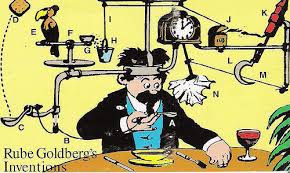
For those of you too young to remember, Rube Goldberg was a cartoonist best known for creating enormously complex machines to accomplish trivial tasks. In today’s post I give you two examples:

The first example, an automatic napkin for soup eaters:
Monetary Sovereignty

The second example, the euro, an incredibly complicated machine, the purpose of which is to simplify cross-border trade in Europe. Cross-border trade in Europe had existed for far longer than the life span of any of the euro creators, but under the theory, “If it ain’t broke, by all means fix the heck out of it,” the euro was created.

Today, the euro and most euro nations are “broke” (in every sense of the word), so to make cross-border trade even simpler, the EU plans to complexify the euro even further.

New York Times 6/4/12

BERLIN — Pressed by a banking crisis and turmoil in the markets, Germany has indicated that it is prepared to accept a grand bargain that would provide greater support for its most indebted euro zone partners in exchange for more centralized control over government spending in Europe.

The worsening crisis has led to a sweeping effort to chart a new path forward for the union, one that encompasses fiscal integration, Europe-wide banking supervision, and tighter coordination of economic policies.

German leaders have not provided details of a potential deal — and not every country may be eager to sign on — but it would be likely to mean an expansion of executive power in Brussels over fiscal targets in member states and supervision of their banks, along with Europewide deposit insurance. It would go far beyond what was contemplated for Europe even six months ago.

Translation: The euro already has ruined your economies by taking away your most valuable asset: Your Monetary Sovereignty. Now, to fix that problem, we will take away your next most valuable asset: Control over your banks.

Changes on this scale would not be easy, involving an arduous process of treaty alterations that could take years, and it is unclear if they would be enough to reassure markets of the stability of the euro. But as Ms. Merkel has repeatedly made clear, Germany would be open to rescuing ailing banks and member states in the region only if that were part of an overhaul of the basic architecture of European governance.

Translation: You think you know what a Rube Goldberg machine is? No, we’ll show you a real Rube Goldberg machine: Treaty alterations that could take years.

While the weaker countries might be expected to sign on, it may well be opposed by Britain, which opposed an earlier effort to increase fiscal discipline out of concern for the effect on its banks.

Translation: Britain, which was smart enough not to surrender its Monetary Sovereignty, now for some strange reason, doesn’t want to surrender its banks to the whims of the people who caused the euro crisis. One must admire the restraint of the British, for not screaming, “I told you so,” at all those foolish nations that surrendered their sovereign currencies.

Even less certain are the positions of Italy and, most problematic, France. Neither wants to find itself in the position of answering to fiscal and banking authorities that, fairly or not, will almost inevitably be deemed an arm of the German government.

Translation: It took more than 70 years, but at long last, Germany will have its chance to rule Europe.

But almost everyone agrees that something has to be done, and quickly. Predictions of the euro’s demise in the absence of bolder action have grown louder as global growth slows, banking-sector woes compound and governments wobble.

As the troubles mount, all sides turn to Germany, the only country with the financial wherewithal to calm the turbulence and guarantee the currency zone’s collective solvency.

Translation: So far, so good. We’ve slowed global growth, compounded banking woes and wobbled governments. Now, trust us with your banks.

[Ahem, I hate to mention this, but Germany is just another monetarily non-sovereign country. The only entity with the “financial wherewithal” is the EU. It is Monetarily Sovereign, and has the unlimited ability to create euros. At the touch of a computer button, the EU could solve the entire euro debt problem. Just sayin’.]

German officials worry that without safeguards on spending and deficits, the country would quickly be bled dry by overspending partners. To forestall that danger, a proposal by the government’s independent council of economic experts to pool excessive debt has garnered increasing attention.

Under the plan, largely ignored when it was introduced late last year, the debt overhang in the 17 members of the euro currency union — defined as any debt exceeding 60 percent of gross domestic product, or nearly $3 trillion by some estimates — would be transferred into a fund that would be paid off over roughly 25 years.

Translation: In the U.S. this is known as “debt consolidation.” People combine all their little, short-term loans into one gigantic, long-term, truly unaffordable debt. In this way, they can spend the rest of their lives trying to get out from under their debt burden — or go bankrupt. Works great.

(José Manuel Barroso, the president of the European Commission) said it was necessary to signal that the euro zone “will do whatever is necessary to assure the stability of our currency. We need to do things faster and we need to go further. It is now evident that also for the stability of the euro we need some concrete measures regarding the euro area and the European Union in general.”

Translation: We don’t care about the people of Greece, France, Italy et al. The only thing we care about is the “stability of the euro.” And please don’t remind us that the whole purpose of the euro was to make trade simple and to make life better for the people of Greece, France, Italy et al. Oops!

Berlin wants commitments to deeper integration, which means individual states giving up sovereignty to a central fiscal authority. Yet, where Germans talk of safeguards, other Europeans howl about dominance and diktats from Berlin. Ms. Merkel also raised on Monday the prospect of “specific European oversight” for systemically important banks as a long-term goal.

Translation: What? Germany wants to dominate Europe? Don’t be ridiculous.

Nervousness within Germany, where record-low unemployment and borrowing rates have preserved a calm at the eye of the financial storm, has also begun to grow. Joschka Fischer, a former foreign minister, warned that “the European house is on fire,” and that Ms. Merkel, in her support for austerity policies, “prefers to douse it with kerosene rather than water.”

Translation: Don’t tell anyone, but we have made a remarkable discovery. Austerity never improves a nation’s economic condition. In fact, austerity guarantees poverty. But don’t tell the EU and the International Monetary Fund. They have been prescribing austerity for years. And pul-eeze don’t tell Greece what austerity has done to them.

(And finally, don’t tell the U.S. Tea/Republican Party. After seeing how well it works in Europe, they have been selling the austerity fiction in America.)
——————————————————————————————————————————————————————————————————————————–
There continue to remain only two, long-term solutions to the euro problems:

1. Each nation return to Monetary Sovereignty by readopting their sovereign currency
or
2. Financial merger into a quasi “United States of Europe.”

That’s it. No other solutions.

But sadly, the twin goals of “trade simplification” and “euro stabilification” continue ever onward, while the people suffer from the ignorance of their leaders. With each gear, lever and pulley added to the Rube Goldberg euro machine, trade becomes more complicated and the euro less stable, and the euro nations plunge from recession toward depression.

Rodger Malcolm Mitchell
http://www.rodgermitchell.com


==========================================================================================================================================
No nation can tax itself into prosperity, nor grow without money growth. Monetary Sovereignty: Cutting federal deficits to grow the economy is like applying leeches to cure anemia. Two key equations in economics:
Federal Deficits – Net Imports = Net Private Savings
Gross Domestic Product = Federal Spending + Private Investment and Consumption + Net exports

#MONETARY SOVEREIGNTY

–Lawrence “Sleepy” Summers comedy hour renewed for another season.

Mitchell’s laws: The more budgets are cut and taxes increased, the weaker an economy becomes. Until the 99% understand the need for deficits, the 1% will rule. To survive long term, a monetarily non-sovereign government must have a positive balance of payments. Austerity = poverty and leads to civil disorder. Those, who do not understand the differences between Monetary Sovereignty and monetary non-sovereignty, do not understand economics.
==========================================================================================================================================

Edited from Wikipedia: Lawrence (Sleepy) Summers (born November 30, 1954) is an American economist. He served as the 71st United States Secretary of the Treasury from 1999 to 2001 under President Bill Clinton. He was Director of the White House United States National Economic Council for President Barack Obama until November 2010.
Monetary Sovereignty

“Sleepy” is the Charles W. Eliot University Professor at Harvard University’s Kennedy School of Government. He is the 1993 recipient of the John Bates Clark Medal for his work in several fields of economics.
================================================================================================================================================================================================================================

Those of you who have read my post, Lawrence Summers: Failing to the top, will not be surprised by the following article. You also may not be surprised that it appeared in the Washington Post, which like all mainstream media, has shown no aptitude for economics.

What may surprise you is that some people continue to pay attention to Summers. In the latest installment of the Lawrence Summers comedy hour, Professor Summers says, the U.S. government should borrow the sovereign currency (dollars) it has the unlimited ability to create. Why? Interest rates are low. Yikes!

Washington Post
It is time for governments to borrow more money
By Lawrence H. Summers, Published: June 4

With the past week’s dismal jobs data in the United States, signs of increasing financial strain in Europe and discouraging news from China, the proposition that the global economy is returning to a path of healthy growth looks highly implausible.

It is more likely that negative feedback loops are again taking over as falling incomes lead to falling confidence, which leads to reduced spending and yet further declines in income.

Translation: The problem is what has come to be known as the “confidence fairy,” which leads to reduced spending and falling incomes.

“It has nothing whatever to do with the federal government or with any other government. It’s all the public’s fault.”

Financial strains hurt the real economy, especially in Europe, and reinforce existing strains. And export-dependent emerging markets suffer as the economies of the industrialized world weaken.

Translation: “There is no difference between the monetarily non-sovereign euro governments and the Monetarily Sovereign governments. If you don’t believe me, look at my wonderful credentials.”

To come up with a viable solution, consider the remarkable level of interest rates in much of the industrialized world. The U.S. government can borrow in nominal terms at about 0.5 percent for five years, 1.5 percent for 10 years and 2.5 percent for 30 years. Rates are considerably lower in Germany and still lower in Japan.

Translation: “What? The government doesn’t need to borrow? It can create dollars at will? And, did you say the U.S. and Japanese governments are Monetarily Sovereign, while the German government isn’t? I wish someone had told me this stuff when I was working for Clinton and Obama. Now, what can I tell the kids at Harvard? (Do I have to return the John Bates Clark Medal?)”

These low rates on even long maturities mean that markets are offering the opportunity to lock in low long-term borrowing costs. In the United States, for example, the government could commit to borrowing five-year money in five years at a nominal cost of about 2.5 percent and at a real cost very close to zero.

Translation: “Given the choice of borrowing at low rates or merely creating dollars ad hoc, hey I go for borrowing. That’s what I’ve taught Clinton, Obama and my students.”

What does all this say about macroeconomic policy? Many in the United States and Europe are arguing for further quantitative easing to bring down longer-term interest rates. This may be appropriate, given that there is a much greater danger from policy inaction to current economic weakness than to overreacting.

Translation: “As you know, quantitative easing has been remarkably successful (in my mind), even without any effect in the real world. I still believe low rates stimulate the economy, despite zero evidence this is so. Who needs evidence? I have credentials. Ask Bill and Barack.”

Any rational chief financial officer in the private sector would see this as a moment to extend debt maturities and lock in low rates — the opposite of what central banks are doing.

Translation: “Sure, the U.S. government, being Monetarily Sovereign, has the unlimited ability to create its sovereign currency, which it does by the simple act of spending. And, O.K., the private sector does not have the unlimited ability to create dollars, so to spend, it must earn income or borrow. I see no difference between the two. Do you?”

So, what is to be done? Rather than focusing on lowering already epically low rates, governments that enjoy such low borrowing costs can improve their creditworthiness by borrowing more, not less, and investing in improving their future fiscal position, even assuming no positive demand stimulus effects of a kind likely to materialize with negative real rates.

Translation: “I also don’t know the difference between the U.S. government and the euro governments. Am I really supposed to understand all this?”

These examples are the place to begin because they involve what is in effect an arbitrage, whereby the government uses its credit to deliver essentially the same bundle of services at a lower cost. It would be amazing if there were not many public investment projects with certain equivalent real returns well above zero. Consider a $1 project that yielded even a permanent 4 cents a year in real terms increment to GDP by expanding the economy’s capacity or its ability to innovate. Depending on where it was undertaken, this project would yield at least an extra 1 cent a year in government revenue for each dollar spent. At any real interest rate below 1 percent, the project pays for itself even before taking into account any Keynesian effects.

Translation: “Presidents Clinton and Obama bought this garbage. So do my students. You should, too.”

There is, of course, still the question of whether more borrowing will increase anxiety about a government’s creditworthiness. It should not, as long as the proceeds of borrowing are used either to reduce future spending or raise future incomes.

Any rational business leader would use a moment like this to term out the firm’s debt. Governments in the industrialized world should do so too.

Translation: “When I say, “a government,” I believe all government’s are the same. Oh sure, some have a sovereign currency, some don’t. And I was told business finance is completely different from Monetarily Sovereign finance, but does that really matter? I mean, really?”

——————————————————————————————————————————————————————————————————————————-

And that, dear reader, is why the U.S. economy, and indeed all economies, are in trouble. The Lawrence Summers of the world have led us here. This is a guy who has caused the U.S. as much damage as any man alive – and continues to cause damage — and we were worried about Osama bin Laden?

I award Sleepy Summers five clowns along with a great big “thank you” for the entertainment he continually provides.

ClownClownClownClownClown

Rodger Malcolm Mitchell
http://www.rodgermitchell.com


==========================================================================================================================================
No nation can tax itself into prosperity, nor grow without money growth. Monetary Sovereignty: Cutting federal deficits to grow the economy is like applying leeches to cure anemia. Two key equations in economics:
Federal Deficits – Net Imports = Net Private Savings
Gross Domestic Product = Federal Spending + Private Investment and Consumption + Net exports

#MONETARY SOVEREIGNTY