–As predicted, the euro nations’ boats sink, while their captains drill holes in the hull.

Mitchell’s laws: To survive, a monetarily non-sovereign government must have a positive balance of payments. Economic austerity causes civil disorder. Reduced money growth cannot increase economic growth. Those, who do not understand the differences between Monetary Sovereignty and monetary non-sovereignty, do not understand economics.
========================================================================================================================================================================================================

Washington Post: BERLIN — The economy of Germany, Europe’s headline performer, slowed to a virtual standstill over the past three months . . . The discouraging news came just hours before German Chancellor Angela Merkel and French President Nicolas Sarkozy called for closer European coordination in setting economic policy and new steps to discipline governments whose lax budget practices prompted the debt crisis.

No, the crisis was caused by the euro-zone nations being monetarily non-sovereign. They cannot control the supply of their currency, the euro. I predicted this on June 5, 2005: “Because of the Euro, no euro nation can control its own money supply. The Euro is the worst economic idea since the recession-era, Smoot-Hawley Tariff. The economies of European nations are doomed by the euro.”

. . . Merkel and Sarkozy . . . proposed that countries harmonize their tax policies, adopt a new tax on financial transactions and commit to balancing their budget . . .

Balancing their budgets assures a recession or depression, by eliminating euro supply growth. A growing economy requires a growing money supply.

The abrupt slowdown in Europe’s largest economy comes at a time when Germany is expected to fund a major portion of the emergency loans extended to struggling neighbors such as Greece, Ireland and Portugal. . . . The new figures call into question whether Germany can remain the economic engine that officials in the United States and elsewhere have been counting on to power Europe’s recovery.

Germany’s economy was strong because it was a net exporter, i.e. a net importer of euros. That was the only way a monetarily non-sovereign nation could increase its money supply.

“Trend growth is not that high,” said Thomas Mayer, chief economist for Deutsche Bank. “It would have been false to think that Germany would turn into a loco-motive for Europe. That is not a viable proposition.”

Right. It’s asking the blind to lead the blind.

According to a release from the Federal Statistical Office of Germany, flagging investment and household consumption were behind the slowdown — particularly disappointing for those, including U.S. officials, who have urged Germany to stoke local demand. . . .

Investment and household consumption “flagged,” because Germany now is short of the euros it formerly had acquired via exports.

Also discouraging were new figures released Tuesday for the entire region that uses the euro. Growth for the second quarter was only 0.2 percent, reflecting government austerity programs and slowing global economic activity.

If you want to kill a nation, austerity is the way to do it. (Hello, Tea/Republicans. Are you watching?)

Although the crisis in Europe is ostensibly driven by high levels of government debt and annual deficits, it is also rooted in slow growth, with nations such as Italy and Spain struggling to expand fast enough that their tax base keeps up with their commitments to citizens and bondholders.

Visualize trying to bail a rowboat having a big hole in the bottom.

Germany’s growth in the past few years offered an example to weaker economies. . . Germany revised its labor and tax rules to become globally competitive. Its stable of large multinationals benefited as China and other fast-growing developing nations snapped up German capital goods and high-end products.

Right. Exports were the key, because they brought in euros.

Figures released last week, however, showed that German exports in June were down significantly from the month before and manufacturing dropped to its lowest level since October 2009.

In a country that has been spared the riots and demonstrations of Greece and Spain, the slowdown may reinforce a public sentiment — reflected in some opinion polls — that Germany should go no further in risking its own financial health to help its weaker neighbors.

Now, visualize bailing your neighbors’ sinking boats, and tossing the water into your own boat.

Merkel and Sarkozy . . . called for what Sar-kozy termed “a true economic government for the euro zone” . . . Compared with some of the more dramatic steps that European officials have taken to address the debt crisis, such as establishing a trillion-dollar bailout fund last year, the proposals offered Tuesday were more evolutionary, Merkel said. By bringing the economic and social policies of the euro nations into sync, the region could “regain confidence step by step,” she said.

The proposals were short on details, and some analysts said they had heard similar ideas before. Over the years, European leaders, particularly from Germany, have offered various ways to control euro-zone spending, but to little effect. National parliaments would still have to approve the proposed measures, such as constitutional amendments to require a balanced budget, and governments would still have to live up to them.

“. . . bringing economic . . . policies into sync . . .” almost sounded like they understood the problem, and were going to combine the euro nations into one Monetarily Sovereign United States of Europe. That would have been one of the two possible solutions (the other being to disband the EU. Unfortunately, they still are talking about non-solutions like balanced budgets. Visualize using leeches to cure anemia.

“They have not given any details on what they feel economic governance should look like,” said Daniela Schwarzer, an expert on European integration at the German Institute for International and Security Affairs. And if the new economic council meetings amounted to no more than the latest in a long series of summits, she said, “that is nothing substantially new.”

They are as clueless as the U.S. Congress and President. Our sole advantage: We are Monetarily Sovereign (though our leaders have not figured that out.) So we can’t go bankrupt, unless our government wants it.

The monetarily non-sovereign euro nations can go bankrupt, and that grim future unnecessarily will drive down the U.S. economy. “Unnecessarily,” because a Monetarily Sovereign nation has complete control over its economic growth, if it is wise enough to use that control.

Recessions are unnecessary in a Monetarily Sovereign nation. Tell that to Congress.

Rodger Malcolm Mitchell
http://www.rodgermitchell.com


==========================================================================================================================================
No nation can tax itself into prosperity, nor grow without money growth. Monetary Sovereignty: Cutting federal deficits to grow the economy is like applying leeches to cure anemia. The key equation in economics: Federal Deficits – Net Imports = Net Private Savings

MONETARY SOVEREIGNTY

–The one simple step that instantly would stimulate the economy and reduce unemployment.

Economic austerity causes civil disorder. Reduced money growth cannot increase economic growth. Those, who do not understand the differences between Monetary Sovereignty and monetary non-sovereignty, do not understand economics.
========================================================================================================================================================================================================

The Tea and Republican Parties wish to cut federal taxes. In this, they are wise. For a Monetarily Sovereign nation, federal taxes have no positive function; they serve only to destroy money. The federal government neither needs nor uses tax dollars.

While, in theory, taxes can prevent inflation, in actual practice, tax changes would be inefficient and damaging. They are far too slow (When will they be collected?), far too political (Which taxes?) and not incremental (How much?). Although the federal government has managed to control inflation, federal taxes have not been the controlling device; interest rates have.

The Democrats wish to increase federal spending. In this they are wise. Many functions, beneficial to Americans, could use more federal support, including Social Security, Medicare, Medicaid, food stamps, research and development, food & drug inspections, infrastructure, education, homeland security, inspection and supervision of many industries, and on and on.

All three parties wish to reduce federal deficits. In this, all are unwise. A growing economy requires a growing supply of money, and federal spending is the method by which the government increases the money supply. It is absolutely impossible to stimulate the economy and/or to cut unemployment — our two most serious problems — without increasing federal deficit spending.

I suggest the one simple step that instantly would stimulate the economy and reduce unemployment would be to eliminate the FICA tax. I first recommended this in 1995, in my book, “The Ultimate America,” then in 1997 in “Free Money,” and more recently with this blog’s post, “Ten Reasons to Eliminate FICA.” I suggest you read it to see the 10 reasons.

FICA is paid, ostensibly, half by salaried employees and half by employers. But, in true effect, it is paid 100% by salaried employees, because employers base salaries on total cost to the company. If FICA were eliminated, several things would happen:

1. Employers would be encouraged to hire more people or to pay higher salaries, because the basic cost of salaries would be reduced by the 15% FICA cost. More people employed, having more money to spend, is perhaps the most powerful economic stimulus. And/or

2. Corporate profits would increase, allowing for more corporate investment, another powerful stimulus. And/or

3. More dollars would go to so-called “fat cats” (company officers), who would spend or invest those dollars, thereby transferring dollars to other people, who also would spend or invest. All that additional spending and investing would be highly stimulative.

In total, the elimination of FICA would grow business, eliminate recessions and reduce unemployment, by adding dollars to the economy. How many dollars?

FICA collected by the U.S. government is projected to reach $935 billion in 2011. (Budget of the U.S. government) This compares with overall federal receipts of $2,567 billion or 36% of total receipts.

The projected 2011 cost of Medicare and Social Security is $1,233 billion, compared to projected overall federal spending of $3,833 billion, or 32% of the total. So depending on how you wish to look at it, the elimination of the FICA tax would reduce federal taxes by 36% or increase spending by 32%, assuming the federal government would pay for Medicare and Social Security, just as it pays for all other federal agencies.

The federal deficit would rise from a currently projected $1,266 billion to $2,201 billion.

Because Medicare and Social Security already are federally-run programs, the elimination of FICA would not increase the “intrusion of big government into our lives” as the Tea/Republicans profess to hate. There would be no change whatsoever in so-called “intrusion.” Nor would this be a step toward the “socialism” the Tea/Republicans also profess to hate. Further, it need not reduce benefits offered by these social programs, an effect the Democrats (or at least the Democrat voters) say they will not abide.

Yes, the federal deficit and debt will increase, but a Monetarily Sovereign nation can pay any debt of any size, any time, merely by instructing banks to credit the accounts of U.S. debt holders – which the government can do, endlessly.

So, but one question remains: Will the resultant increase in the federal deficit and debt cause inflation, (and if so, is this a worse outcome than recession and unemployment?)

Would a 73% ($935 billion) deficit increase cause inflation? From a percentage standpoint, we have had many such increases. The 2007 – 2008 increase was 186%. The 2008-2009 increase was 208%. Back in 1982-1983 the deficit increase was 780%. At none of those times did deficit increases cause inflation.

What about that nominal dollar increase of $935. Well, in 2008-2009, the deficit increased from $458 billion to $1,412 billion, an increase of $954 billion. No inflation. In fact, there has been no relationship between federal deficits and inflation for at least 60 years.

Deficits don't cause inflation

(You can see the lack of relationship between federal deficits and inflation discussed further at Item 12.)

Summary: Today’s huge problems are recession and unemployment, not inflation. Eliminating FICA would greatly stimulate business, reduce unemployment and increase wages, all without causing inflation.

Let’s do it now.

Rodger Malcolm Mitchell
http://www.rodgermitchell.com


==========================================================================================================================================
No nation can tax itself into prosperity, nor grow without money growth. Monetary Sovereignty: Cutting federal deficits to grow the economy is like applying leeches to cure anemia. The key equation in economics: Federal Deficits – Net Imports = Net Private Savings

MONETARY SOVEREIGNTY

–When will we suffer the Tea/Republican/Obama riots in the streets?

Economic austerity causes civil disorder. Reduced money growth cannot increase economic growth. Those, who do not understand the differences between Monetary Sovereignty and monetary non-sovereignty, do not understand economics.
====================================================================================================================================================================================================

How soon will we suffer the Tea/Republican/Obama riots in the streets?

An interesting article ran on Washington’s Blog. I’ll quote from parts of it, but I can’t do it justice here. I urge you to go there to read the entire article.

The essence is that austerity combined with a large gap between the wealthy few and the rest of the population, an inevitable result of “cut-deficit” preaching by the Tea/Republicans and President Obama, will lead to riots in the streets, sabotage and other forms of serious civil unrest.

Guest Post: Austerity and Runaway Inequality Lead to Violence And Instability
By Washington’s Blog

A study this month by economists Hans-Joachim Voth and Jacopo Ponticelli shows that – from 1919 to the present – austerity has increased the risk of violence and instability:

From the end of the Weimar Republic in Germany in the 1930s to anti-government demonstrations in Greece in 2010-11, austerity has tended to go hand in hand with politically motivated violence and social instability. In this paper, we assemble cross-country evidence for the period 1919 to the present, and examine the extent to which societies become unstable after budget cuts. The results show a clear positive correlation between fiscal retrenchment and instability.
[…]
Studying instances of austerity and unrest in Europe between 1919 to 2009, Ponticelli and Voth conclude that there is a “clear link between the magnitude of expenditure cutbacks and increases in social unrest. With every additional percentage point of GDP in spending cuts, the risk of unrest increases.”

“Expenditure cuts carry a significant risk of increasing the frequency of riots, anti-government demonstrations, general strikes, political assassinations, and attempts at revolutionary overthrow of the established order. While these are low probability events in normal years, they become much more common as austerity measures are implemented.”
[…]
The relation between austerity and riots is so clear that former IMF chief economist and Noble prize winning economist Joseph Stiglitz coined a phrase to describe what happens after the International Monetary Fund demands austerity in return for loans to indebted countries: “The IMF Riot”.
[…]
The military must be prepared . . . for a “violent, strategic dislocation inside the United States,” which could be provoked by “unforeseen economic collapse,” “purposeful domestic resistance,” “pervasive public health emergencies” or “loss of functioning political and legal order.” . . . “widespread civil violence,” the document said, “would force the defense establishment to reorient priorities in extremis to defend basic domestic order and human security.”

As I suggested, read the entire post, the essence of which can be summarized: Civil unrest occurs when:

1. The government cuts spending
and
2. The gap between rich an poor grows.

As we have said throughout this blog, the drive to reduce the federal deficit is a combination of ignorance about Monetary Sovereignty and madness, supported by zero data, and based on faulty, obsolete assumptions about economics. Congress and the President have not created a deficit reduction committee. They have created a Riot Production and America Destruction Committee.

Sadly, the politicians’ response will be to call out the military, and ruthlessly suppress the population even further, rather than to solve the fundamental problem by federal deficit spending to stimulate the economy, create jobs and lift the lives of the underclasses.

Thus, do all great nations fall at the hands of their leaders. America is no exception.

Rodger Malcolm Mitchell
http://www.rodgermitchell.com


==========================================================================================================================================
No nation can tax itself into prosperity, nor grow without money growth. Monetary Sovereignty: Cutting federal deficits to grow the economy is like applying leeches to cure anemia. The key equation in economics: Federal Deficits – Net Imports = Net Private Savings

MONETARY SOVEREIGNTY

–A quick lesson: How Economists Lie, Using Graphs

Economic austerity causes civil disorder. Reduced money growth cannot increase economic growth. Those, who do not understand the differences between Monetary Sovereignty and monetary non-sovereignty, do not understand economics.
====================================================================================================================================================================================================

I use graphs to make my points. Graphs allow readers to visualize the data, but graphs can be misleading. While I try very hard not to mislead, I always am aware I inadvertently could be making a nonexistent point. The old line, “Figures don’t lie, but liars figure,” was never more true than with graphs.

Look at this graph. It’s one of the most common — and deceptive — types of graph. You will see it every day in magazines, newspapers and blogs

1

It shows four lines, all rising, three of which essentially are parallel. All four use the same scale, “Billions of Dollars” on the left. Looking at this graph, one could “prove” that Federal Debt Held by Private Investors, M2 and Gross Private Domestic Investment move together, while Total Domestic Nonfinancial Sectors moves up more rapidly.

The problem with this graph is the fact that it uses the same scale for all four variables, and the scale blurs out the real differences. America has grown over the years. So most of its measurements have grown.

But here is exactly the same graph, with one variable removed.

5

Those three variables that seemed to move together, look a lot less together.

Then there is the following graph. One more variable is removed, and the scale now is % Change From Year Ago. Remember, the basic data are the same. Suddenly, there is no relationship between the two remaining variables. They don’t move together at all.

6

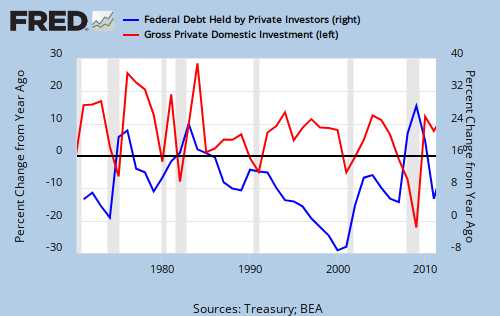
Now look at the following graph, which uses exactly the same data as the first graph, above. Rather than “Billions of Dollars,” the scale now is % Change From Year Ago, and Federal Debt Held by Private Investors is scaled on the right.

2

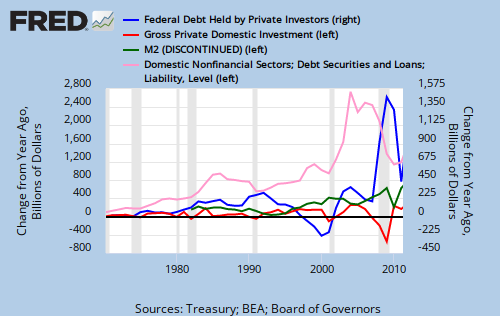
Then there is this graph, which again, uses the same data, except it now shows Change from Year Ago in billions of dollars. Again, the same data as above:

3

And the following graph, again the same basic data, just moving one variable to the right hand scale:

4

I could go on and on, but you get the idea. Demonstrating a point with graphs is a great way to educate, but it can be tricky. The most well-intentioned graph can make a misleading point, even when the data are completely accurate. All of the above graphs use the same basic data, yet all look substantially different. Different conclusions could be drawn from each of them.

Graphs are analogies. They are not reality. They only purport to represent reality. So the next time you see a graph (even mine), ask yourself, “Are the data shown in a way that fairly makes the point?”

Rodger Malcolm Mitchell
http://www.rodgermitchell.com


==========================================================================================================================================
No nation can tax itself into prosperity, nor grow without money growth. Monetary Sovereignty: Cutting federal deficits to grow the economy is like applying leeches to cure anemia. The key equation in economics: Federal Deficits – Net Imports = Net Private Savings

MONETARY SOVEREIGNTY