Should we really be turning food into oil? Do biofuels starve the world?

The debt hawks are to economics as the creationists are to biology. Those, who do not understand Monetary Sovereignty, do not understand economics. If you understand the following, simple statement, you are ahead of most economists, politicians and media writers in America: Our government, being Monetarily Sovereign, has the unlimited ability to create the dollars to pay its bills.
============================================================================================================================================
Oil is non-renewable; corn, soybeans and sugar are renewable. One day (Who knows when?), the world will run out of oil. The world never will run out of corn, soybeans and sugar. Based on those simple facts, the decision was made to turn food into oil, otherwise known as biofuel. Yet that decision has been a favorite liberals’ (and to a lesser degree, conservatives’) target.

The underlying facts are not so simple. My friend Warren Mosler, for whom I have great respect, wrote on his blog:

“The reality is very simple, and there is no end in sight. The US is a net exporter of food, and a net importer (directly and indirectly) of motor fuels. So with current high gasoline prices we get a higher price for our food surplus by burning up part of it for fuel.

Even if the energy used in creating the ethanol is somewhat more than the energy produced, the energy used is generally coming from lower cost and domestically produced sources such as coal. And the fuel burned in our cars replaces gasoline- a much higher cost energy that we import.

So, bottom line, burning up part of our surplus crops as motor fuel, which drives up food prices world wide, we reduce imports of motor fuels and we get a higher price for the remaining foods we export. That is, we benefit economically from the global chaos and the likelihood of mass starvation created by this policy.

(We should) outlaw ethanol and biofuels that use up acreage that otherwise produces food.”

I wrote to Warren, “So it is your opinion that the U.S. is short of farming acreage, and that we now have reached the limits of U.S. food output? And it is your opinion that the entire world has reached the limits of food production, which is why the U.S. turning some of its corn into oil raises all food prices, worldwide? Sounds a bit suspicious to me. Do you have any data to support these beliefs?” I’ll let you know what he says.

I saw “A Note on Rising Food Prices” by Donald Mitchell (no relation) of The World Bank Development Prospects Group, 2008. It’s a long paper, but I’d like to show you the featured (bolded) lines from three adjacent paragraphs:

“–Estimates of the contribution of biofuels production to food price increases are difficult, if not impossible to compare.
–Despite all the differences in approach, many studies recognize biofuels production as a major driver of food prices.
–Many other potential drivers of the escalating food prices are mentioned in discussions, but there are few quantitative estimates of their impact.”

To paraphrase, “We have estimates, not data, and we can’t compare those estimates. Some people think biofuels raise food prices, but some do not. Nevertheless, we emotionally, not factually, have adopted the position that biofuels raise food prices.”

The paper goes on to list some of the reasons for higher food prices:
1. The increase in energy prices
2. Increases in prices of fertilizer and chemicals
3. Increases in the costs of transportation
4. Drought in Australia
5. Poor crops in Europe
6. Rapid import demand increases for oilseeds by China to feed its growing livestock and poultry industry
7. Decline of the dollar
8. The increased investment in commodities by institutional investors to hedge against inflation
9. And oh yes, turning corn and soybeans into oil.

Those of you who have read Inflation/Oil know that inflation has been caused by increased oil prices. So one should assume that creating oil from plants would at least to some degree, mitigate inflation by increasing the supply of oil. Of the nine reasons for higher food prices, five are due to the increased price of oil.

This means, if corn and soybeans were not turned into oil, the price of oil would be higher, inflation would be worse and the price of food would go higher. Of course that is speculation, because despite many absolute opinions, no one really knows the effect of biofuels on food production or food prices.

Consider corn. Oil is made from corn silage. Only a tiny percentage of all corn is used for human consumption. It’s called sweet corn. The vast majority of corn is field corn, which is turned into silage. Only silage is turned into oil. Silage is made from cobs, leaves, stalks, husks and the grain itself.

“In 2009, there were over 86 million acres of corn planted in the United States. In the same year, only a little more than a quarter-million of that was used for growing sweet corn.” ( CompareXY Library) With only 1% of all corn acreage devoted to being eaten by humans, it is difficult to say with any certainty that oil production decreases sweet corn production. A further complexity: Even sweet corn cobs, leaves, stalks and husks are turned into silage.

The above is a bare hint at the massive data surrounding this subject, data that can be turned to any desired meaning. For me, the bottom line is:

1. If the creation of biofuels uses less oil than it creates, the process saves a non-renewable energy source at the cost of a renewable energy source.
2. Creating oil reduces inflation.
3. Inflation has an adverse affect on people’s ability to buy food.
4. The U.S. use of field corn, soybeans and sugar for oil has only a minuscule affect, if any, on the world’s human food supply.
5. The U.S. and the world are capable of producing more food crop than now is produced.
6. A limiting factor in world food production is oil prices, which can be reduced by increasing the supply of biofuels.

There are many other factors and many other considerations, and the above surely is an overly simplified summary, but on balance, I feel biofuels are a worthwhile federal investment. I do not believe biofuel production with cause the mass starvation Warren predicts. Quite the opposite.

I welcome your comments.

Rodger Malcolm Mitchell
http://www.rodgermitchell.com


==========================================================================================================================================
No nation can tax itself into prosperity, nor grow without money growth. It’s been 40 years since the U.S. became Monetarily Sovereign, and neither Congress, nor the President, nor the Fed, nor the vast majority of economists and economics bloggers, nor the preponderance of the media, nor the most famous educational institutions, nor the Nobel committee, nor the International Monetary Fund have yet acquired even the slightest notion of what that means.

Remember that the next time you’re tempted to ask a dopey teenager, “What were you thinking?” He’s liable to respond, “Pretty much what your generation was thinking when it screwed up the economy.”

MONETARY SOVEREIGNTY
–Why the Democrats’ ignorant plan is better than the Tea/Republicans’ ignorant plan

The debt hawks are to economics as the creationists are to biology. Those, who do not understand Monetary Sovereignty, do not understand economics. If you understand the following, simple statement, you are ahead of most economists, politicians and media writers in America: Our government, being Monetarily Sovereign, has the unlimited ability to create the dollars to pay its bills.
======================================================================================================================================================

The Tea (formerly Republican) Party wants lower taxes (good) and less federal spending (bad). The Tea Party hero of the day, Rand Paul is an ardent follower of Ayn Rand. Yes, that Ayn Rand, the one who believes the rich are gods who deserve more, while the poor are leeches who deserve less.

He has couched his beliefs in Tea appeals to tax cuts, patriotism and freedom from government interference, as in freedom from health care, freedom from military protection, freedom from good roads and safe bridges, freedom from healthful medicines and food, freedom to discriminate against gays, freedom from safe banks, freedom from a good education, freedom from clean air, freedom from energy saving, freedom from police protection, freedom from Social Security, freedom from safe air travel, and the many other freedoms we so ardently desire.

But the Tea night is ending, and the dawn of realization has begun.

Washington Post: by Jon Cohen and Dan Balz, Wednesday, April 20, 2011. “Despite growing concerns about the country’s long-term fiscal problems and an intensifying debate in Washington about how to deal with them, Americans strongly oppose some of the major remedies under consideration, according to a new Washington Post-ABC News poll.

“The survey finds that Americans prefer to keep Medicare just the way it is. Most also oppose cuts in Medicaid and the defense budget. More than half say they are against small, across-the-board tax increases combined with modest reductions in Medicare and Social Security benefits. Only President Obama’s call to raise tax rates on the wealthiest Americans enjoys solid support.”

Now, as we Americans awaken to the fact that the Tea/Republican plan to reduce federal spending amounts to the reduction of all the things we want, as well as benefitting those hated rich people, somehow President Reagan’s “government is the problem” mantra doesn’t seem so attractive.

Of course, increasing taxes on anyone, rich or poor, is a typically bad, Democratic idea. All taxes remove money from the economy, and removing money from the economy causes recessions and depressions. Further, this removal of money always hurts the poor more than it hurts the rich. See: Taxing the rich hurts the poor.

That said, I favor Obama’s plan to the Tea/Republican “plan.” Before you faint, let me explain. Both plans are equally ignorant in that they begin with the false assumption federal deficit spending must be reduced. In the Economics Common Sense and Knowledge race, both parties come in last.

However, they have convinced the innocent public of this falsehood, which forces on us a lesser-of-two-evils choice, and Obama’s plan is less evil. Why? Because raising tax rates on the rich not only will satisfy the jealous public, and not only will preserve the various benefits of federal spending, but in reality, will not collect much more in taxes.

We already have learned that higher taxes beget better tax “loopholes.” Remember, rich people know how to bribe politicians better than do poor people. So as those rates rise, the deductions will rise, too. A (for instance) 10% increase in tax rates on those making more than $250K per year, will not net a 10% increase in taxes collected from the rich – maybe not even 5%. Depending on the effectiveness of the bribery, a tax rate increase actually could net less money, because better deductions could be worth more than the marginal rate.

Bottom line, the Obama plan will make everyone happier. The poor will benefit; the rich won’t care and the economy will be less injured by losing money.

As an aside, if I were running for office, my opponent would tell the voters I voted in favor of tax increases, and this is why the politicians find themselves surrendering to their party, rather than thinking.

Rodger Malcolm Mitchell
http://www.rodgermitchell.com


==========================================================================================================================================
No nation can tax itself into prosperity, nor grow without money growth. It’s been 40 years since the U.S. became Monetarily Sovereign, and neither Congress, nor the President, nor the Fed, nor the vast majority of economists and economics bloggers, nor the preponderance of the media, nor the most famous educational institutions, nor the Nobel committee, nor the International Monetary Fund have yet acquired even the slightest notion of what that means.

Remember that the next time you’re tempted to ask a dopey teenager, “What were you thinking?” He’s liable to respond, “Pretty much what your generation was thinking when it screwed up the economy.”

MONETARY SOVEREIGNTY

–Chicago Tribune reminds us why our nation is in trouble.

The debt hawks are to economics as the creationists are to biology. Those, who do not understand Monetary Sovereignty, do not understand economics. If you understand the following, simple statement, you are ahead of most economists, politicians and media writers in America: Our government, being Monetarily Sovereign, has the unlimited ability to create the dollars to pay its bills.
========================================================================================================================

Thank heaven for the Chicago Tribune. Without them and their ilk, I might have nothing to write. Despite frequent letters from me, they continue to display an almost supernatural reluctance to understand what they write about. These folks simply refuse to learn economics, and they seem proud of it. Here’s their latest:

“S&P didn’t wait for the hot air to finish blowing before raising the prospect that at some point, the U.S. government may not be able to keep paying interest on its bonds.”

Ah, yes, the old “at some point.” Add it to “eventually,” “someday,” “some time,” “soon,” “ticking time bomb,” “unsustainable,” “over time,” and other confident predictions about an unknown future.

The federal government is Monetarily Sovereign. It has the unlimited ability to credit checking accounts. In the space of one minute, the federal government could credit every bond holder’s checking account, not only for interest, but for principal. Further, because a government with the unlimited ability to create dollars does not need to borrow dollars, all federal debt could disappear in that one minute. And none of this would affect federal spending by even one cent.

Imagine. A nation without debt, and it easily can be accomplished without adding even one dollar to the money supply, so there are no inflation implications. What would the Tea (formerly Republican) Party have to scream about then?

Anyway, what does the Tribune mean when it says the U.S. government may not be able to keep paying interest? Ask them. Let me know if ever they answer.

“A rating cut almost certainly would push interest rates higher, undermining the Federal Reserve’s efforts to pump up the economy by printing money.”

Perhaps, the Tribune editors can be excused for not knowing it mostly is the Treasury that “prints money.” (Actually, credits checking accounts. Physical printing is a minuscule part of dollar creation.) But the Trib cannot be excused for thinking interest rates affect a Monetarily Sovereign nation’s ability to create money. Even were interest rates 200%, the government easily could continue creating dollars. Not that we recommend such a thing, but the physical ability exists.

“Unable to borrow on reasonable terms, America would have no choice but to win back the market’s confidence by jacking up taxes and slashing programs.”

I’ve asked the Tribune on many occasions, “Why would a nation, with the unlimited ability to create dollars, need to borrow dollars?” They never answer, so once again I’ll try to educate the ineducable. The federal government does not need to create T-securities, then trade them for dollars it previously created. T-securities could disappear (as could taxes), and this would not affect the federal government’s ability to spend. (Yes, yes, I know. There are inflation implications to the instant elimination of taxes, but not to the elimination of T-securities)

“It’s the federal government that can’t stop borrowing more than $4 billion a day to pay for politicians’ priorities.”

Federal borrowing pays for absolutely nothing. And excuse me, but do you consider Medicare, Social Security, Medicaid, food stamps, the military, the infrastructure, R&D, education, etc., etc., etc., to be politicians’ priorities? How about people’s priorities?

“(The U.S. is ) much more diversified and adaptable than the smaller European countries now in severe distress. But even the world’s most powerful nation can’t buy time forever when it’s running up a tab it hasn’t got the money to pay.”

Here the Tribune editors show they don’t understand the difference between the Monetary Sovereignty of the U.S. and the monetary non-sovereignty of “smaller European countries.” And as for, “. . . it hasn’t got the money to pay,” if that were true, how have we been paying it? (And please, please don’t say, “by borrowing.”)

Actually, this isn’t the worst Tribune editorial. It’s pretty much average on the ignorance meter. But it provides a reminder of how astray our media have helped lead America. The only solution is for the media to receive letters, lots and lots of letters, urging them to open their minds to learning. If you want to contribute to the effort, here are some people you may wish to contact:

Gerould W. Kern at ctc-editor@tribune.com
R. Bruce Dold, Editorial Page Editor at bdold@tribune.com
Jane Hirt, VP/Managing Editor at jhirt@tribune.com
Joycelyn Winnecke, VP/Associate Editor at jwinnecke@tribune.com

Perhaps, if enough of us write, the message will begin to penetrate.

Rodger Malcolm Mitchell
http://www.rodgermitchell.com


==========================================================================================================================================
No nation can tax itself into prosperity, nor grow without money growth. It’s been 40 years since the U.S. became Monetarily Sovereign, and neither Congress, nor the President, nor the Fed, nor the vast majority of economists and economics bloggers, nor the preponderance of the media, nor the most famous educational institutions, nor the Nobel committee, nor the International Monetary Fund have yet acquired even the slightest notion of what that means.

Remember that the next time you’re tempted to ask a dopey teenager, “What were you thinking?” He’s liable to respond, “Pretty much what your generation was thinking when it screwed up the economy.”

–How Monetary Sovereignty differs from Modern Monetary Theory — simplified

The debt hawks are to economics as the creationists are to biology. Those, who do not understand Monetary Sovereignty, do not understand economics. If you understand the following, simple statement, you are ahead of most economists, politicians and media writers in America: Our government, being Monetarily Sovereign, has the unlimited ability to create the dollars to pay its bills.
==========================================================================================================================================

Some have asked what is the difference between Monetary Sovereignty (MS) and Modern Monetary Theory (MMT). Others use the terms interchangeably.

Actually, while both share many features, there are differences. Both understand that the U.S. federal government is Monetarily Sovereign, while euro nations, and U.S. states counties and cities are monetarily non-sovereign. Monetarily Sovereign governments uniquely:

–Have the unlimited ability to credit bank accounts (pay bills), including their own
–Neither need nor use taxes or borrowed funds to support spending
–Rely on continually increased deficits, rather than on exports, to support economic growth

And, there are additional similarities, related to, and/or derived from, the above.

Two differences should be noted, one not particularly important and one quite important. Of lesser importance: MMT says the purpose of taxes is to create demand for money. The requirement that taxpayers use dollars creates the need for taxpayers to accept dollars as payment for debts.

MS doesn’t deny that taxes help create demand for dollars, though other factors may be sufficient. Perhaps the most important factors are: Dollars are legal tender and dollars are commonly used and accepted by the vast majority of Americans and the world (which does not pay U.S. taxes).

Yet, even were the MMT position to be correct, it is clear that federal taxes are not necessary for demand purposes, as there are adequate state and local taxes, all of which are paid in dollars, making the point moot. After some discussion, I believe MMT now accepts the position that federal taxes are not necessary to create demand for dollars.

The more important difference between MS and MMT is the handling of inflation. MS suggests increasing interest rates when inflation threatens. MMT holds that increasing interest rates exacerbates inflation by increasing costs, and that the correct prevention/cure for inflation is to reduce federal deficits, with higher taxes and/or with reduced federal spending.

MS says:

1. Deficits have not been related to inflation for at least 40 years. Instead, inflation has been related to oil prices. Since deficits have not been the cause, reducing deficits is not the cure.

2. Reduced federal deficits lead to recessions and depressions, meaning the MMT approach leaves a poor choice between inflation and recession, or a very difficult balancing act between the two.

3. Reducing federal deficits cannot be done quickly or incrementally. The questions surrounding which taxes to raise or which spending to cut are slow, difficult, cumbersome and politically charged, as witness the repeated battles over the debt ceiling. Deficit control is ill suited to inflation fighting, which needs fast, incremental action.

4. Interest is a minor cost for most businesses, and an increase in interest rates represents a minuscule increase in business costs – not enough to affect pricing significantly.

5. Money is a commodity, the value of which is determined by supply and demand. Demand is determined by risk and reward. The reward for owning money is interest, so when interest rates increase, investment tends to flow to money (i.e. bonds, CDs, money markets), increasing the value of money. When interest rates fall, investment tends to flow to non-money (stocks, real estate), reducing the value of money. Increased money value is the prevention/cure for inflation.

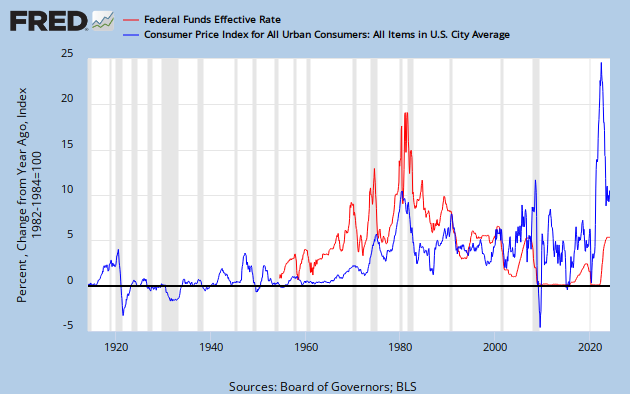
There isn’t definitive evidence supporting either the MMT or MS position, though there are some hints. There actually is something of a parallel between higher Fed Funds rates and higher inflation, which at first glance might support the MMT position.

test

However, because the Fed raises interest rates in anticipation of inflation, this parallel is to be expected. Timing is key. If high rates fight inflation, one would expect to see rates rise as inflation rises, with the highest rates followed by reductions in inflation. The above graph seems to show a Fed raising interest rates in anticipation of inflation, then reducing rates as inflation moderates.

(Unfortunately, the picture is blurred by the Fed’s use of interest rates not just to cure inflation but in a misguided attempt to stimulate the economy.)

In any event, the Fed’s following of the raise-rates-to-prevent/cure-inflation prescription seems to have been successful. Despite massive deficits in the past, particularly during and after the Reagan administration, and despite significant increases in the price of oil (the prime driver for inflation) the Fed has been able to keep inflation close to its 2%-3% annual goal. Tax policy has not been involved.

Though substantial reductions in deficits could cut inflation (by causing recessions or depressions), I’ve encountered no good arguments this would be a wise strategy. Recessions and depressions are a poor solution for inflation.

I do see historical evidence that interest rate control has been an effective means for inflation control.

Rodger Malcolm Mitchell
http://www.rodgermitchell.com


==========================================================================================================================================
No nation can tax itself into prosperity, nor grow without money growth. It’s been 40 years since the U.S. became Monetarily Sovereign, and neither Congress, nor the President, nor the Fed, nor the vast majority of economists and economics bloggers, nor the preponderance of the media, nor the most famous educational institutions, nor the Nobel committee, nor the International Monetary Fund have yet acquired even the slightest notion of what that means.

Remember that the next time you’re tempted to ask a dopey teenager, “What were you thinking?” He’s liable to respond, “Pretty much what your generation was thinking when it screwed up the economy.”

MONETARY SOVEREIGNTY